
Ask three people on a highway site what GSB is and you get one answer. Ask them which grading and you may get three. The specification allows six, they are not interchangeable, and the difference between them is the difference between a sub-base that drains the pavement and one that holds water under it for the life of the road.
Everything below is from the MoRTH Specifications for Road and Bridge Works, Fifth Revision, Section 400, which is the edition most running contracts are let on. Check the edition your own contract cites before you quote a number from here in a meeting.
What GSB is and where it sits
GSB stands for granular sub-base. It is laid on the prepared sub-grade and under the base course, which on most flexible pavements is wet mix macadam. It can be natural sand, gravel, crushed stone, crushed slag or a blend of them, as long as the blend lands inside one of the six grading envelopes and passes the physical tests.
It has two jobs. It spreads the load coming down through the base so the sub-grade sees a pressure it can carry. And it gets water out. Rain that finds its way through the surfacing and the shoulders has to leave sideways through the sub-base, or it sits on the sub-grade and softens it. That second job is why the fines limits in the table are as tight as they are.
The six gradings in Table 400-1
Figures are per cent passing by weight on each IS sieve. A dash means the clause sets no limit on that sieve for that grading.
| IS sieve | I | II | III | IV | V | VI |
|---|---|---|---|---|---|---|
| 75.0 mm | 100 | – | – | – | 100 | – |
| 53.0 mm | 80–100 | 100 | 100 | 100 | 80–100 | 100 |
| 26.5 mm | 55–90 | 70–100 | 55–75 | 50–80 | 55–90 | 75–100 |
| 9.50 mm | 35–65 | 50–80 | – | – | 35–65 | 55–75 |
| 4.75 mm | 25–55 | 40–65 | 10–30 | 15–35 | 25–50 | 30–55 |
| 2.36 mm | 20–40 | 30–50 | – | – | 10–20 | 10–25 |
| 0.85 mm | – | – | – | – | 2–10 | – |
| 0.425 mm | 10–15 | 10–15 | – | – | 0–5 | 0–8 |
| 0.075 mm | <5 | <5 | <5 | <5 | – | 0–3 |
Fifth Revision. Gradings I and V have a 75 mm top size; the other four top out at 53 mm.
Which grading goes where
Clause 401 says it in two sentences. Gradings III and IV shall preferably be used in the lower sub-base. Gradings V and VI shall be used as a sub-base-cum-drainage layer. The grading for a project is whatever the contract specifies.
Read the table and the three families show. Gradings I and II are dense mixes: a continuous run of sizes with 10 to 15 per cent passing the 425 micron sieve, which compacts tightly and carries load well but does not let much water through. Gradings III and IV are controlled on only four sieves and allow as little as 10 or 15 per cent passing 4.75 mm, so they are the coarsest and the most open. Gradings V and VI keep a sand fraction but allow at most 5 and 8 per cent on the 425 micron sieve, and VI holds the 75 micron fraction to 3 per cent.
Where MoRTH and IRC:37 point different ways
The pavement design guideline does not repeat the specification. IRC:37-2018 treats the sub-base as two sub-layers, a drainage layer on top and a filter or separation layer under it that stops sub-grade soil working up into the voids. For the drainage layer it recommends Gradings III and IV. For the filter layer it recommends I, II, V and VI. Where the whole sub-base is 200 mm or less and cannot be split, it allows a single drainage-cum-filter layer in Grading V or VI, which is the one case where the two documents say the same thing.
| Layer | MoRTH Clause 401 | IRC:37-2018, Clause 7.2.1 |
|---|---|---|
| Upper sub-base, drainage | – | III or IV |
| Lower sub-base, filter or separation | III or IV preferred | I, II, V or VI |
| Single layer doing both jobs | V or VI | V or VI, where the sub-base is 200 mm or less |
| Minimum thickness when split in two | 150 mm each layer | 100 mm each layer |
A designer working to IRC:37 and a site engineer reading Clause 401 can each be right and still disagree. The contract drawing and its technical schedule settle it.
The total thickness is a pavement design output under IRC:37 and changes with traffic and sub-grade CBR, so it is on the drawing, not in the specification.
The physical requirements
Passing the sieves is half of it. Table 400-2 sets four more tests on the same material.
| Property | Test | Limit |
|---|---|---|
| Aggregate impact value | IS 2386 Part 4, or IS 5640 | 40 maximum |
| Liquid limit | IS 2720 Part 5 | 25 maximum |
| Plasticity index | IS 2720 Part 5 | 6 maximum |
| CBR at 98% dry density | IS 2720 Part 16 | 30 minimum, unless the contract says otherwise |
If the aggregate's water absorption is above 2 per cent, it is also tested for wet aggregate impact value under IS 5640. Soft materials such as kankar, laterite and brick ballast get the wet test regardless.
The plasticity index is the one that catches people. Crushed rock itself is non-plastic, but the fines that come with it are only as clean as the face they came off. Overburden that was not stripped properly, or a clay seam running through the bench, arrives at the screen as plastic fines and fails the material at a PI of 6 even when every sieve is inside its band. That is a mining problem that shows up as a laboratory result.
Laying and compaction
The sub-grade is checked and rolled first. GSB is then mixed with water to within a narrow band of optimum moisture, spread to the required thickness and cross-fall, most often with a motor grader, and rolled.
- Density. Rolling continues until the layer reaches at least 98 per cent of maximum dry density, with the maximum found by the heavy compaction test of IS 2720 Part 8.
- Roller. A thin lift can be finished with an 80 to 100 kN smooth wheeled roller. A full-depth lift needs a vibratory roller of at least that static weight. Roller speed is capped at 5 km/h.
- Direction. Rolling starts at the lower edge and works toward the crown, or toward the upper edge on a superelevated section, each pass overlapping the last.
- Segregation. Coarse and fine material that has separated in tipping or grading has to be remixed or replaced before it is rolled, not after.
Moisture matters more than roller passes. Too dry and the fines will not move into the voids, so the density stalls a point or two short however long the roller stays on it. Too wet and the drum pushes a wave of material ahead of itself. Most density failures on GSB are moisture failures.
Why GSB fails on site
The usual causes, most of which start at the plant or the face and not on the road:
- Too many fines. The 75 micron limit is under 5 per cent on four of the six gradings. A plant running with a blinded bottom deck, or a blend with too much crusher dust in it, goes over without anyone noticing by eye.
- The 425 micron band on Gradings I and II. Ten to fifteen per cent is a window five points wide. It is the row a sieve analysis most often fails on.
- Segregation in the stockpile. A cone built by a single conveyor sends the coarse fraction rolling to the toe. Load from one side of it and the first tipper is all stone and the last is all fines. Both fail, in opposite directions.
- Plastic fines. See the PI note above. It cannot be screened out afterwards.
- Sampling. A sample scooped off the top of a tipper is not the load. Disputes between the plant's result and the site lab's are more often about where the sample came from than about the material.
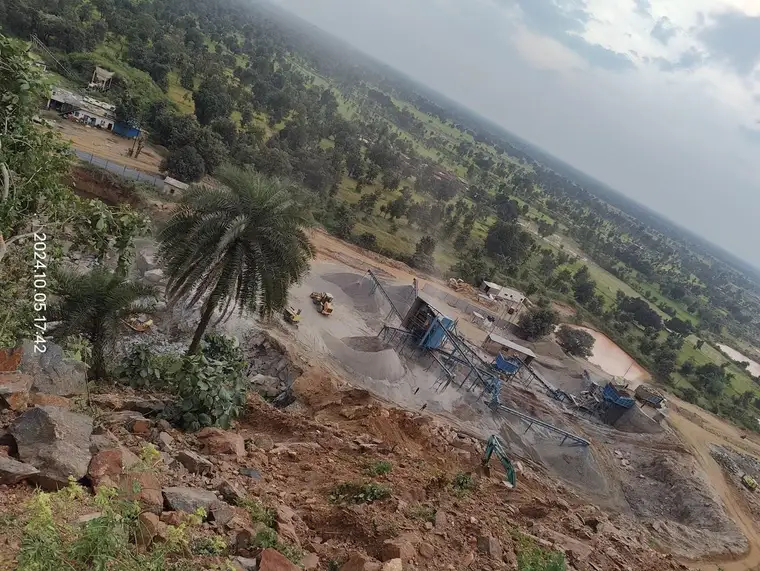
A plant that is run for grading, not for tonnage, pulls its own samples through the shift and resets a deck when the numbers start to walk. That is how our crushing crews work, because finding a drifting grading in the stockpile costs an hour and finding it in a laid layer costs the layer.
Turning a drawing into tonnes
GSB is laid by the cubic metre and bought by the tonne. Compacted crushed-stone GSB usually comes out between 2.2 and 2.3 tonnes per cubic metre, depending on the rock; use the maximum dry density from your own lab report once you have one.
Volume = 1,000 m × 10 m × 0.20 m = 2,000 m³
Tonnage = 2,000 m³ × 2.25 t/m³ = 4,500 t
Tippers = 4,500 t ÷ 20 t a load = 225 loads
About 4,500 tonnes a kilometre, before wastage
A full four-lane section with shoulders is wider than that and has more than one layer, which is worked through in how much aggregate a kilometre of highway needs.
What to send when you ask for a rate
Four things let a supplier quote GSB properly on the first call: the grading number, the monthly quantity, the chainage or nearest town, and when laying starts. If the contract has changed the CBR or added a test, send that page too. We supply all six gradings from our own plants and from plants we run on client sites, delivered and weighed. The details are on the aggregate supply page, and the other products that come off the same decks are on materials.