
01
Opening a face
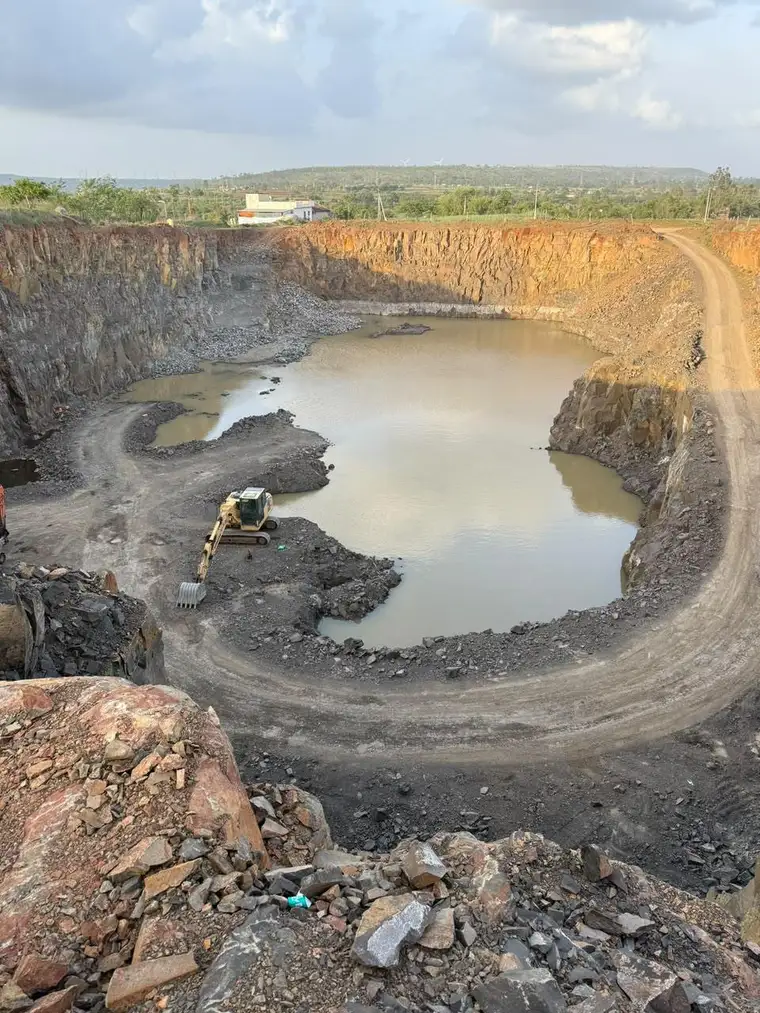
Survey, benching and overburden stripping to get from surface to sound rock. On most sites that is two to four weeks before the first useful tonne moves, and we would rather tell you that up front.
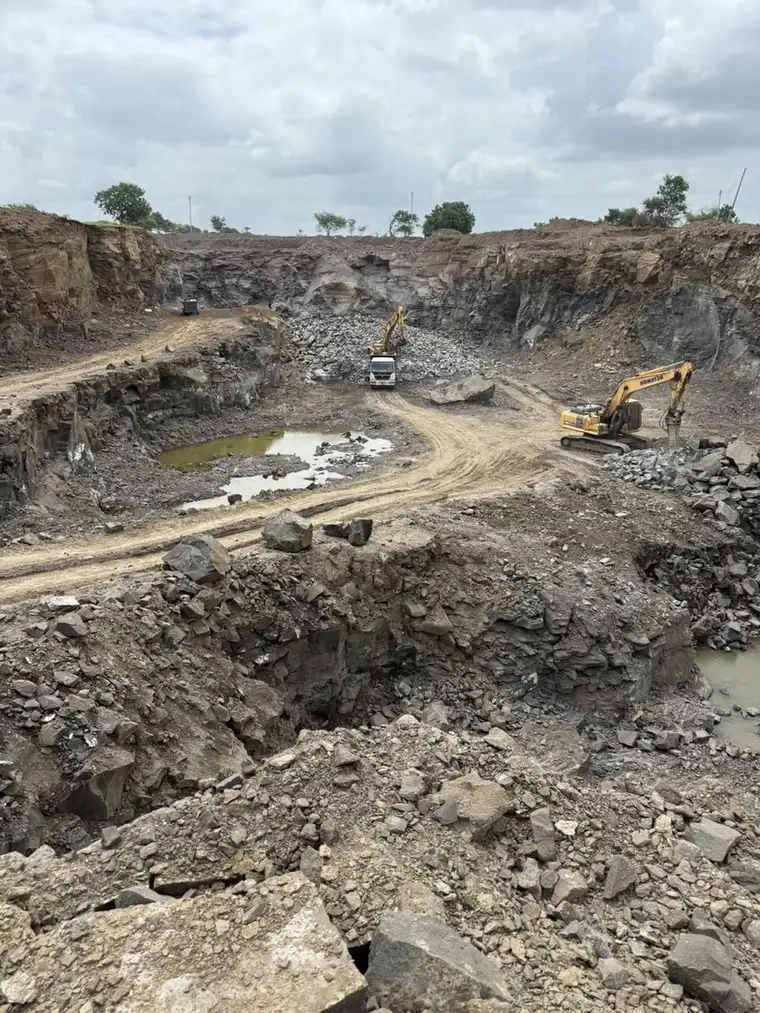
Taking a lease from bare ground to a working face: overburden off, rock down, material moving. Twenty excavators and the crews who run them.
Mining is the part of the job nobody sees in a finished road.
Somebody has to open the face, strip the overburden, drill it, shoot it and get the rock to a hopper before a single tonne of GSB exists. Get that wrong and every problem downstream is a symptom: the crusher starves, the grading wanders, the road waits.
We have been doing it since 2000, on our own leases and on client leases, in ten states. The sequence is the same everywhere. What changes is the rock, and the rock changes everything else.
What you get
01
Survey, benching and overburden stripping to get from surface to sound rock. On most sites that is two to four weeks before the first useful tonne moves, and we would rather tell you that up front.
02
Komatsu, Kobelco and L&T, sized from face loading down to bench trimming. Owned, so machine availability is our problem rather than a line in your risk register.
03
Most of our work runs on client-held leases: you hold the mineral, we produce against it. Where a client would rather buy material than run a quarry, we work our own leases instead.
04
Royalty, transit passes, district permissions, magazine licensing for explosives. Unglamorous, and the single most common reason a quarry sits idle with a plant already erected.
05
Basalt on the Samruddhi Mahamarg, granite in Karnataka, sandstone through Bundelkhand, hill rock in Manipur. Fragmentation, wear rates and crusher settings differ on every one.
06
Benches left safe, faces left stable, the site handed back in a condition that does not become somebody else's liability.
Order of work
Rock type, overburden depth, access, water, and where a plant can physically stand. This visit decides most of the cost.
Machines, plant and crew moved in. Camp, fuel, workshop and magazine set up before production, not during it.
Overburden stripped and benches cut to a working geometry, so drilling and loading are safe and repeatable rather than improvised.
Pattern designed for the rock and the fragmentation the crusher wants. Oversize costs more at the hopper than it saves at the face.
Excavators to tippers, tippers to hopper. Short leads and a clean haul road are worth more than an extra machine.
Faces stabilised, benches left safe, site cleared.
Straight answers
Yes, and most of our work is exactly that. You hold the lease, we bring the machines, the plant and the crew and produce against it. Royalty and transit paperwork get handled either way.
Three to six weeks on a normal site. Two weeks to mobilise, the rest to strip overburden and cut a working bench. Poor access or a monsoon start pushes it out.
Yes, including the plant at Asotra in Barmer, Rajasthan, which has been in production since 2008, and the Bajarang plant at Bara in Uttar Pradesh.
Usually goes with
Ten drilling machines with compressor support, putting holes where the blast design says they go, to the depth and angle it says.
Licensed shotfirers, a design for the rock in front of them, and vibration monitored on every shot. Breaking overburden and rock without breaking anything else.
Get a rate
Four things and we can quote it. Send it before 6pm on a working day and you will hear back the same day.
Where · What · How much a month · When