
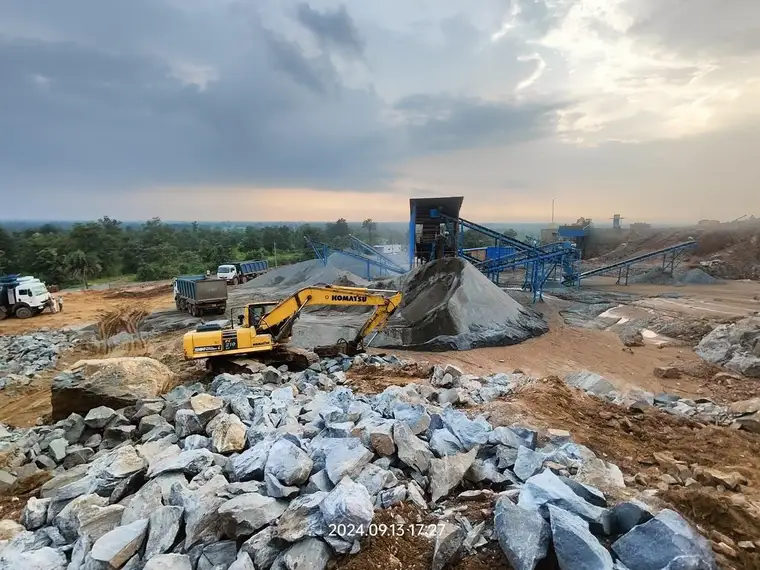
Stand at the edge of a formation and GSB and WMM look like the same thing: grey crushed stone with fines in it, tipped, spread and rolled. Purchase orders mix them up, and so, now and then, does a tipper driver. The difference between GSB and WMM is not in how they look. It is in what the pavement design expects each one to do, and the specification follows from that.
Clause references are to the MoRTH Specifications for Road and Bridge Works, Fifth Revision. Check the edition your contract cites.
The difference between GSB and WMM in a sentence each
GSB, granular sub-base, is the first engineered layer above the sub-grade: it spreads the load down to a pressure the soil can take and lets water out sideways. WMM, wet mix macadam, is the base course above it: a dense, plant-mixed layer of crushed stone that carries the load and gives the bituminous layers something stiff and even to sit on.
GSB and WMM compared
Clause 401 governs GSB and Clause 406 governs WMM. Percentages are by weight.
| Point | GSB (Clause 401) | WMM (Clause 406) |
|---|---|---|
| Position | On the prepared sub-grade, under the base | On the GSB, under the prime coat and DBM |
| Job | Spread load to the sub-grade; drain the pavement | Carry load; support the bituminous layers |
| Material | Natural sand, crushed gravel, crushed stone, crushed slag or a blend | Crushed stone; crushed gravel only if 90% of the pieces retained on 4.75 mm have two fractured faces |
| Gradings | Six, in Table 400-1; the contract names one | One, in Table 400-13 |
| Top size | 75 mm (Gradings I and V) or 53 mm | 53 mm, with 95–100% passing 45 mm |
| Passing 75 micron | Under 5% on Gradings I to IV; 0–3% on VI | 0–5% |
| Strength | Impact value 40 max; CBR 30 min at 98% density | Abrasion value 40 max or impact value 30 max; no CBR test |
| Shape | No limit | Combined flakiness and elongation 35% max |
| Plasticity | Liquid limit 25 max; PI 6 max | PI 6 max on the fraction passing 425 micron |
| Mixing | Mechanical mixer with controlled water | Plant with bin feeders and a pugmill or pan mixer |
| Moisture at rolling | 1 to 2% below optimum | At optimum, within agreed limits |
| Laying | Motor grader | Paver finisher; grader only by exception |
| Single layer | Up to 200 mm; 150 mm min each if split in two | 75 mm min, 200 mm max |
| Compaction | 98% of MDD, IS 2720 Part 8 | 98% of MDD, IS 2720 Part 8 |
| Usually fails on | Fines, the 425 micron band, plastic fines | Segregation, flaky stone, moisture at rolling |
Fifth Revision. GSB Grading V sets no limit at 75 micron but holds the 425 micron sieve to 5 per cent or less.
Why the two specifications differ
Start with water. Whatever gets into a pavement has to leave through the sub-base, so four of the six GSB gradings hold the 75 micron fraction under 5 per cent and the two drainage gradings strip the fines almost completely. The table, and which grading goes where, is in GSB grading as per MoRTH Clause 401. WMM has no drainage job. It is graded to pack: a continuous curve with 8 to 22 per cent passing 600 microns, so the voids between the stones fill and the layer locks.
Then strength. Stress falls with depth, so the stone near the top has to be harder and better shaped than the stone at the bottom. The base gets an impact value limit of 30 and a shape limit of 35. The sub-base is allowed 40 and has no shape limit at all, which is why gravel and natural sand can go into GSB and cannot go into WMM. In place of a shape test, GSB has to prove itself the way a soil does, with a CBR of at least 30.
Then evenness. A grader-laid sub-base that varies a little along the road is tolerable under everything above it. A base that varies is not, because the DBM is only as flat and as evenly supported as the layer it is laid on. Hence the pugmill, the paver with level control, and a clause that forbids tipping WMM in heaps on the road. The full requirements are in WMM as per MoRTH Clause 406.
Can GSB be used in place of WMM?
No. GSB fails the WMM specification on three lines of the table before anyone reaches for a sieve: it may contain uncrushed material, its impact value can be ten points too high, and nobody has tested its shape. Even a GSB made entirely from good crushed stone is graded wrong for a base. Grading III allows 10 to 30 per cent passing 4.75 mm where WMM needs 25 to 40, and the drainage gradings are open on purpose.
The other direction is less obvious, because Clause 406 is titled sub-base/base and a designer may put WMM lower down. A site may not. WMM laid where the drawing shows a Grading V or VI drainage layer puts a dense layer where the design needs an open one, and the water that was meant to leave stays. Layer types and thicknesses come out of the pavement design under IRC:37. Changing one is a design change that needs the Engineer, not a purchase decision.
What each one costs a plant to make
Both come off the same crusher and cost different amounts to produce, for reasons worth knowing before two rates are compared.
- Crushing stages. A 53 mm top size with no shape limit can be made on a jaw and one secondary. Holding a combined index of 35 on WMM stone usually means a cone kept choke-fed at a tight setting, and often a third stage. What the jaw, cone and VSI each do explains why.
- Crushed faces. Every piece of WMM coarse aggregate has to come from crushing. GSB can take screened natural gravel or sand as part of the blend where a source exists, which costs less than breaking rock.
- Deck set-up. Dense GSB can be close to a screened crusher-run product. WMM is blended from separate fractions, so the plant has to cut and stockpile at least three sizes and hold each one steady. The GSB drainage gradings are the exception on the sub-base side: taking the fines out needs its own deck arrangement and its own stockpile.
- Source rock. An impact value of 40 lets in rock that 30 keeps out. A quarry that makes acceptable GSB does not automatically make WMM.
- The pugmill. WMM needs a wet mix plant between the stockpile and the tipper: bin feeders, a water system, a mixer, and an operator. And once mixed it cannot wait. GSB will sit in a stockpile for weeks; WMM has to be under the roller before it dries, which ties the plant's hour to the paver's.
None of this makes one material better. They are different products, and a quotation that prices WMM level with GSB deserves a question about what is being offered.
Quantities: similar weight, different thickness
Compacted, the two weigh much the same: typically 2.2 to 2.3 tonnes per cubic metre for crushed-stone GSB and 2.2 to 2.4 for WMM, depending on the rock. Both are measured for payment in cubic metres of finished work and bought by the tonne.
GSB = 1,000 m × 10 m × 0.20 m × 2.25 t/m³ = 4,500 t
WMM = 1,000 m × 10 m × 0.25 m × 2.30 t/m³ = 5,750 t
Loads = 10,250 t ÷ 20 t a load = 513 loads
About 10,250 tonnes of granular material a kilometre, before wastage
The thicknesses are for arithmetic only; yours are on the drawing. A full four-lane section is worked through in how much aggregate a kilometre of highway needs.
Ordering the right one
Write the clause and the grading on the order, not only the name: GSB Grading II to Clause 401, or WMM to Clause 406. Add the monthly quantity, the chainage and the date laying starts. We produce both at our own plants and at plants we run on client sites, with the decks set to the grading in the contract and every load weighed. Rates and lead distances start on the aggregate supply page, and the single sizes that come off the same decks are listed on materials.