
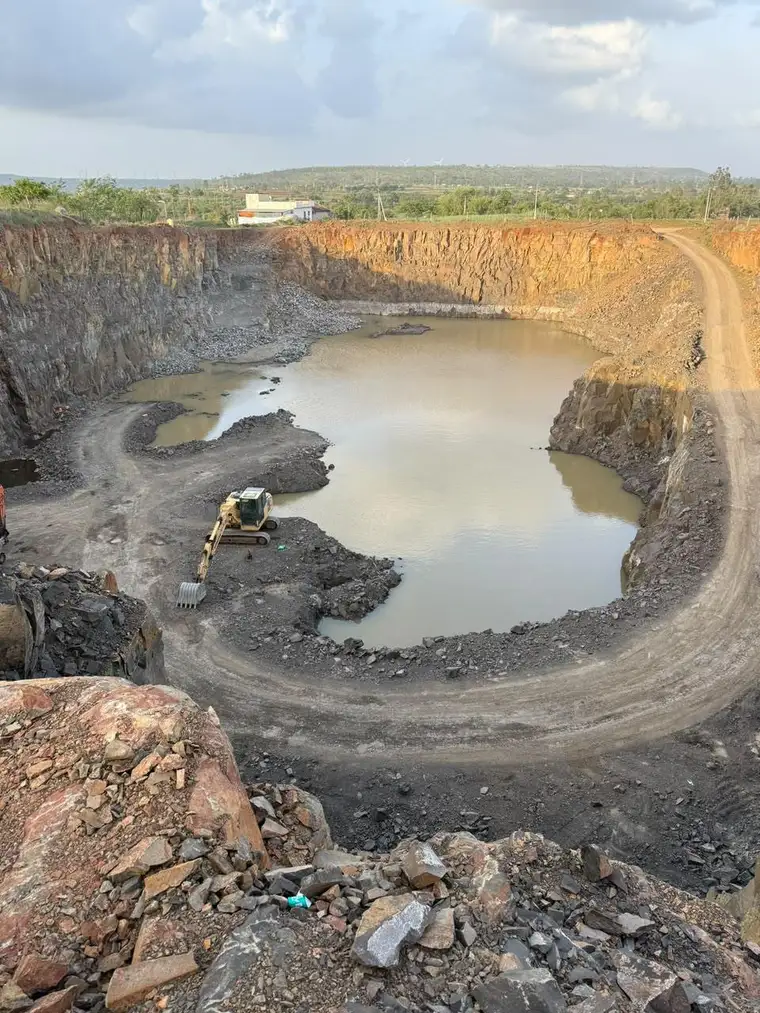
People search for a stone crusher licence as if it were one document. It is not. A crushing unit in India runs on a stack of separate permissions, issued by different departments under different Acts, and the absence of any one is enough for an inspecting officer to seal the plant. On a highway package that means a paver with nothing to lay.
This is the list, who issues each item, and who normally holds it when a contractor's plant works on a client's lease. Stone crusher rules differ by state and are amended often, so check every distance, form and fee against the current state notification before relying on it.
Consent to establish a stone crusher, and consent to operate
Consent to establish is the State Pollution Control Board's permission to build the unit at a named site and capacity, and consent to operate is its permission to run it. Both are granted under Section 21 of the Air (Prevention and Control of Pollution) Act, 1981 and Section 25 of the Water (Prevention and Control of Pollution) Act, 1974. Some states call the first one consent for establishment, or simply the board's NOC. It is the same permission.
CPCB places stone crushers in the Orange category under its harmonised classification of industries, and its position is plain: a unit operates only after obtaining both consents. The consent to operate is granted for a fixed period and has to be renewed. It names the capacity, the products and the pollution-control conditions, and a change in capacity needs a fresh application. Most consent orders also say that they are no substitute for permissions required under other laws, which is the board telling you the rest of this page still applies.
The emission standard a consent refers to is in Schedule I of the Environment (Protection) Rules, 1986: suspended particulate matter, measured between 3 and 10 metres from any process equipment, must not exceed 600 micrograms per cubic metre.
Where a crusher is allowed to stand
Siting criteria are set by each state. They usually take the form of minimum distances from highways, habitation, schools, hospitals and other crushers, and some states confine new units to notified crusher zones. Two examples show how different the form can be.
- Maharashtra. The Maharashtra Pollution Control Board's published location criteria, laid down at its 123rd meeting on 30 March 1999, ask for 500 m from the nearest human habitation of 1,000 people or more, and 500 m from a state or national highway. The Board amended its siting criteria by a circular dated 4 March 2020, so the 1999 figures are a starting point and not the last word.
- Karnataka. The state has a separate statute, the Karnataka Regulation of Stone Crushers Act, 2011. A crusher there needs a licence under that Act and has to stand in a declared safer zone, in addition to the pollution board's consents.
CPCB's guidelines add a direction of travel: new crushers should come up in dedicated crusher zones under the state's siting policy. For a project crusher, siting is the first thing to establish. A plant erected a few metres inside a prohibited distance cannot be cured by any amount of dust control.
What CPCB's 2023 guidelines ask for
The Central Pollution Control Board issued its Environmental Guidelines for Stone Crushing Units in July 2023 and circulated them to every state board for implementation. They are not a licence. They are the checklist a board works from when it grants or renews a consent, and a district-level committee under the District Magistrate is meant to carry out surprise inspections against them.
- Dust suppression at source. Sprinklers at crushing, screening, transfer and loading points, and regular wetting of the roads inside the premises.
- Enclosures. Crushers and screens housed in sheeting, and conveyors covered.
- Wind-breaking walls. A sheet or brick wall along the periphery, which the CPCB text wants three feet higher than the highest node of the crusher, with product stockpiles kept below the wall.
- Metalled internal roads. Roads, ramps and the working yard metalled or concreted, so that tipper wheels are not grinding loose fines into dust all shift.
- Green belt. Plantation around the boundary, to a plan approved by the state department concerned.
- Legal source of raw material. Stone bought or raised only from lawful sources, with records kept.
The guidelines also ask for permission from the groundwater authority where a borewell feeds the sprinklers, and for a health survey of workers every six months. Boards copy these into consent conditions with their own additions and their own numbers. The consent order, not the guideline, is the document a plant is inspected against.
The legal source of the stone
A crusher with every consent in place is still illegal if the rock going into its hopper is not. Building stone is a minor mineral under Section 3(e) of the Mines and Minerals (Development and Regulation) Act, 1957, and Section 15 of that Act leaves the rules for granting it to the states. So the permission to quarry is a lease, a licence or a short-term permit under the state's minor mineral concession rules, and its name and term change with the state.
Three things travel with it. Royalty is paid to the state on the quantity removed. Every load leaving the lease carries a royalty-paid transit pass, which is what a checkpost and an auditor both ask for. And the quarry needs prior environmental clearance under the EIA Notification, 2006, which since 2016 has applied to minor mineral leases of every size. The mineral paperwork has its own page: quarry lease, royalty and transit pass.
Land, stone crusher NOC, power, weighbridge and explosives
The table puts the whole file in one place. Names, forms and issuing offices vary by state; the rows are the questions to ask.
| Clearance | Issued by | What it covers |
|---|---|---|
| Consent to establish | State Pollution Control Board | Permission to build the unit at that site and capacity, under the Air Act, 1981 and the Water Act, 1974 |
| Consent to operate | State Pollution Control Board | Permission to run it, with emission and dust-control conditions; granted for a fixed period and renewed |
| State crusher licence, where one exists | Authority named in the state Act or policy | A separate licence to run a crusher, as under the Karnataka Regulation of Stone Crushers Act, 2011 |
| Quarry lease, licence or short-term permit | State mining department | The right to raise the stone, under the state's minor mineral concession rules |
| Royalty and transit passes | State mining department | Royalty on the quantity removed; a pass with every load |
| Environmental clearance for the quarry | State Environment Impact Assessment Authority, or the authority the state has designated | Prior clearance for the mining lease under the EIA Notification, 2006 |
| Land use permission | Revenue or planning authority | Use of the land for a non-agricultural or industrial purpose, where state law requires conversion |
| Local body NOC | Gram panchayat or municipal body | No-objection to the unit within its limits |
| Power connection | Distribution company; state Electrical Inspector | Sanctioned load and metering; approval before an installation above the notified voltage is energised |
| Groundwater permission | Central Ground Water Authority or state groundwater department | Drawing from a borewell for sprinklers and washing |
| Weighbridge verification | State Legal Metrology department | Verification and stamping under the Legal Metrology Act, 2009, generally repeated every twelve months |
| Explosives licence and magazine | Petroleum and Explosives Safety Organisation | Possession and use of explosives under the Explosives Rules, 2008; separate from everything above |
DG sets are covered by the consent conditions, which fix their acoustic enclosures and stack heights.
Blasting is the row most often assumed to be covered by something else. It is not. Explosives are licensed under the Explosives Act, 1884 and the Explosives Rules, 2008, with a licensed magazine and named people to handle the charge, and that file is separate from both the lease and the consents. See explosives licence, magazine and shotfirer.
Labour and safety registration is the other separate file. Since 21 November 2025 it has run under the Occupational Safety, Health and Working Conditions Code, 2020, which replaced the Factories Act and the Mines Act, and state rules under the Code are still arriving. Ask the labour office which registration the unit falls under before the crew arrives.
Who holds what on a client's lease
Most highway crushing is done by a contractor's plant standing on a lease that the main contractor or a lessor holds. The paperwork splits along the same line as the assets, and the split belongs in the work order.
- With the lease holder. The lease or permit, the mining plan and environmental clearance, royalty, and the transit passes. Passes are issued against the lease, whoever loads the tipper.
- With whoever is named on the consent. Consent to establish and consent to operate are granted to a named applicant for a named site. On a captive project crusher that may be the main contractor or the plant operator. Settle it before the plant moves, because the application rests on the land and lease documents.
- With the plant operator. The plant, its crew and their registrations, the weighbridge and its stamping, and the dust-control hardware the consent conditions call for.
- With whoever holds the explosives licence. The magazine, the stock records and the people authorised to fire. A licence covers what it names and does not transfer with a work order.
The gap to watch is between the first two. A plant can arrive on a lease that is valid for mining and has no consent for crushing, and nobody notices until the board's regional officer does.
Before a plant is ordered
Four documents sent with a plant enquiry answer the clearance question on the first call: a copy of the lease or permit showing its validity, the status of the environmental clearance, whether consent to establish has been applied for and in whose name, and the survey number of the land where the plant will stand. Most of our crushing is done on client leases, and a lease that is not yet cleared is the usual reason a start date moves, so we ask for these before quoting one. The service is on crusher plant operations and the quarry side on mining operations. What follows the paperwork is in setting up a stone crusher plant, week by week.