
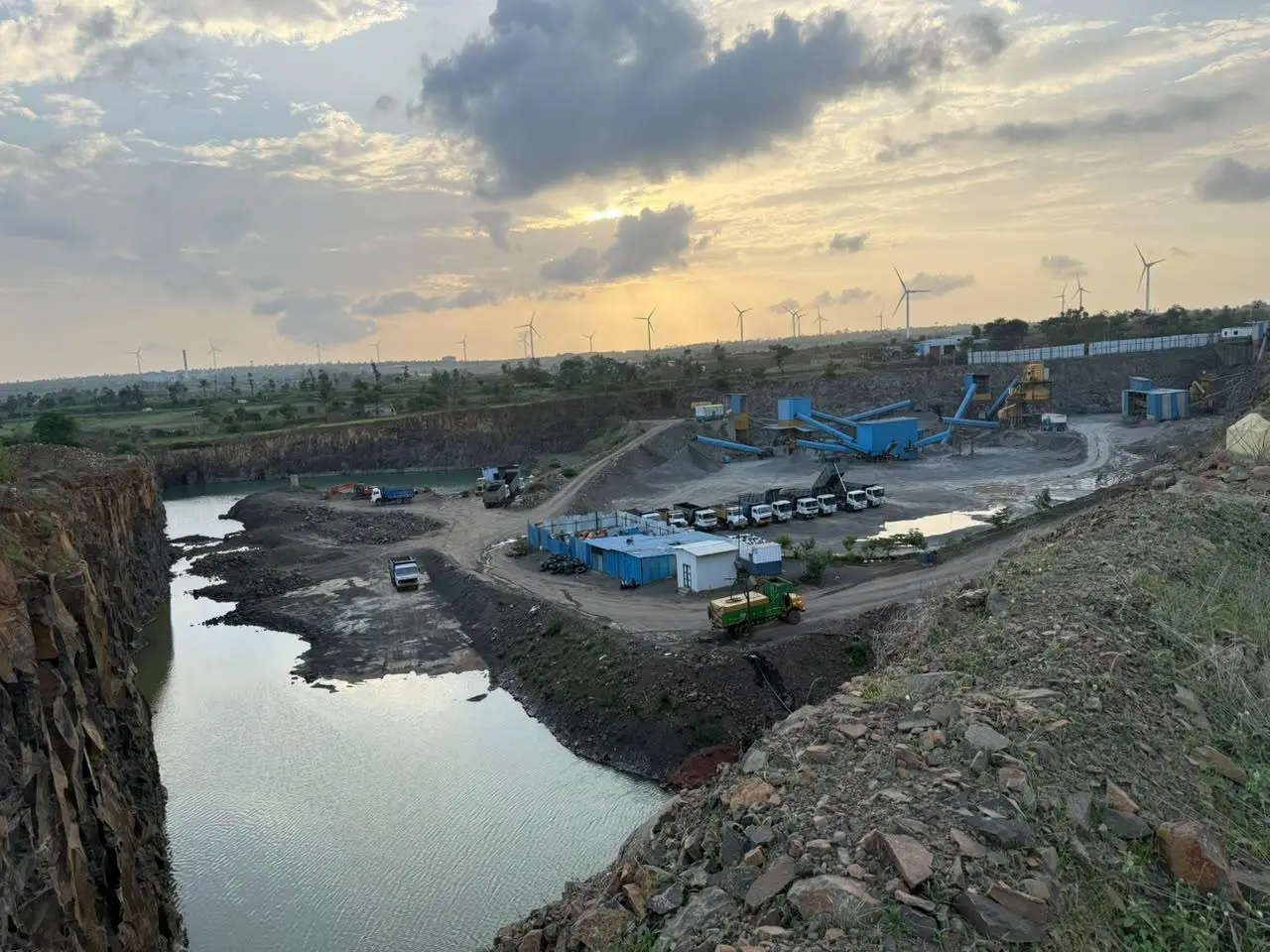
From the contractor's office, stone crusher plant setup looks like a delivery date. On the ground it is a chain of jobs, each waiting for the one before, and a week lost at the front cannot be bought back at the end. A package that wants GSB on the first dry day after the monsoon needs the order placed, and the lease cleared, a good deal earlier than most programmes show.
The sequence below is for a fixed three-stage plant of the kind highway packages use, 250 to 350 TPH, brought to site in pieces on low-bed trailers. Our own figure for it is about a month from order to steady production on a site with reasonable access: two weeks to move the plant and machines, two weeks to erect and commission.
What crusher plant erection involves
Crusher plant erection is the work of turning trailer loads of steel into a line that takes shot rock in at one end and drops graded products at the other. It has five parts: civil foundations, the structure and machines that stand on them, the electrical system, the conveyor belts, and commissioning. On a three-stage plant the machines are a feed hopper and grizzly, a primary jaw, a secondary cone, a tertiary stage and the screens, with a conveyor for every transfer and every product.
Site and layout, before the first trailer
Layout is where a plant's running cost is fixed, and it is fixed on the site visit. Five things get decided.
- Hopper level and ramp. Tippers tip into the feed hopper from above, so the primary has to sit below a tipping point. A natural step in the ground saves building a ramp out of fill. Where there is none, the ramp is earthwork that must be compacted and retained before the first loaded tipper reverses up it.
- Stockpile room. Every product conveyor builds its own heap, and each heap needs space for a loader to work and a tipper to turn. A yard that fills in ten days stops the plant on the eleventh. How much stock a programme calls for is worked out in what TPH crusher plant a package needs.
- Weighbridge. On the way out, where every loaded tipper has to cross it and none can go round, with level approaches on both sides.
- Drainage. The yard is graded so that water runs away from the foundations, the tunnel under the hopper and the panel room. This is cheap in the dry season and close to impossible in July.
- Power. Where the transformer or the DG sets stand, and the cable routes from there, so that no cable crosses a haul lane.
Wind is the sixth. The plant goes downwind of the camp and of the nearest houses where the ground allows, and the dust conditions a pollution board writes into a consent (sprinklers, wind-breaking walls, metalled internal roads) are far easier to meet if they were on the layout from the start.
Stone crusher plant setup, week by week
The sequence assumes the lease is cleared, the consents are in hand and a road exists that a low-bed can use. Where the layout is known early enough for foundations to be cast while the plant is still travelling, the concrete has had its curing before the heavy lifts arrive.
- 01
Weeks 1 and 2: dismantle, move and prepare the ground
The plant is stripped at its last site and loaded onto low-bed trailers; planning that journey is covered in shifting a crusher plant as an over-dimensional load. At the new site the pad is levelled and compacted, the ramp is built, and foundation positions are set out from the layout drawing.
- 02
As early as the layout allows: foundations and curing
Pedestals and rafts are cast for the jaw, the cone, the screens and the conveyor trestles, with holding-down bolts set to template. Then the concrete has to be left alone. IS 456 asks for at least seven days of moist curing where ordinary Portland cement is used and ten where the cement is blended, and a vibrating machine bolted down too early will show it within a season. Work that does not need the concrete goes on alongside: conveyor frames assembled on the ground, the panel room, earthing pits, the weighbridge.
- 03
Week 3: structure and machines
Primary first: hopper, grizzly feeder and jaw. Then the secondary cone, the screens on their towers and the tertiary stage. Lifts are by crane and alignment is checked at each stage, because a screen that is out of level sends material to one side of every deck below it.
- 04
Week 3: electricals
Motors are cabled back to the control panel. Starters and interlocks are wired so that a stopped conveyor stops everything feeding it, and the whole installation is earthed. The supply is either a grid connection through a transformer or DG sets, a choice discussed in the next section.
- 05
Week 3 into week 4: belts
Belts are pulled onto the conveyors, jointed, tensioned and tracked until they run centred on the idlers. Skirts and scrapers are fitted at the transfers. A belt that wanders spills material under the conveyor all shift, and somebody has to shovel it.
- 06
Week 4: trial run
Each drive is run empty first and checked for direction of rotation, vibration and bearing temperature. Rock is then fed at a low rate and brought up in steps while the crusher settings are closed in to working size.
- 07
Week 4: decks set to the contract grading
Screen meshes are chosen and crusher settings adjusted until the products match the grading in the contract, whether that is GSB to Clause 401, WMM or single sizes. It takes several runs, because changing one deck changes what reaches the next.
- 08
Week 4: first samples
Samples are drawn from each product and sent to the laboratory the contract nominates. Nothing is invoiced before they pass. The weighbridge is verified and stamped by the Legal Metrology department before the first dispatch, since the slip is the bill.
That is the fortnight from machines landing to material off the last belt. Steady production comes a little after the first tonne, once the crew has the feed rate, the settings and the loader working in step.
Grid connection or DG sets
A three-stage plant in this class has a connected load of several hundred kilowatts, and there are two ways to supply it. A grid connection is generally cheaper to run per tonne. It also needs an application to the distribution company, often a line extension and a transformer, a metering arrangement, and the state Electrical Inspector's approval before an installation above the notified voltage is energised. None of that runs to the plant contractor's clock.
DG sets arrive with the plant and run the day they are cabled. They burn diesel for every tonne, need acoustic enclosures and exhaust stacks to the pollution board's norms, and add a fuel-logistics job to the site. A common pattern on a highway package is to start on DG so that production is not waiting for a line, and to move to grid power if the package is long enough and the line arrives. Power or genset diesel is one of the items that can sit outside a per-tonne crushing rate, so the choice is one the client makes with open eyes.
What delays a plant
Erection is the predictable part. Four things outside it are not.
- Clearances. A plant cannot legally run without consent to establish and consent to operate from the State Pollution Control Board, and the rock under it needs a valid lease or permit. An uncleared lease is the commonest reason a plant stands erected and silent. The full list is in licences and clearances a stone crusher needs.
- Power. A grid connection promised for week four that arrives in month four. Decide early whether to start on DG.
- Access. A low-bed carrying a cone crusher needs a road that takes its weight and its turning circle. One weak culvert or a village lane in the last few kilometres can hold the whole convoy.
- Weather. A monsoon start means casting foundations between showers, a ramp that will not compact, and a haul road that fails under the first loaded tipper.
What to settle before the order
Five answers shorten the month more than anything done during it: a layout agreed on the ground, the status of the lease and the consents with dates, the power source for day one, the route the trailers will take, and the grading table the decks are to be set to. Send those with the enquiry and the site visit becomes a confirmation instead of a survey. How we take a plant from there to production is on crusher plant operations. If a monsoon start or an uncleared lease is going to push the date, we would sooner say so before the order than after.