
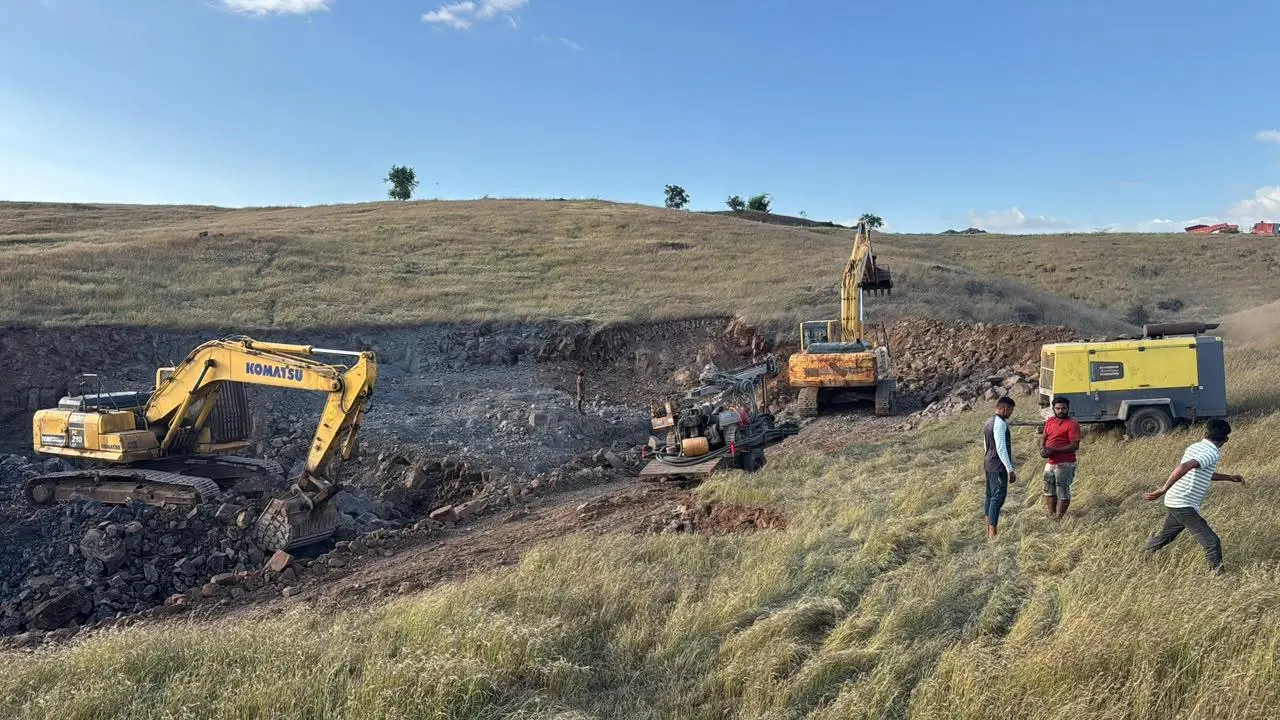
A stop-work order for blasting rarely starts with a blast. It starts with an officer asking for a document: the magazine licence, the shotfirer's certificate, the stock book. If the person in front of him cannot produce it, the explosive on site is unlicensed, and the principal contractor's name is on the gate.
This article sets out which explosive licence does what, how a magazine licence and a shot firer certificate fit together, and where PESO's authority stops and DGMS's begins. Form numbers are those in the Explosives Rules 2008, and regulation numbers those of the Metalliferous Mines Regulations 1961. Rules change: the Mines Act 1952 has been replaced by the Occupational Safety, Health and Working Conditions Code 2020, new mines regulations were in draft and the Explosives Rules under review in 2026, and the current PESO and DGMS position governs.
Two regulators: PESO and DGMS
PESO, the Petroleum and Explosives Safety Organisation, administers the Explosives Act 1884 and the Explosives Rules 2008. It controls the explosive: who may make it, store it, sell it, carry it and use it. Its licensing officers are the Chief Controller and the Controllers of Explosives, with the District Magistrate as the authority for some small licences.
DGMS, the Directorate General of Mines Safety, regulates safety in mines. It controls the act of blasting inside a mine: who may charge and fire, how holes are stemmed, the danger zone, and blasting near structures. The Explosives Rules draw the line themselves. Rule 97 leaves blasting operations in mines to the mines legislation, and Rule 98 covers blasting by a shot firer in areas other than mines.
So the first question is whether the ground is a mine. A quarry worked to win stone is one, whoever opens it, a highway contractor's captive quarry included. A rock cut on the road alignment is construction. Many packages have both, and then both regimes apply, each to its own ground. Whether a very small quarry falls outside the mines legislation is a question for the regional DGMS office, not for assumption.
The explosive licence: possession, use and the magazine
There is no separate licence to blast. The licence is to possess explosives for use, and it attaches to the place they are kept. Under the Explosives Rules 2008 that is Form LE-3, a licence to possess explosives for use in a magazine. The application is in Form AE-3, filed online through the National Single Window System, and for a normal quarry or project magazine the authority is the Chief Controller or a Controller authorised by him. A limited category for small quarries and agricultural use is granted by the District Magistrate. A licence runs for one to five years at a time.
A magazine is a store built to the specification in the rules and licensed for a stated quantity. PESO describes constructed magazines with masonry or concrete walls, and portable steel magazines of a design approved by the Chief Controller. Before one is built, the applicant needs prior approval of the plans and a no-objection certificate from the District Magistrate. Before it is used, it is inspected and the licence endorsed. The rules fix safety distances from the magazine to roads, houses and other works according to the quantity stored, and those distances have to stay clear, which is the usual reason a magazine cannot be put where it is convenient.
For highway work the MoRTH specification repeats the point. Clause 302 requires the magazine to be built to the designs and specifications of the Explosives Department and located at the approved site, and puts every permit on the Contractor.
Carrying explosives by road
Explosives move from the supplier's magazine to the site magazine in a road van licensed in Form LE-7 by the Controller of Explosives. The van is built to a specification in the rules. It carries the indent in Form RE-11 raised by the consignee, the consignor's pass in Form RE-12, a copy of the van licence and the bill. PESO's guidance adds that cartridged explosives go to the consignee's magazine and not directly to a blasting site, that a loaded van is not to be parked near the blast, and that the driver and cleaner must have had their antecedents verified by the police.
From the magazine to the bench, explosives travel in their original unopened packages or in locked containers kept for the purpose, with detonators carried separately. Nothing comes nearer than 50 m to the shot until it is ready to charge, and whatever is left after the day's work goes back to the magazine. Explosives are not handled between sunset and sunrise except as the rules or the licensing authority specifically allow.
Blaster, shotfirer, shot firer: the competency
The words overlap. The certificates do not.
In a mine or quarry. Regulation 160 of the Metalliferous Mines Regulations 1961 requires charges to be prepared, and holes charged and stemmed, by or under the personal supervision of a competent person the regulations call a blaster, who fires the shots himself. The trade calls the same person a shotfirer. Nobody can be appointed without a Manager's, Foreman's, Mate's or Blaster's certificate. The regulation also bars from the job anyone whose wages depend on the rock broken, and makes the manager fix how many shots one blaster may fire in a shift.
On a construction site that is not a mine. Rule 98 of the Explosives Rules requires blasting to be carried out by a shot firer holding a valid certificate issued by the Controller of Explosives, who carries a copy while blasting. The certificate is in Form LE-10, applied for in Form AE-10, granted after the Controller has examined the applicant, and valid for five years. It states the area the holder is authorised for and the category of blasting, so a certificate for one kind of work is not a certificate for all of them.
Each regime asks for its own paper. A firm that works both quarries and road cuts should be able to show the right one for each, and a principal contractor should look at which is in front of him.
Records of receipt, issue and return
The paper trail is built so that the explosive in the magazine, plus what was fired, always equals what was received.
- Receipt. Each consignment is entered in the account of receipts, Form RE-3, against the indent and the pass it arrived with.
- Issue, use and return. Form RE-5 is the daily account of explosives used. Its columns are the shot firer's name and permit number, the quantity issued, the number of holes fired, the quantity used and the quantity returned, signed by the shot firer and the magazine in-charge.
- Transport. The van's own record of each load is Form RE-6.
- Returns. A quarterly return of explosives received, used and destroyed goes to the Controller and the District Magistrate by the tenth day of the following quarter.
Stock books are page-numbered and kept for three years. On a mine the regulations add their own layer. The magazine is in the charge of a competent person, explosives are issued only against a written requisition signed by the blaster, and issues and returns are written up in a bound paged book. Theft or loss is reported at once to the police and the licensing authority. MoRTH Clause 302 asks the highway contractor for the same thing in plainer words: a careful day-to-day account of explosives in an approved register, open to the Engineer at all times.
What a principal contractor should ask a blasting subcontractor for
| Document | Issued by or kept under | What to check on it |
|---|---|---|
| Licence to possess explosives for use, Form LE-3 | PESO; the District Magistrate for the small category | Licensee's name, premises, quantity, validity, and that it covers use at your site |
| Magazine approval and no-objection certificate | PESO and the District Magistrate | Location matches the approved plan; safety distances still clear |
| Road van licence, Form LE-7 | Controller of Explosives | Vehicle number and validity, or the supplier's van if they deliver |
| Blaster's competency certificate (quarry or mine) | Metalliferous Mines Regulations 1961 | Name, type of certificate, and a written appointment for this mine |
| Shot firer's certificate, Form LE-10 (construction site) | Controller of Explosives | Name, five-year validity, authorised area and category of blasting |
| DGMS permission for blasting near structures | DGMS, under Regulation 164 | Which structures it covers and the conditions imposed |
| Indents, passes and receipt account (RE-11, RE-12, RE-3) | The licensee, under the Explosives Rules | Quantities received tally with consignments |
| Daily account of issue, use and return (RE-5) | The licensee; signed by shot firer and magazine in-charge | Issued equals used plus returned, every day |
| Blast record and vibration monitoring | The blasting contractor | Charge per delay and seismograph reading for shots near structures |
Form numbers as in the Explosives Rules 2008. Ask for originals and read the names: a licence or certificate in someone else's name is not cover for the person in front of you.
A quarry and its crusher carry a longer list of consents than explosives alone. Those are set out in stone crusher licences and clearances and quarry lease, royalty and transit passes.
Before you ask for a blasting rate
Decide first which ground is mine and which is construction, because that fixes whose certificate is needed. Then send the blasting contractor the location, the distance to the nearest structure and public road, and whatever licence you already hold, so the question of whose licence the explosive is drawn under is settled before mobilisation and not at the magazine door. Our blasting is carried out by licensed shotfirers under DGMS rules, with magazine licensing and explosive movement records kept on site, and a client's safety officer is welcome to audit any of it. The scope is on the controlled blasting page. What the shots themselves have to respect is in flyrock and the danger zone and blast vibration limits in India.