
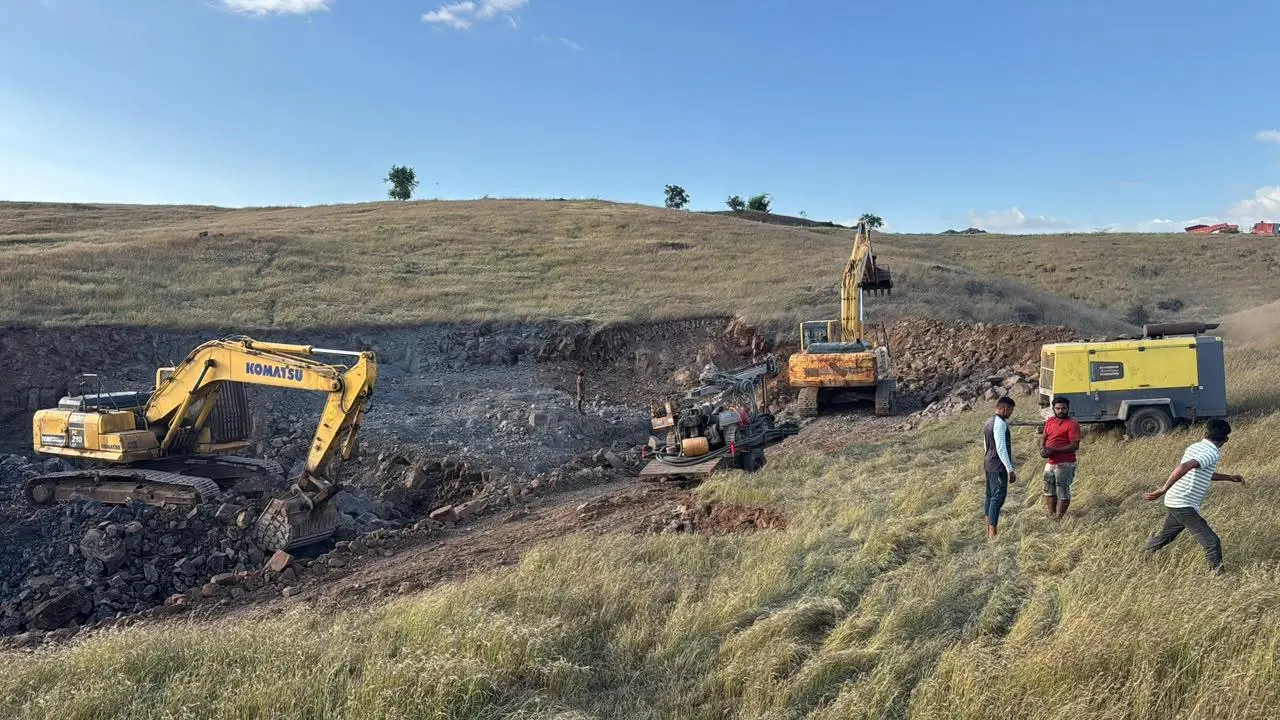
Every tonne that goes through a crusher started as a hole. The drilling method fixes the hole diameter, the diameter fixes the burden and spacing, and those fix the fragmentation the hopper sees and the vibration the neighbours feel. Choosing between DTH drilling, a top hammer rig and a wagon drill is the first design decision on a bench, made before anyone talks about explosive.
The figures below are typical ranges from manufacturers' published data and standard blasting references. They move with the rock, the machine and the operator. Read them as a guide to what suits a site, not as a specification.
What blast hole drilling is
Blast hole drilling is the drilling of holes of a planned diameter, depth and inclination, on a planned pattern, to take the explosive charge that breaks a bench. Rock is cut in one of two ways. Percussive drilling breaks it with repeated hammer blows on a bit studded with tungsten carbide buttons, the bit turning a little between blows. Rotary drilling crushes it under a heavy, steady load on a rolling tricone bit, with no hammer at all. In both, compressed air blown down the string lifts the cuttings out of the hole.
Percussive drills divide again by where the hammer sits. On a top hammer drill it is on the feed, above the hole, striking the rod string. On a DTH drill it goes down the hole and strikes the bit directly. That one difference explains most of the table further down.
The five types of drilling in mining and quarrying
- Jackhammer. A hand-held pneumatic rock drill on integral steel, drilling holes of about 32 to 40 mm. Holes of 1.5 to 3 m are its working range and about 6 m is the practical limit on extension steel. It opens faces, drills toe holes and boulders, and works where no rig can stand. It cannot feed a 250 TPH plant.
- Pneumatic wagon drill. A top hammer or a small DTH hammer on a light wheeled or crawler mast, fed by a separate towed compressor. Hole sizes run from about 64 mm to 115 mm. It is cheap, repairable at site and still the commonest drill on small Indian quarries. Everything depends on the compressor behind it and on how carefully the mast is set by hand.
- Hydraulic top-hammer crawler. A hydraulic drifter on a boom-mounted feed with its own power pack, rod changer and dust collector and, on current machines, angle and depth instruments. It is the fastest way to drill holes of roughly 64 to 127 mm on benches up to about 15 m.
- Down-the-hole (DTH). A pneumatic hammer directly behind the bit, on tubes that only rotate and carry air. Quarry hole sizes are typically 90 to 165 mm and the method goes on to about 250 mm. Penetration depends on air pressure, which is why a DTH rig is specified together with its compressor.
- Rotary. A tricone bit under tens of tonnes of pulldown, for holes from roughly 150 mm to beyond 400 mm.
Top hammer vs DTH: where the hammer sits
A top hammer's blow travels down the rods as a stress wave and loses a little at every threaded coupling. In a short hole the loss is small, and the high blow energy of a hydraulic drifter makes it the quicker machine. As rods are added, less of each blow reaches the bit, the string flexes more and the hole wanders. Trade guidance puts the turning point at around 15 m of hole and about 100 mm of diameter. Past that the long, slender string is the weak link.
A DTH hammer avoids both problems. The piston strikes the bit directly, so the blow at 30 m is the blow at 3 m, and the hammer body nearly fills the hole and guides it. One 2025 survey of holes at a gold mine measured an average deviation of 1.7 degrees on DTH holes against 4.6 degrees on top hammer holes. Sandvik treats deviation above 8 per cent of hole length as a problem on top hammer benches and reports 3 to 5 per cent with a guide adapter in the string. Those are single-site and manufacturer figures, but the direction is not disputed. What a crooked hole does to a shot is the subject of blast hole deviation.
The price is air. A DTH hammer is only as good as the pressure and volume delivered to it, which is covered in compressor air and bit selection.
The methods side by side
| Method | Typical hole diameter | Bench height it suits | Hole straightness | Air or power need | Where it is used |
|---|---|---|---|---|---|
| Jackhammer | 32–40 mm | Up to about 3 m | Poor beyond 2 to 3 m; set by hand | Small portable compressor | Face opening, toe holes, boulders, trenches |
| Pneumatic wagon drill | 64–115 mm | Roughly 5 to 10 m | Fair; depends on manual set-up | Separate towed compressor, 7 to 10 bar on older hammers | Small and medium stone quarries, road cuttings |
| Hydraulic top-hammer crawler | 64–127 mm | Up to about 15 m | Good in short holes, falling with depth; guide tubes help | On-board diesel hydraulics, with a small compressor for flushing only | Quarries and highway rock cuts that need metres per shift |
| Down-the-hole (DTH) | 90–165 mm in quarries, up to about 250 mm | About 8 m upward, including deep benches | Best of the percussive methods | High-pressure compressor, typically 10 to 24 bar | Deeper benches, hard or broken rock, larger quarries |
| Rotary (tricone) | 150 mm to beyond 400 mm | The tall benches of large pits | Good; a heavy, stiff string | Large diesel or electric rig with tens of tonnes of pulldown | Coal overburden, iron ore, limestone for cement |
Compiled from manufacturers' published data and trade handbooks. Rock, machine and operator move every figure in it.
Why tricone rotary drilling belongs to large mines
Tricone rotary drilling needs weight on the bit. The rig has to push down with tens of tonnes, which means a machine far heavier than any quarry crawler, and that mass only pays where the holes are large and there are thousands of them: coal overburden, iron ore, the limestone benches of a cement plant. A 250 mm hole also wants a burden of roughly 6 to 10 m by the usual multiples, a bench to match and a shovel that can dig the result.
A stone quarry feeding a jaw crusher wants the opposite. Smaller holes on a tighter pattern spread the explosive more evenly through the rock and give the fragmentation a 250 to 350 TPH plant can swallow. In holes under about 165 mm, percussion is also the cheaper way to drill a metre of hard rock, which is why DTH and top hammer own the aggregate business.
One point of vocabulary, because the word is used two ways. Rotary in this section means a tricone bit and no hammer. On a quarry floor the same word usually means a rig whose rotary head turns a DTH hammer, which is rotary-percussive drilling and is the common quarry machine, not the exception. Some rigs carry both: a tricone for soft ground and a hammer for hard.
Making blast hole diameter, bench height and the loader agree
Four things have to fit one another, and the drill is only one of them.
- Diameter against bench height. A widely used starting check is that the hole diameter in millimetres should be no more than about fifteen times the bench height in metres, so a 100 mm hole wants a bench of roughly 7 m or more. Below that, too much of a short hole is stemming, the collar rock comes out as boulders and the toe stays. The bench should also be at least twice the burden, and three times is better.
- Bench height against the loading machine. The face has to be one the excavator can scale and dig safely. A 20 tonne class machine and a 15 m face do not belong together however well the drill copes. This is a bench design question, with DGMS conditions attached.
- Diameter against the crusher. Bigger holes mean wider patterns and coarser rock between them, most of all in jointed ground where whole blocks can sit between holes untouched. The top size the primary jaw accepts sets how coarse the shot may be, which is worked through in fragmentation and crusher output.
- Diameter against the neighbours. A larger hole holds more explosive in every metre and so puts more charge on each delay. Near houses, a smaller hole is often the only way to bring the charge per delay down.
Once those agree, the pattern follows from the diameter. Burden, spacing and sub-drilling are all set out as multiples of it.
What we put on a bench
We run ten drilling machines, rotary and percussion, with high-pressure compressor support, on rock from Bundelkhand sandstone to the hard granite of Karnataka. Which one goes to a site depends on the bench the lease allows, the rock, and what the plant at the other end has to be fed. Send the rock type, the bench height you have or can cut, the monthly tonnage and what stands near the boundary, and we will say which machine and what hole size we would put on it. The details are on the drilling services page. Where one crew should own both the hole and the charge that goes in it, see controlled blasting.