
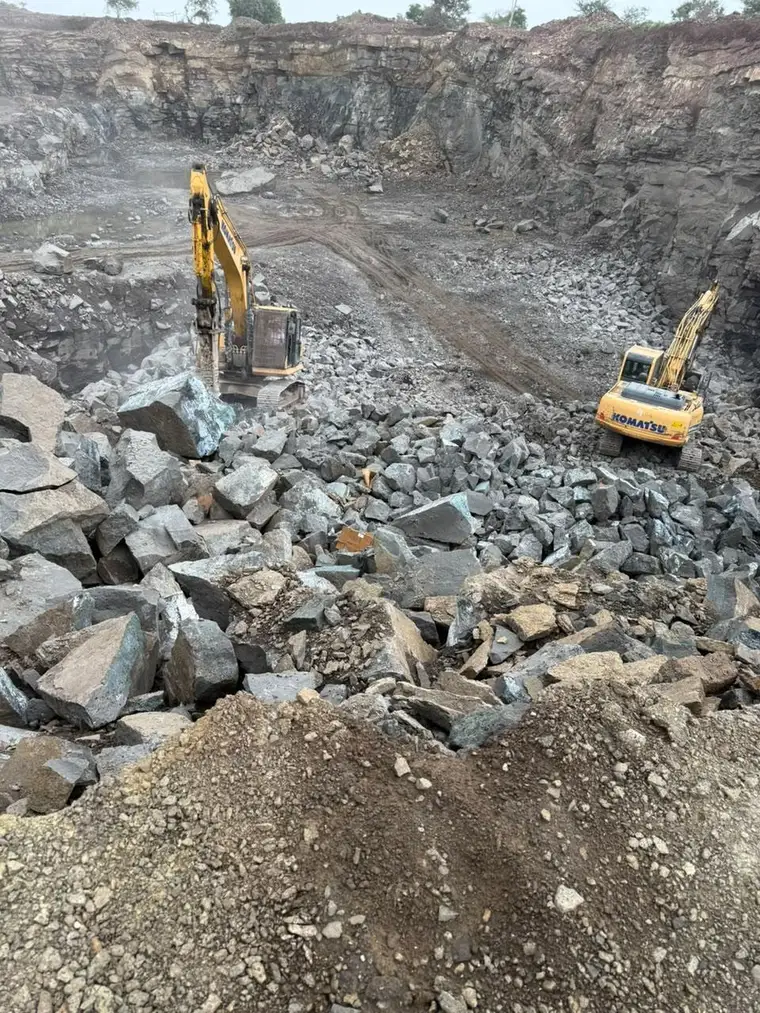
The mining page on this site carries a line most plant managers learn the expensive way: oversize costs more at the hopper than it saves at the face. Widen the pattern and the month's drilling and explosive bill falls. Then the breaker at the hopper works every shift, the jaw waits on it, and a plant rated for 250 TPH delivers well short of that. Nobody books the lost tonnes against the blast.
Blast fragmentation and crusher productivity are one system. What the mining industry calls mine to mill is the practice of running them as one. This article is about the half of it that happens at the face.
What blast fragmentation means
Blast fragmentation is the range of rock sizes a shot produces, from dust to the largest boulder, described as a size distribution: what percentage of the muckpile passes each size. Two parts of that curve matter most to a plant. The top size decides whether the rock will go into the primary crusher at all. The proportion of fines decides how much of the shot passes straight through the plant and comes out as the product nobody is short of.
Good fragmentation is not the finest possible. It is the distribution that costs least across drilling, blasting, loading, crushing and what the product sells as, all taken together.
What size a jaw crusher can take
A jaw crusher is sized by its feed opening: the gape, between the jaw plates at the top, and the width, between the side plates. The usual rule, given by crusher makers and mineral-processing texts alike, is that the largest lump fed should be about 80 per cent of the gape. Some older references allow 85. A rock larger than that, or a slab of the wrong shape, sits across the opening where the jaws cannot grip it.
Top size = 0.8 × gape
750 mm gape = 0.8 × 750 mm = 600 mm
900 mm gape = 0.8 × 900 mm = 720 mm
1,000 mm gape = 0.8 × 1,000 mm = 800 mm
A 700 mm boulder needs a gape of about 875 mm or more
Length matters as well as thickness. A slab 500 mm thick and 1.5 m long passes the test on one dimension and still bridges the hopper. Blocky rock from widely jointed granite and slabby rock from bedded sandstone fail in different ways, and the blast design has to know which it is dealing with. How the stages after the jaw share the reduction is in jaw, cone and VSI crusher stages.
What oversize boulders in blasting cost
- The breaker at the hopper. Every boulder that reaches the plant has to be broken by a hydraulic breaker at the feeder while the jaw waits. Metso's estimate is that clearing a bridged jaw takes several minutes, and that ten such stops in a day add up to an hour of lost production.
- Secondary breaking at the face. Boulders set aside by the excavator are broken on the pit floor or drilled and popped. Either way it is a second handling of rock that has already been paid for once.
- Slow digging. A coarse, tight muckpile loads slowly. Bucket fill drops, cycles stretch and the tippers queue, so the same fleet delivers less to the hopper.
- A starved plant. A jaw fed in bursts between blockages sends an uneven stream to the cone. A cone that is not kept full makes a flakier product and wears its liners unevenly.
- Shock. Large, hard lumps load the jaw plates, the toggle and the bearings hardest.
What excess fines cost
The opposite error is quieter. A shot that is over-charged or badly timed turns part of the bench to dust. In a metal mine that is welcome, because the ore is going to be ground anyway, which is why mine-to-mill programmes there push explosive energy up. A road-aggregate quarry is different. The plant is paid for GSB, WMM and clean 40, 20 and 10mm chips, and fines made in the blast pass the jaw untouched and add to the crusher dust.
Dust has its uses. On our plants it is sold as a product and not left in a heap. But it earns less than chips, and a GSB or WMM blend can only absorb so much of it before it fails the fines limit in its grading. Over-charging also costs explosive, throws rock and raises vibration. The cheapest tonne is the one broken just small enough.
How the blast design moves the size distribution
| Variable | What it does to the size distribution | What it trades against |
|---|---|---|
| Burden | Too large and the charge is over-confined: coarse rock, a toe and back-break. Too small and the front blows out and scatters. | Drilling cost falls as burden grows; vibration and flyrock risk move with it |
| Spacing | Stretch it and boulders appear from midway between holes, soonest on a low bench. | The cheapest metre to save and the easiest to overdo |
| Powder factor | More explosive per cubic metre gives finer rock throughout, and more fines around each hole. | Explosive cost, throw, and dust the plant cannot sell as chips |
| Stemming | The collar zone holds no explosive and breaks only by what the charge below does to it. Long stemming means cap-rock boulders; stemming that blows out wastes the hole. | Shorter stemming is traded directly against flyrock |
| Delay timing | Enough time between holes and rows for the rock ahead to move gives each hole a free face and a looser pile. Too little and the shot chokes; scatter in the timing makes the result uneven. | Timing is also the main control on vibration |
Directions as given in standard blasting references. How far each one moves the result depends on the rock's jointing more than on anything in the design.
The geometry is set out in burden, spacing and sub-drilling and the charge in powder factor. Our blasting page makes the point about the last row of the table: delays are where fragmentation and vibration are actually won.
Two things sit above all five. The rock's own joints decide the largest block that can exist before a hole is drilled, and no design breaks a block that no hole passes through. And the design only works if the holes are where it put them, which is the point of blast hole deviation.
Predicting and measuring fragmentation
Prediction models exist. The best known is Kuz-Ram, developed by Cunningham in the 1980s, which combines an empirical equation for the average fragment size with a standard size-distribution curve. It takes a rock factor, the powder factor, the charge per hole and the pattern geometry, and returns a predicted distribution. Later work has refined it, notably with the Swebrec function, which copes better with a maximum block size. All of them need calibrating to the site, and they are best used to compare one design with another, not to promise a top size.
Measurement is harder than it sounds, because nobody can sieve a muckpile. The methods in use:
- Image analysis. Photographs of the muckpile, of tipper loads or of the belt after the primary, with a scale object in frame, processed by software such as WipFrag or Split-Desktop into a size distribution. It sees only the surface and under-counts fines, and published comparisons put its error anywhere between 2 and 20 per cent.
- Boulder count. The number and rough size of boulders set aside from each shot. Crude, and very useful.
- Breaker hours. Hours run by the breaker at the face and the one at the hopper, set against tonnes crushed.
- Plant data. Tonnes per hour through the jaw, stoppages for bridging, and the share of crusher dust in the product. The plant measures every shot, whether anyone reads the result or not.
The discipline is to record the pattern, charge and timing of every shot against what the plant then did with it. After a dozen shots the bench has said more than any model will.
Running the face for the plant
This is easiest where one contractor holds the drill, the charge and the crusher, because the cost and the saving land in the same account. Our shots are designed for the bench in front of the crew and for the fragmentation the crusher wants, by licensed shotfirers, and the same firm runs the three-stage plant the rock goes into. If your plant is short of its rated output, send the jaw's feed opening, the present pattern and powder factor, and a few photographs of the muckpile with something in frame for scale. Controlled blasting covers the design side, and crusher plant operations the plant.