
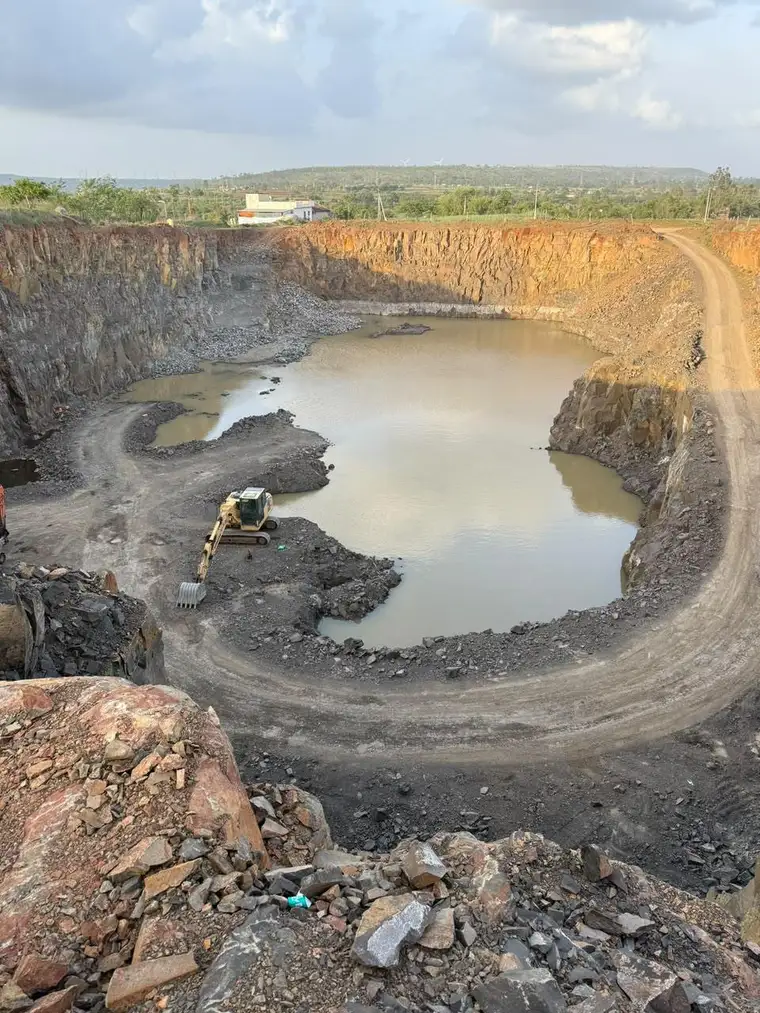
A bench is where a quarry earns its tonnes, and a badly shaped one is where its accidents start. Too high, and the excavator cannot reach the loose rock hanging at the crest. Too narrow, and a tipper is reversing along an open edge with a muck pile on its other side. Bench height in an opencast mine is the first figure an inspector looks at. Bench width is usually the first one a crew gives away when the plant is short of feed.
The figures below are from Regulation 106 as it stands in October 2026. The regulations have outlived the Mines Act 1952 and continue under the OSH Code 2020 until replacements are notified, so check the number before it goes into a notice.
What a quarry bench is
A bench is one step of a quarry face: a level floor to work from and a near-vertical face in front of it, cut to a height the drilling and loading machines can handle. The top edge of the face is the crest and the bottom is the toe. Height is measured vertically from toe to crest. Width runs from the toe of the face above to the crest of the face below.
Bench height and width under Regulation 106
This is the provision people mean when they ask for the DGMS bench width or height. It treats soil, hand-worked stone and mechanised stone differently.
| Ground and method | Bench height | Breadth or slope | Sub-regulation |
|---|---|---|---|
| Alluvial soil, morum, gravel, clay, debris | 1.5 m maximum | Breadth not less than the height; or, without benches, sides at 45° or flatter | 106(1)(a) |
| Float or similar deposit worked by manual means on a sloping face | 6 m maximum | Breadth not less than the height; sides not steeper than 60° | 106(2)(a) |
| The same, in comparatively hard and compact rock, with the Regional Inspector's written permission | Up to 7.5 m | Width not less than 6 m | 106(2)(a), proviso |
| Deep-hole blasting or heavy machinery | As the Chief Inspector's conditions specify | As the conditions specify | 106(2)(b) |
| Any hard and compact ground | No figure | Sides adequately benched, sloped or secured | 106(3) |
Angles are measured from the horizontal. The Regional Inspector can vary the soil limits in writing, and the Chief Inspector can relax sub-regulation (2) where special difficulties exist.
The fourth row is the one a highway-package quarry lives under. Where the method cannot comply with the fixed dimensions, the owner, agent or manager gives notice in writing, in duplicate, not less than 60 days before starting, to the Chief Inspector and the Regional Inspector, with the method of working and the precautions against falls of sides and material. Work may begin only in accordance with the conditions the Chief Inspector specifies. That letter, not the 6 m figure, is then the law for that quarry. The notice is one of the papers listed in opening a stone quarry.
Two more rules apply to every opencast working whatever the method. No tree, loose stone or debris may stay within 3 m of the edge of the excavation without the Chief Inspector's written permission. And no face or side may be undercut so as to leave an overhang.
How height is tied to the excavator and the drill
The loading machine sets the ceiling. An excavator has to be able to reach the top of the muck pile and scale loose rock off the face above it, so the working height is held to about the machine's digging reach, and permission conditions are commonly framed the same way. A 20 to 30 tonne class backhoe typically reaches 9 to 10 m. Take the figure from the maker's chart for the boom and stick actually fitted.
The drill sets the practical limit under that. Hole depth is bench height plus sub-drill, and deviation grows with depth. A small-diameter hole from a hand-held jackhammer wanders too far to be trusted past a few metres, which is why manual quarries work in lifts of 1.5 to 3 m, while a crawler rig putting down 100 to 115 mm holes holds a 6 to 10 m bench without strain. The machines are compared in blast hole drilling methods.
There is a floor as well as a ceiling. Burden scales with hole diameter, and a bench much lower than about twice its burden is too stiff to break cleanly: it craters and throws where it should heave. Three to four times the burden is where fragmentation and toe are easiest to hold. So the hole diameter you own narrows the range of bench heights worth designing for, and the reasoning is set out in burden and spacing.
Width for the machine, the haul road and the muck pile
A working bench holds four things side by side: the rows being drilled, the muck pile they turn into, the loading machine with a lane for the tipper, and a bund or clear strip at the outer edge. Add them up for the largest machine on site, not the average one.
Block drilled = 3 rows × 3 m burden = 9 m
Muck pile spread = taken as bench height = 8 m
Loading and haulage = excavator plus one lane = 10 m
Edge bund and margin = = 3 m
Working width = 9 + 8 + 10 + 3 = 30 m
About 30 m. The inputs are assumed; put in your own machines and your own throw
A bench that is not being worked can be far narrower. Its job is to catch what comes off the face above and to break the overall slope, and it is usually called a berm or catch bench. What must not happen is a working bench shrinking to berm width because the faces above it were not pushed back in step. Lane widths for one-way and two-way running are in quarry haul road design.
Face angle, berms and the overall slope
Three angles get confused. The face angle is the slope of a single bench face, typically 70 to 80 degrees in sound rock shot with vertical holes. The overall slope is the line from the toe of the lowest bench to the crest of the highest, and it is always flatter, because every berm adds horizontal distance. The third is the angle the rock mass will stand at for years, which depends on jointing and water and is a geotechnical question, not a drilling one.
Face setback = 8 m ÷ tan 75° = 2.14 m a bench
Horizontal = (3 × 2.14) + (2 × 6 m) = 18.4 m
Vertical = 3 × 8 m = 24 m
Overall slope = arctan (24 ÷ 18.4) = 52.5°
About 52° overall from 75° faces. Widen the berms to 8 m and it drops to about 47°
Where joints dip out of the face, the slope fails along them however neat the benches look, and the remedy is to turn the face or flatten it, not to trim it. On a final wall, controlled blasting earns its cost: a pre-split or a trimmed last row leaves a face that does not go on shedding rock onto the berm below.
Ramps and drainage
Benches are joined by ramps, and a ramp eats bench. At the gradient the permission allows, climbing one 8 m lift takes a long run of road that cannot be drilled until the ramp is moved. Decide where the ramps go before the first bench is cut, and put them on the side of the pit that will be worked last.
Give every bench floor a slight fall, a per cent or two, back towards a drain along the toe, so rain runs to a sump and not over the crest. Water going over a crest washes out the fines that hold the top of the face together. Water standing at the toe fills the next round's holes. Both get worse from June, which is the subject of running a quarry through the monsoon.
What goes wrong on a bench
- Undercutting. Digging into the toe of a soft or broken face to make loading easier leaves the rock above hanging. Regulation 106(5) prohibits it outright.
- Overhangs. A hard band in the stemming zone that the charge never reaches, or back-break that leaves cracked blocks leaning out over the face, puts a lip at the crest. It has to be scaled or trimmed before anyone works under it.
- Toe left standing. Too little sub-drill, holes that stopped short, or a front-row burden heavier at the floor than at the collar leaves a hump of unbroken rock. The next floor rises, tippers ground on it, and a breaker spends a week doing what the blast should have.
- Benches lost. The faces above are not advanced, so the working bench narrows round by round until the machine has nowhere to stand. It is the usual way a legal quarry becomes an illegal one.
- Loose at the edge. Spoil, boulders or stacked drill rods left inside the 3 m strip the regulation wants clear.
What a bench design needs from you
Four things: the rock type and how it is jointed, the machines that will load it, the hole diameter available, and the conditions of the lease and the mine-safety permission. Send those with a photograph of the face as it stands today. We cut and work benches with our own excavators and drilling machines, on client leases and on our own, and the scope is set out under mining operations.