
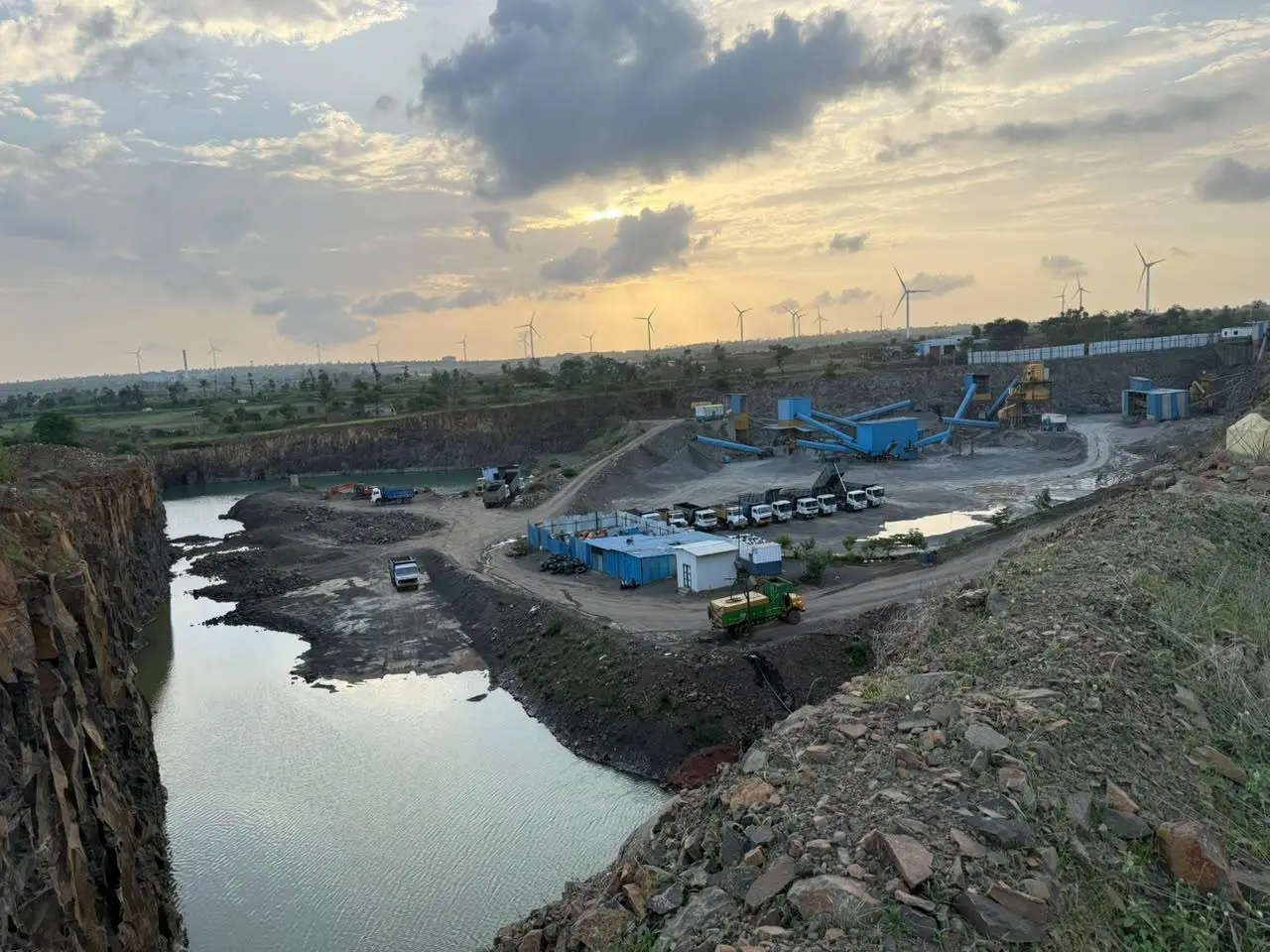
A crusher makes fines whether anyone wants them or not. Every stage, from the jaw to the last cone, sheds material under 4.75 mm, and it all ends up in one pile at the end of the bottom conveyor. Whether that pile is waste, crusher dust or manufactured sand depends on what is done to it next. The three names are used loosely enough that good sand gets rejected as dust, and dust gets poured into columns as sand.
The crusher dust vs M-sand question is settled by a sieve analysis, not by a name. Below: what each material is, what IS 383:2016 requires of a sand for concrete, and where plain dust is the right thing to order.
What crusher dust, M-sand and river sand are
Crusher dust is the 0 to 4.75 mm fraction that passes the finest screen deck of an aggregate plant. Nothing more has been done to it. Its grading is whatever the rock and the crushers produced that shift, many of its particles are flaky because they were chipped off larger stones, and it carries all the rock flour made along the way.
M-sand is manufactured sand. Rock is crushed deliberately for sand, normally through a vertical shaft impactor that throws stone against stone until the particles are roughly cubical. The product is then screened to a grading and washed or air-classified to take out the excess fines. It is made to a specification.
River sand is natural sand, rounded by water and sorted by the river. It needs less water in a mix than any crushed sand. Its extraction is restricted, state by state, by sand mining rules, which is why this comparison exists at all.
What IS 383:2016 says about crushed sand
IS 383 grades all fine aggregate, natural or crushed, into four zones by the percentage passing each sieve. Zone I is the coarsest and Zone IV the finest.
| IS sieve | Zone I | Zone II | Zone III | Zone IV |
|---|---|---|---|---|
| 10 mm | 100 | 100 | 100 | 100 |
| 4.75 mm | 90–100 | 90–100 | 90–100 | 95–100 |
| 2.36 mm | 60–95 | 75–100 | 85–100 | 95–100 |
| 1.18 mm | 30–70 | 55–90 | 75–100 | 90–100 |
| 600 micron | 15–34 | 35–59 | 60–79 | 80–100 |
| 300 micron | 5–20 | 8–30 | 12–40 | 15–50 |
| 150 micron | 0–10 | 0–10 | 0–10 | 0–15 |
For crushed stone sand the limit on the 150 micron sieve is raised to 20 per cent. The standard recommends against Zone IV sand in reinforced concrete unless trials show the mix proportions are suitable.
The bands do not overlap on the 600 micron sieve, so that sieve decides the zone. On any other sieve a sand may stray outside its band by up to 5 per cent and still be classed in the zone, within an overall allowance of 10 per cent.
The second control is fines. Table 2 of the standard limits material finer than 75 microns to 3 per cent in natural sand, 15 per cent in crushed sand and 12 per cent in a blend of the two. The crushed sand allowance is generous for a reason: its fines are mostly rock flour, where the fines in a river sand are mostly silt and clay. That reasoning holds only if the quarry face was clean. Dust from a face with clay seams or badly stripped overburden carries plastic fines, and no percentage makes those acceptable in concrete.
Is crusher dust good for concrete?
Sometimes, and only when it has been tested as a sand. Raw dust from a plant set up for coarse aggregate tends to miss on three points.
- Fines. Unwashed dust can carry well over 15 per cent passing 75 microns, and the figure climbs when the feed is soft or a screen is blinding.
- Grading. Dust is often gap-graded: plenty of 2 to 4.75 mm chips, plenty of flour, and too little in between. It can fall outside all four zones.
- Shape. Chips broken off in a jaw or a cone are flat and sharp. They lock up in a mix where rounded or cubical grains would roll.
All three push up water demand. Concrete made with raw dust needs more water for the same slump, and more water at the same cement content means lower strength and more shrinkage, or else more cement or admixture to get back to where the mix started. A properly made crushed sand closes most of that gap. Shaping deals with the particles, screening with the grading and washing with the fines.
MoRTH accepts crushed sand on those terms. Section 1000 allows natural sand, crushed stone sand or a combination as fine aggregate in structural concrete, all to IS 383, and Clause 602 says the same for pavement quality concrete, with a sand equivalent of at least 50. Some bituminous mixes go further. Stone matrix asphalt under Clause 515 requires 100 per cent crushed fine aggregate, and Clause 505 does not allow natural sand in a binder course at all.
Where crusher dust is the right material
Dust is a product, not a waste heap, as long as it goes where its properties suit.
- Fines in GSB and WMM. Both layers need a fine fraction to close the voids, and non-plastic crusher dust is the usual source. The limits are the layer's own: under 5 per cent passing 75 microns on the dense GSB gradings, 0 to 5 per cent on WMM, and a plasticity index of 6 or less on both.
- Bituminous mixes. The fraction passing 2.36 mm in DBM and BC is fine aggregate, crushed in most mixes, and rock dust is one of the fillers the specification names.
- Blocks and pavers. Block and paver plants run stiff, vibrated mixes that tolerate angular fines. Most still screen the dust to a consistent top size first.
- Paver bedding. IRC:SP:63 wants bedding sand that is angular and well graded, with no more than 10 per cent passing 75 microns and no more than 3 per cent clay and silt. Screened or washed dust can meet that. Raw dust heavy with fines holds water under the blocks and should not be used.
- Filling and levelling. Trench backfill, plinth filling and blinding under slabs, where the material only has to compact and stay put.
One caution on quantity. Damp dust bulks, so a volume of it holds less material than the same volume dry; buy it by weight, for the reasons in aggregate weight in cubic metres, CFT and brass.
Crusher dust vs M-sand vs river sand, side by side
| Point | Crusher dust | M-sand (crushed stone sand) | River sand |
|---|---|---|---|
| Origin | By-product of crushing coarse aggregate | Rock crushed and processed to make sand | Dug or dredged from a riverbed |
| Processing | None beyond the bottom screen deck | Shaped, screened, washed or classified | Screened; sometimes washed |
| Particle shape | Angular, often flaky | Angular to cubical | Rounded, smooth |
| Grading | Varies shift to shift; may fit no zone | Controlled to an IS 383 zone | Varies with the source and the reach |
| Finer than 75 micron | Uncontrolled | 15% max under IS 383 | 3% max under IS 383 |
| Nature of the fines | Rock flour, plus clay if the face was dirty | Rock flour | Silt and clay |
| Water demand in concrete | Highest | Moderate | Lowest |
| Suits | GSB, WMM and bituminous fines; filling; blocks | Concrete, blocks, paver bedding | Concrete and plaster, where it can be had |
| Ask the supplier for | Sieve analysis and plasticity index | IS 383 certificate with zone and 75 micron figure | IS 383 certificate with zone and 75 micron figure |
Water demand is a ranking, not a number. The actual difference depends on the mix and is found by trial.
Buying fines without the argument
Decide the use first. For GSB or WMM, ask for dust with a sieve analysis and a plasticity index, and blend it at the plant. For concrete, ask for crushed stone sand to IS 383:2016 with the zone and the 75 micron figure on the certificate, and run a trial mix before the first pour, because the water demand of a new sand is found in the mixer and nowhere else.
Our plants produce crusher dust alongside the coarse sizes, and it is sold as fine aggregate and manufactured sand where the specification allows it. What each stage of a plant does to the fines is covered in jaw, cone and VSI crusher stages. Production and gradings are on the stone crushing page, and the product list is on materials.