
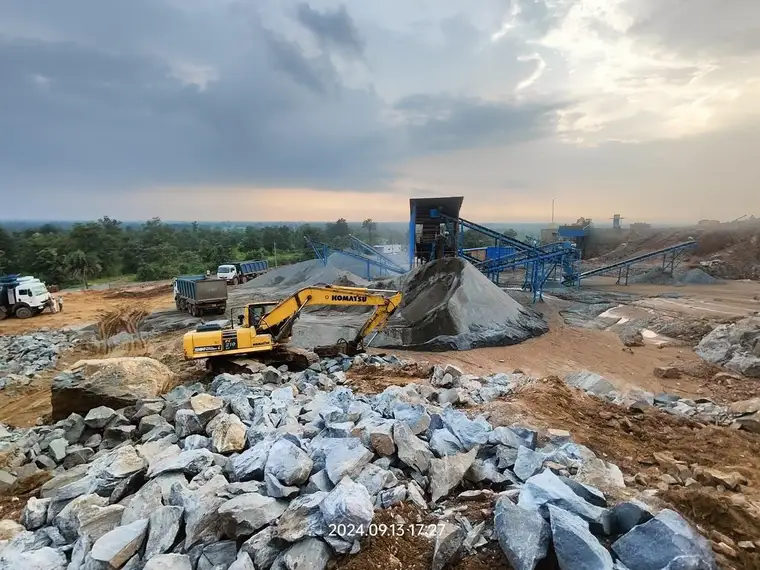
Type jaw crusher vs cone crusher into a search bar and most of what comes back treats it as a choice. On a highway plant it is not one. The two machines sit in the same line doing different jobs, and a third stage follows them because neither can finish the stone alone.
What follows is what each stage of a three-stage crushing plant takes in, what it hands on, and where it fails if it is asked to do the next machine's work. Sizes and ratios are typical figures for hard-rock aggregate plants. The rock and the maker's manual move every one of them.
What a three-stage crushing plant is
A three-stage crushing plant is a line of three crushers in series, a primary jaw, a secondary cone and a tertiary cone or VSI, with vibrating screens that sort the product and send oversize back to be crushed again.
Each stage covers for the one before it. The jaw accepts rock no other machine will swallow, and makes poor shape. The cone does the heavy reduction but only behaves when it is kept full. The tertiary stage, working in a loop with the screens, makes the 20mm and 10mm chips a bituminous layer will accept.
Why one crusher cannot take a boulder to 10mm
Reduction ratio is feed size divided by product size, and every compression crusher has a limit on it. Crusher makers measure the ratio at the 80 per cent passing size of feed and product, and on that basis the published figures are modest: 2 to 3 for a jaw, 3 to 5 for a cone with a standard cavity, 2 to 4 for a short-head cone. Quote a jaw the other way, largest lump over closed side setting, and the brochures say about 6:1. Both are honest. They are measuring different things. Run the more generous top-size figures against the job.
Reduction needed = 700 mm ÷ 10 mm = 70 : 1
Jaw alone, at 6 : 1 = 700 ÷ 6 ≈ 117 mm
Jaw and cone, 6 × 4 = 700 ÷ 24 ≈ 29 mm
Three stages, 6 × 4 × 3 = 700 ÷ 72 ≈ 10 mm
Three stages get there with no machine pushed past its ratio
A crusher can be forced past its ratio by closing the setting. A cone treated that way packs, its adjustment ring starts to bounce and the product carries more dust. Sharing the same reduction across three machines costs more steel on day one and gives each of them work it can do all shift.
Primary: grizzly, scalping and the jaw crusher
Hopper, grizzly and scalping
Shot rock is tipped into the hopper and drawn out over a grizzly: a vibrating feeder whose last section is a set of spaced bars. Lumps ride over the bars into the jaw. Soil, fines and anything else smaller than the gap fall through and never enter the crusher. That matters twice. Material already smaller than the jaw's setting only takes up room in the chamber and grinds the plates. The scalpings are also where the clay is, so sending them to a reject heap keeps the plasticity index of a sub-base blend under control.
The other limit at the hopper is top size. A jaw accepts lumps up to about 80 per cent of its feed opening. Anything larger bridges across the mouth and stops the plant until a rock breaker deals with it, which is why blast fragmentation decides crusher output long before the plant does.
What the jaw crusher does
A jaw crusher squeezes rock between a fixed plate and a moving one until it breaks, and lets it fall when it is small enough to pass the gap at the bottom. It is the simplest crusher on the plant and the most forgiving. Its job is to make shot rock small enough for a conveyor and for the cone's feed opening. Nothing more.
What it cannot do is shape. Large lumps in a jaw are broken in a single layer, and rock loaded that way cleaves along its weakest plane and comes out as slabs. Jaw-run stone screened into 40mm or 20mm will pass a sieve analysis and fail the flakiness and elongation index. Treat jaw product as feed for the next stage, never as a finished aggregate.
Secondary: the cone crusher and choke feeding
In a cone crusher a mantle gyrates inside a fixed bowl liner, also called the concave. Big pieces are nipped directly between the two. Smaller pieces, when the chamber is full, are crushed against each other, and this stone-on-stone breakage is what gives a cone its shape and spares its liners. Most of the size reduction on a plant happens here.
The condition is in that sentence: when the chamber is full. A cone is designed to be choke fed, with stone standing above the head and spread evenly all the way round it. Feed it in a trickle and each piece meets steel instead of stone. The product turns flaky, the liners wear in one band and the power draw swings with every surge. A surge bin and a feeder ahead of the cone are not accessories.
A cone is also bad at dirt and at steel. Fines and clay pack in the bottom of the chamber, so they are screened out ahead of it, and a magnet over the feed belt catches the lost bucket tooth.
Tertiary: a short-head cone or a VSI
The third stage takes what the screens reject and finishes it, in one of two ways. A short-head cone is a cone with a shallower, finer cavity. Its ratio is the lowest on the plant, 2 to 4, and it is run choke fed in closed circuit, with its product going back over the screens.
A VSI, a vertical shaft impactor, works differently. A rotor flings stone at speed against anvils or against a bed of stone held in the chamber, and each particle breaks where it is weakest: across a thin flake, at a sharp corner. What comes out is the most cubical chip any crusher makes, and a fine fraction good enough to sell, which is the subject of crusher dust versus M-sand. The cost is fines whether you want them or not, and rotor tips and anvils that wear quickly in abrasive rock.
Which one a plant carries depends on the products. A contract that is mostly GSB and WMM can live with a tertiary cone. One that needs tight shape for bituminous concrete, or manufactured sand, is the case for a VSI.
Where impactors fit, and why they suit softer rock
A horizontal shaft impactor hits rock with blow bars on a spinning rotor and throws it against breaker plates. Its reduction ratio is far higher than any compression crusher's, 7 to 10 on the makers' basis, its product is well shaped, and in limestone a single impactor can do the work of a jaw and a cone.
The catch is wear. Steel striking rock at speed is consumed quickly when the rock is abrasive, and Sandvik's own selection guidance keeps impactors to stone with a low abrasion index. That is why limestone plants are often impactor plants while basalt, granite and quartzite are crushed by jaw and cone. Which rock makes good road aggregate goes through the four common ones.
Stage by stage: feed, product and reduction ratio
| Stage | Feed | Product | Typical reduction ratio | What it is bad at |
|---|---|---|---|---|
| Grizzly feeder | Shot rock as tipped | Lumps to the jaw; soil and fines out under the bars | None: it sorts | Wet clay, which bridges the bars |
| Primary jaw | Lumps up to about 80% of the feed opening | About 150–250 mm down, set by the CSS | 2–3 (about 6:1 lump to setting) | Shape: slabby, flaky product |
| Secondary cone | Jaw product with the fines scalped out | About 60 mm down | 3–5 | Trickle feed, clay, tramp steel |
| Tertiary short-head cone | Screen oversize, roughly 25–60 mm | 20 mm down, in closed circuit | 2–4 | Fines in the feed; running in open circuit |
| VSI | Chip-size stone from the cone | Cubical chips and sand | 4–6 quoted; less when run for shape | Abrasive rock; makes fines regardless |
| HSI impactor | Soft to medium rock, large lumps | Well-shaped stone in one or two stages | 7–10 | Abrasive rock: blow bar cost |
Ratios are makers' typical figures at the 80 per cent passing size of feed and product. Feed and product sizes are typical for plants of 250 to 350 TPH and move with the cavity and the setting.
Screens and the closed circuit
Crushers make sizes. Screens decide which of them leave. A stack of vibrating decks splits the stream into 40mm, 20mm, 10mm and dust, and whatever the top deck refuses goes back to the tertiary crusher. That loop is the closed circuit, and it is what makes a product calibrated: nothing larger than the deck aperture can reach the stockpile.
It has a price. Stone going round twice is tonnage the plant handles and does not sell, so a plant's nameplate figure and its saleable output are different numbers; crusher plant capacity in TPH works through the gap. GSB and WMM are then blended from the screened sizes in the proportions their grading tables ask for.
What to send before a plant is chosen
Four things settle which stages a job needs: the rock, the largest lump the blast will send to the hopper, the products with their monthly split, and the shape limit in the contract. Our plants run three stages, a primary jaw, a secondary cone and a tertiary stage with screening, at 250 to 350 TPH, with the decks set to the grading the contract calls for. What they produce is on the stone crushing page. If the real question is whether to put a plant on your site at all, crusher plant operations is the place to start.