
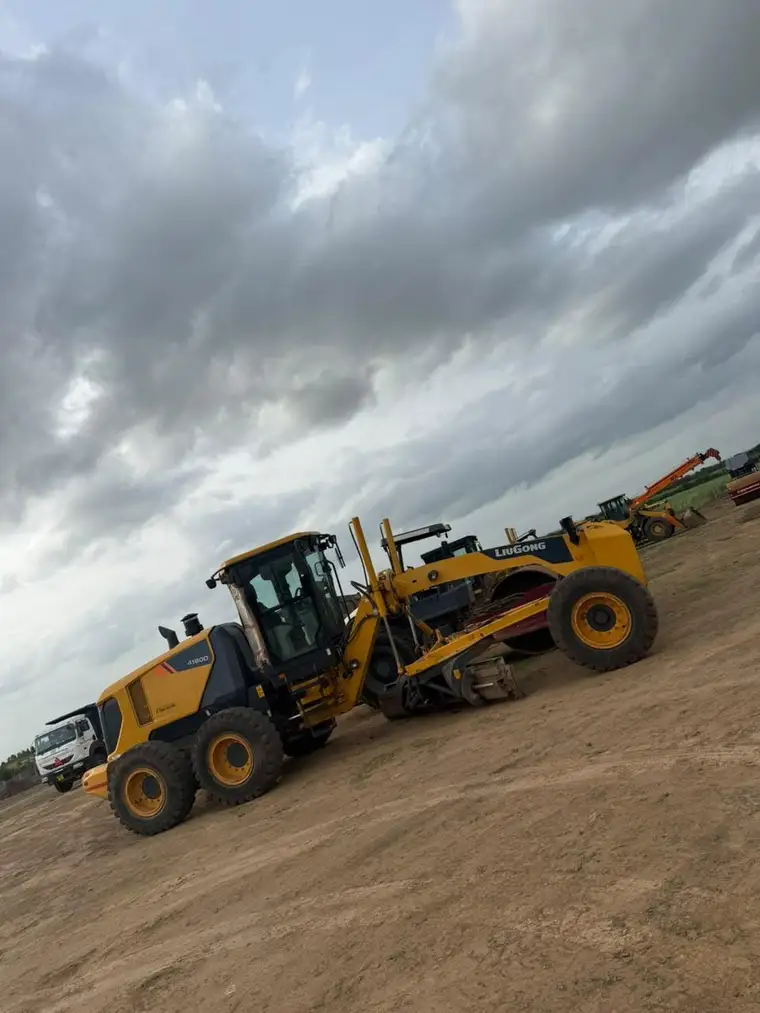
An embankment fails slowly. A layer placed too thick, or rolled two points dry, passes the eye, takes the next layer on top of it, and shows up two monsoons later as a dip in the bituminous surface that no overlay holds for long. By then the repair starts with taking the pavement off. Clause 305 exists so that each layer can be proved before the next one hides it.
What follows is embankment construction as per MoRTH: the Specifications for Road and Bridge Works, Fifth Revision, Section 300, with the testing rules from Clause 903. Contracts amend both, so check the edition and the technical schedule your own contract cites.
What Clause 305 covers
Embankment construction under MoRTH Clause 305 is the placing of approved fill in uniform layers, each brought to the right moisture and rolled to a stated percentage of its laboratory maximum dry density, to the lines and levels on the drawing. One clause covers the embankment body, the sub-grade, earthen shoulders and miscellaneous backfill.
Fill may be soil, moorum, gravel, reclaimed pavement material, fly ash, pond ash or a mixture of them. The clause gives preference to suitable material coming out of roadway excavation on the same contract, and asks that the best of what is available be saved for the sub-grade and the portion just under it. Matching cuts to fills is its own exercise, covered in balancing earthwork with a mass haul diagram.
Unsuitable material: what cannot go into the bank
Clause 305.2.1.1 lists six kinds of material as unsuitable for embankment.
- Material from swamps, marshes and bogs.
- Peat, logs, stumps and perishable matter, and any soil that classifies as OL, OI, OH or Pt under IS 1498.
- Material susceptible to spontaneous combustion.
- Material in a frozen condition.
- Clay with a liquid limit above 50 and a plasticity index above 25.
- Material carrying salts that would leach in the embankment.
Expansive clay has its own rule. With a free swelling index above 50 per cent by IS 2720 Part 40, it is not used as fill. Below 50 per cent it may go into the body of the bank, but the sub-grade and the top 500 mm of embankment under it have to be non-expansive. That is the rule that governs black cotton soil.
Size is limited too: ordinarily 75 mm in the embankment and 50 mm in the sub-grade. The Engineer may allow larger pieces if they can be placed and compacted, but never more than two-thirds of the compacted layer thickness.
Table 300-1: the minimum dry density the soil must be capable of
Table 300-1 is a test on the material, not on the finished layer. It asks whether the soil, compacted in the laboratory by the heavy compaction test, can reach a minimum dry unit weight. A light silty soil that cannot is rejected as a source, however well it might be rolled.
| Type of work | Maximum laboratory dry unit weight, IS 2720 Part 8 | About, in g/cc |
|---|---|---|
| Embankment up to 3 m high, not subjected to extensive flooding | Not less than 15.2 kN/m³ | 1.55 |
| Embankment over 3 m high, or of any height subject to long periods of inundation | Not less than 16.0 kN/m³ | 1.63 |
| Sub-grade, earthen shoulders, verges and backfill | Not less than 17.5 kN/m³ | 1.78 |
Fifth Revision. Not applicable to lightweight fill such as cinder or fly ash. The last column is a conversion, 9.81 kN/m³ to 1 g/cc, for reading against a laboratory report.
Sub-grade material has a second test to pass. It must give the design CBR at the specified density and moisture, and where the available soil cannot, the clause points to stabilisation. That side of it is in sub-grade CBR and compaction.
Table 300-2: embankment compaction of 95 per cent, sub-grade 97
This is the table the roller answers to. It states the field dry density required, as a percentage of the laboratory maximum.
| Type of work or material | Relative compaction, % of maximum laboratory dry density by IS 2720 Part 8 |
|---|---|
| Sub-grade and earthen shoulders | Not less than 97 |
| Embankment | Not less than 95 |
| Expansive clay in the sub-grade and the 500 mm just below it | Not allowed |
| Expansive clay in the remaining portion of the embankment | 90–95 |
Fifth Revision. Many contracts substitute their own version of this table.
At least seven working days before compaction starts, the contractor submits the maximum dry density and optimum moisture content of each fill material, with the graph of density against moisture they were read from. The approved values are the basis of every field test that follows. How they are found is in OMC, MDD and the field density test.
Embankment layer thickness and moisture at compaction
Material is spread in layers of uniform thickness over the full width with a motor grader. The compacted thickness of a layer is capped at 250 mm where a vibratory roller or vibratory soil compactor is used, and at 200 mm with an 80 to 100 kN static roller.
Moisture is checked where the material is placed, before rolling, by IS 2720 Part 2. At the time of compaction it has to lie between 1 per cent above and 2 per cent below optimum moisture content. A soil with an OMC of 12 per cent is rolled between 10 and 13. Expansive clay is the exception and is compacted on the wet side of optimum.
Dry soil is watered from a sprinkler tanker and mixed through the layer by blading or disc harrow. Wet soil is aired until it comes back into the band; if the weather will not allow that, compaction stops. Clods are broken to 75 mm in embankment and 50 mm in sub-grade.
The sequence on the ground
- 01
Set out and strip
Batter pegs mark the limits on both sides. The bank is built slightly wide so the loose edge can be trimmed back to compacted material. Topsoil is stripped where directed, to not more than 150 mm, and stockpiled no higher than 2 m.
- 02
Prepare the ground
The original ground is levelled, scarified, watered and rolled. Where sub-grade level is less than 0.5 m above the ground and the ground is not already at 97 per cent, it is loosened to 0.5 m below sub-grade level and recompacted in layers. Unsuitable ground is taken out to at least 500 mm and replaced.
- 03
Bench into existing slopes
Where fill meets an existing embankment or a slope steeper than 1 vertical to 4 horizontal, continuous horizontal benches at least 300 mm wide are cut so the new material keys in. Flatter slopes are ploughed or scarified. In wet ground the benches fall slightly inward to a subsoil drain.
- 04
Spread and grade
Spread with the grader to a loose thickness that compacts to the limit for the roller in use, and shape to crossfall. Haulage proceeds only when enough spreading and compaction plant is working at the fill.
- 05
Bring to moisture and roll
The clause names a self-propelled single-drum vibratory roller or padfoot vibratory roller of 80 to 100 kN static weight, or a heavy pneumatic tyred roller, proved in a compaction trial. Earthmoving plant does not count as compaction equipment.
- 06
Test, then repeat
The layer is tested and accepted before the next is placed, and the surface is kept at a crossfall that sheds water at all times.
Which drum suits which soil is in which roller for which layer. Around culverts and bridges the rules tighten. Fill within twice the height of the road from the back of an abutment is built separately from the main bank, not before the concrete or masonry has been in place 14 days, and is brought up in equal layers on both sides. It may not be organic soil, or clay with a plasticity index above 20 and a liquid limit above 40.
Testing frequency and acceptance
Clause 903.2 sets two rounds of testing. Borrow material is tested before use, for every 3,000 m³ from each source. Then every compacted layer is tested for density.
| Test | Method | Minimum frequency |
|---|---|---|
| Sand content | IS 2720 Part 4 | 2 tests per 3,000 m³ |
| Plasticity | IS 2720 Part 5 | 2 tests on each type of soil |
| Density (MDD and OMC) | IS 2720 Part 8 | 2 tests on each type of soil |
| CBR, on material for the sub-grade | IS 2720 Part 16 | 1 test, the average of three specimens |
| Field density, embankment | IS 2720 Part 28 | One set of ten per 3,000 m² of each layer |
| Field density, sub-grade and earthen shoulders | IS 2720 Part 28 | One set of ten per 2,000 m² of each layer |
Fifth Revision. Test locations are chosen by random sampling. If a non-destructive method is used, the number of tests is doubled.
Acceptance is statistical. The mean of a set must be not less than the specified density plus a margin that grows with the scatter of the results.
Margin factor = 1.65 - 1.65 ÷ √10 = 1.13
Specified = 95% of an MDD of 18.50 kN/m³ = 17.58 kN/m³
Standard deviation of the ten results = 0.25 kN/m³
Mean required = 17.58 + 1.13 × 0.25 = 17.86 kN/m³
A set that averages exactly 95 per cent passes only if all ten results are identical
Scatter costs density. The cheapest way to pass is uniform moisture and the same number of passes everywhere, not an extra pass on the day of the test.
What to settle before the first layer
The decisions that save rework are made before any soil moves: which borrow areas pass Table 300-1 and the unsuitable list, which roller and how many passes the trial proves for each soil, and who tests what. Send the L-section and the borrow area results, with the contract's version of Table 300-2, and we can say what plant the job needs. We run excavators, graders and rollers on cut, embankment and sub-grade, with rollers and graders we own. Most of that work sits alongside one of our plants on the same project, which puts the formation and the supply of the GSB that goes on it with one contractor. The scope is on the earthwork and excavation page.