
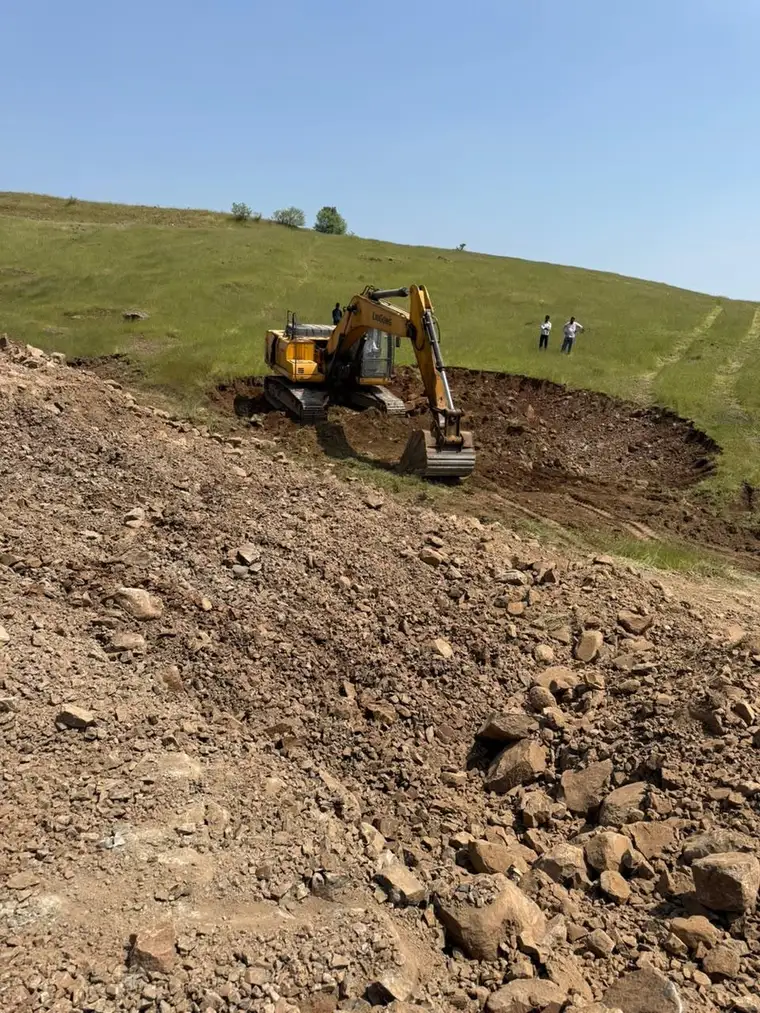
A pavement is blamed from the top and fails from the bottom. The rut appears in the bituminous course, the patch goes on the bituminous course, and the cause sits 600 mm lower, in a layer of soil that was signed off on a density result months before.
This article covers what the sub-grade is, how the sub-grade CBR value is measured and turned into a design number, what sub-grade compaction MoRTH asks for, and what happens above when either falls short. References are to the MoRTH Specifications for Road and Bridge Works, Fifth Revision, and to IRC:37-2018. Check the editions your contract cites.
What the sub-grade is in a road
The sub-grade is the top 500 mm of the prepared foundation immediately below the pavement, whether that foundation is embankment fill or the floor of a cutting. IRC:37 defines it that way, and says it may be in-situ material, select soil brought in for the purpose, or stabilised soil.
Everything above it is bought and laid as pavement: GSB, then WMM, then the bituminous courses. The sub-grade is the last layer of earthwork and the first layer the pavement designer puts a number on. The whole stack is set out in highway pavement layers.
The CBR test: IS 2720 Part 16
CBR stands for California Bearing Ratio. A plunger 50 mm in diameter is pushed into a compacted specimen in a 150 mm mould at 1.25 mm a minute. The load needed to reach 2.5 mm and 5.0 mm penetration is expressed as a percentage of a standard load, 1,370 kg at 2.5 mm and 2,055 kg at 5.0 mm. The 2.5 mm value normally governs. If the 5.0 mm value comes out higher the test is repeated, and if it does so again the 5.0 mm value is the one reported.
For design the specimen is soaked first: 96 hours under water, with surcharge weights on top standing in for the pavement. Soaking represents the worst moisture the sub-grade is likely to see in service. A clayey soil gives a far lower value soaked than unsoaked, so the two are never compared.
How IRC:37 arrives at a design CBR
IRC:37-2018 asks for the CBR to be measured on soil remoulded in the laboratory at placement density, which is at least 97 per cent of the heavy compaction maximum, and at optimum moisture content, then soaked for four days. Each soil type gets the average of at least three specimens. The guidelines add that where rainfall is under 1,000 mm, four-day soaking may be too severe for a sub-grade well protected by thick bituminous layers.
The design value is not the average along the alignment. For expressways, national highways, state highways and urban roads it is the 90th percentile: the value that 90 per cent of the results equal or exceed. Other roads may use the 80th percentile where design traffic is under 20 msa. The weakest tenth of the borrow sets the pavement for the whole length.
The CBR is then converted to a resilient modulus, which is the number the design calculation uses.
CBR of 5% or less: MR = 10 × CBR
CBR above 5%: MR = 17.6 × CBR^0.64
CBR 5% 10 × 5 = 50 MPa
CBR 8% 17.6 × 8^0.64 = 67 MPa
CBR 10% 17.6 × 10^0.64 = 77 MPa
CBR 15% 17.6 × 15^0.64 = 100 MPa
The design modulus is capped at 100 MPa, so soil better than about CBR 15 earns nothing more
Two more rules reach the site. The effective sub-grade CBR should be more than 5 per cent on any road expected to carry over 450 commercial vehicles a day in its year of construction. And where the 500 mm sub-grade is stronger than the embankment under it, the design uses an effective value for the two together, not the CBR of the top layer alone. The 2012 edition put the first rule differently, asking for select sub-grade soil of at least CBR 8 on the same class of road, and contracts written on it still carry that figure.
Sub-grade compaction: 97 per cent, and of what
MoRTH builds the sub-grade under Clause 305, the same clause as the embankment, with tighter numbers.
| Requirement | Value | Where it is |
|---|---|---|
| Field compaction | Not less than 97% of maximum dry density by IS 2720 Part 8 | Table 300-2 |
| Dry unit weight the soil must reach in the laboratory | Not less than 17.5 kN/m³ | Table 300-1 |
| Largest particle | 50 mm ordinarily | Clause 305.2.1.4 |
| Expansive clay | Not allowed in the sub-grade or the 500 mm below it | Table 300-2 |
| Strength | Design CBR at the specified density and moisture | Clause 305.2.1.6 |
| Density testing | One set of ten measurements per 2,000 m² of each layer | Clause 903.2.2 |
Fifth Revision. The embankment below needs 95 per cent and is tested per 3,000 m².
The 97 per cent is of the maximum found by the heavy compaction test, not the light one, and the two differ by enough to turn a pass into a fail. OMC, MDD and the field density test explains both tests and the sand replacement check. Moisture at rolling has to be between 1 per cent above and 2 per cent below optimum.
The clause also reaches below the fill. On a low embankment, where sub-grade level is less than 0.5 m above the ground and the ground is not at 97 per cent, the ground is loosened to 0.5 m below sub-grade level and recompacted. In a cutting, a formation whose density falls short is loosened to 500 mm and recompacted the same way. The layer-by-layer method is in embankment construction as per MoRTH Clause 305.
What a low CBR costs in the layers above
The designer cannot change the traffic. What changes with sub-grade strength is the thickness of granular layer needed to keep the strain on top of the sub-grade inside its limit. Weaker support, thicker GSB and WMM. On a long package that difference is bought by the tonne.
Volume = 1,000 m × 10 m × 0.05 m = 500 m³
Tonnage = 500 m³ × 2.25 t/m³ = 1,125 t
About 1,100 tonnes a kilometre for each extra 50 mm on a 10 m width
The 2.25 t/m³ is a typical compacted density for crushed-stone granular material and moves with the rock. The thickness itself comes out of the IRC:37 design for the project's traffic, not from a rule of thumb, and how much aggregate a kilometre of highway needs works a whole section through. The direction is what matters here: effort spent raising sub-grade CBR comes back as aggregate that does not have to be quarried, crushed and hauled.
Improving a weak sub-grade
- Select borrow. Clause 305 asks for the best available material to be saved for the sub-grade. A separate borrow area of gravelly soil or moorum for the top 500 mm is the usual first answer.
- Stabilisation. Where no soil within reach makes the design CBR, the clause points to stabilisation: lime-treated soil under Clause 402 or cement-treated soil under Clause 403. As a general guide lime suits plastic clays and cement suits sandier soils.
- A stronger upper layer. IRC:37 allows the 500 mm to be built in two layers of different strength, or a strong sub-grade over a weaker embankment, with the design based on the effective value of the combination. Its own worked example puts 500 mm of CBR 20 borrow over CBR 8 embankment and arrives at an effective CBR of about 15. On site the stronger layer is often called a capping layer.
- Drainage. Often the cheapest of the four, and the subject of the next section.
How failure from below shows, and the part water plays
A sub-grade too weak or too loose for its load does three recognisable things.
- Rutting. Channels in the wheel paths, often with the surface heaved up alongside, where the soil has densified or sheared under repeated loads. IRC:37 designs against exactly this by limiting the vertical strain on top of the sub-grade.
- Pumping. Wet fines worked up into the sub-base under traffic, blocking the voids that were meant to drain it. A contaminated GSB holds water against the sub-grade, and the loss of strength feeds itself.
- Settlement at structures. The bump at a bridge approach or over a culvert, where backfill in a confined space went in too thick or was rolled by a machine that could not reach the wall. Clause 305 asks for small vibratory rollers, plate compactors or power rammers there.
Water runs through all three. The design assumes the soaked state, so a sub-grade kept dry is carrying a margin and one kept wet has none. IRC:37 asks for the bottom of the sub-grade to be generally not less than 1.0 m above the water table or high flood level on new roads, and for the drainage and filter layers of the sub-base to run the full width to the embankment slope so that water has a way out. During construction MoRTH requires the surface to be kept at a crossfall that sheds water at all times. A sub-grade left flat through a week of monsoon is not the sub-grade that was tested.
Before the GSB goes down
The checks that protect the pavement are cheap at this stage and impossible later. Density at 97 per cent on every 2,000 m². Level and crossfall. A CBR check on soil remoulded at field density, where the contract asks for one. Soft spots dug out and replaced, not bridged. We prepare sub-grade with graders and rollers we own, under whichever consultant the contract nominates, and most of that work sits alongside one of our plants on the same project. The scope is on the earthwork and excavation page, and questions about the granular layers that go on top belong with aggregate supply.