
HAM, EPC and BOT are usually explained from the lender's side of the table: who puts the money in and who gets it back. A site engineer or a purchase manager meets them differently. The model is why the client's cash arrives in lumps, why one date on the programme cannot move, and why one client asks where your rock comes from and another asks only for your rate.
Definitions first, with the numbers from the model agreements and ministry circulars. Then the part that usually goes unwritten: what each model does further down the chain, to the people making the stone.
EPC, HAM and BOT defined
EPC
EPC stands for engineering, procurement and construction. The authority, which on a national highway is NHAI or the ministry, pays for the road in full. The contractor designs it and builds it for an agreed contract price, paid in stages as defined parts of the work are completed, against the weightages in Schedule H of the agreement. The contractor raises no project finance and carries no traffic risk. What it does carry is the defect liability period: five years for a flexible pavement and ten for a rigid one under the ministry's circular of August 2018. A longer period has been announced since, so read the tender.
HAM
The full form of HAM is Hybrid Annuity Model, approved by the Cabinet Committee on Economic Affairs in January 2016. The authority pays 40 per cent of the bid project cost during construction, released in instalments as physical progress crosses set thresholds: five instalments in the original model agreement, ten in later versions. The concessionaire raises the other 60 per cent as equity and debt and is repaid in half-yearly annuities over a fixed 15-year operation period, thirty of them, with interest on the reducing balance. It maintains the road throughout and is paid separately for doing so. The toll belongs to the authority.
BOT
BOT stands for build, operate, transfer, and it comes in two forms. Under BOT (Toll) the concessionaire finances, builds and maintains the road and recovers its money by collecting toll over a concession period fixed project by project, commonly two to three decades. Where the toll will not carry the cost, the authority can add viability gap funding of up to 40 per cent of the total project cost. Under BOT (Annuity) the concessionaire still finances and builds, but is paid a fixed half-yearly annuity by the authority, which keeps the toll and the traffic risk with it.
The difference between EPC, HAM and BOT
The difference between EPC and HAM, and between BOT and HAM, comes down to three risks: building the road, financing it, and whether the traffic turns up.
| Question | EPC | HAM | BOT (Toll) |
|---|---|---|---|
| Who pays for construction | Authority, all of it | Authority 40%, concessionaire 60% | Concessionaire, less any viability gap grant |
| Who raises the finance | Nobody. The contractor funds working capital only | Concessionaire, for its 60% | Concessionaire, for all of it |
| How the builder is paid | Stage payments against Schedule H | Milestone instalments, then 30 half-yearly annuities | Toll from road users |
| Construction risk | Contractor | Concessionaire | Concessionaire |
| Traffic risk | Authority | Authority | Concessionaire |
| Who maintains the road | Contractor, through the defect liability period | Concessionaire, for 15 years | Concessionaire, for the whole concession |
| How long the builder answers for the pavement | 5 years flexible, 10 years rigid | 15 years from completion | Until hand-back |
BOT (Annuity) sits between the last two columns: financed like BOT, paid like the annuity half of HAM. Figures are from the model agreements and circulars. A particular concession can differ, so read yours.
What the model does to the payment rhythm
A supplier is paid out of the client's cash, and the model decides when the client has any. Under EPC, money follows certified stages. Under HAM, the authority's 40 per cent arrives in a few large instalments, each released only when physical progress crosses its threshold, and the rest of the construction cost is drawn from lenders who watch the same progress. Between two milestones the builder is spending without being paid.
Two things follow for whoever supplies the stone. The first is that aggregate is consumed ahead of the money. GSB and WMM go down early and are most of the tonnage in a pavement, as the worked example in aggregate quantity per kilometre shows, so the supplier's heaviest months come before the client's largest receipts. The second is that the weeks before a milestone are exactly when the client wants the most material and has the least cash.
A supply contract that ignores this ends in an argument about credit. One that states the billing cycle, the credit period and what happens to dispatch when a bill is overdue does not. Under BOT (Toll) there is no authority money during construction at all unless a grant has been given, so the same rule applies with more force.
Where the programme pressure comes from
Every highway contract has a completion date. What differs is what the date costs. On EPC the pressure is contractual: milestones, and damages for missing them. On HAM it is financial as well, because annuities do not begin until the road is complete, the debt draws interest all through construction, and the next instalment of construction support waits on physical progress. On BOT (Toll) for a new road the revenue itself waits, because tolling starts when the road opens.
At the plant all three arrive as the same demand: more tonnes, sooner, in the dry months. The difference is how sharp the peak is. Where a client's cash is tied to physical progress, expect the monthly call-off to be lumpy, and size capacity and stock for the peak month and not the average. That sum is done in what TPH a package needs.
Who cares about quality, and for how long
Every model tests the aggregate to the same MoRTH limits. What changes is who lives with the result. An EPC contractor answers for a flexible pavement for five years after completion. A HAM concessionaire maintains the road for 15, so a base course that gives trouble in year eight is its own cost. A BOT (Toll) concessionaire has the longest view of all, and pays for every repair out of its own toll.
That changes the conversation with a supplier. A buyer with a five-year horizon asks whether the material passes. A buyer with a fifteen-year horizon asks where the rock comes from, whether the face will be the same in month twenty as in month two, how flakiness is controlled at the crusher, and who is pulling the samples. Those questions are set out as a list in the aggregate supplier checklist. Consistency of source becomes something worth paying for.
Why concessionaires contract a plant for the life of a package
Put the three together: a completion date with money riding on it, a call-off that peaks before the cash does, and a fifteen-year interest in what goes into the road. Buying aggregate by the load from the district market answers none of them. A plant dedicated to the package does. Its capacity is committed and cannot be outbid by another buyer in a busy month, it stands on or near the alignment so the lead is short, and it is set to the contract gradings and fed from one face, so the material in the last kilometre is the material that was approved for the first.
Whether the concessionaire owns that plant or brings in an operator with one is a separate decision, weighed in owning a crusher plant or contracting one. The contract model pushes towards having a plant. It does not say whose.
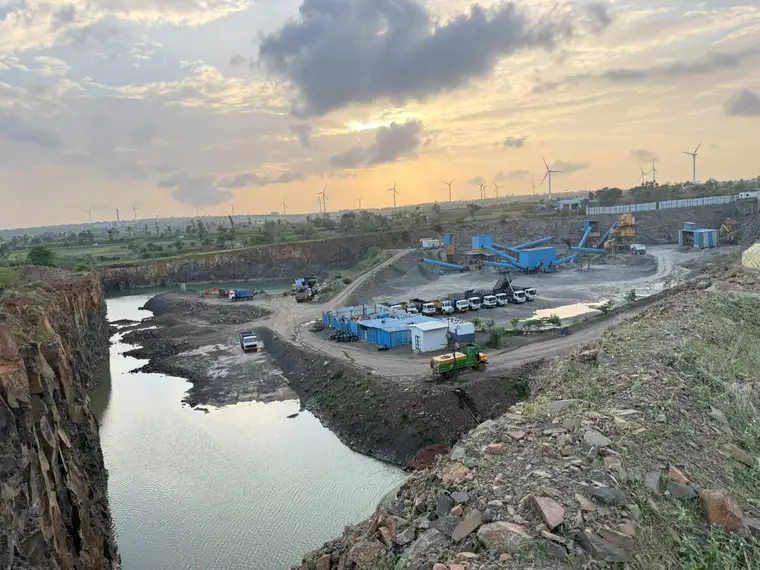
The Ujjain to Jaora greenfield highway for MKC Infrastructure is this arrangement at work. It is a 98.73 km access-controlled package on Hybrid Annuity Mode, the largest single package on our project list, and we run mining and crushing for it on a 250 TPH three-stage plant producing GSB and aggregate for the four-lane paved shoulder works.
What to settle before the first load
Whatever the model, write four things down with the supplier at the start: monthly quantities by product against the programme, the billing cycle and credit period, what is allowed to move the rate, and who tests what. Give the milestone dates along with the grading, because they show where the peak months fall. If the package is long enough to carry a dedicated plant, we move one of ours onto the site and run it, which is described under crusher plant operations. If it is a haul from an existing plant, that is aggregate supply.