
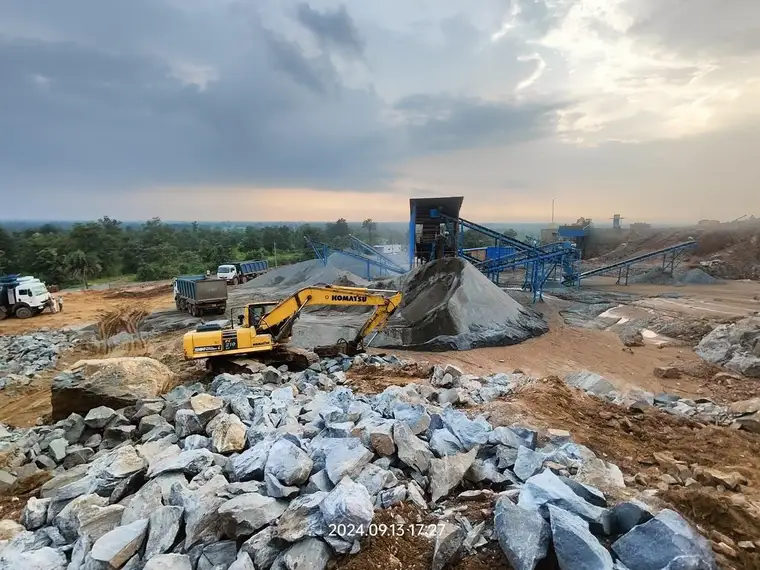
A purchase desk comparing a stone crusher plant on hire with a plant of its own usually starts from the wrong number. It starts from the price of the machine. The price matters, but it is one line of nine, and it gets divided by a figure nobody has written down yet: how many tonnes that plant will make before it stops being yours.
This page sets out the structure of the sum, an owned plant against a crusher plant contractor's rate, for a highway package. There are no rupee figures in it, deliberately. Steel, diesel, liners and interest all move, and a stone crusher plant cost that was right in one district last year is wrong in the next. The structure does not move.
Three deals that get called a stone crusher plant on hire
Three different arrangements answer to the same search, and they put the risk in three different places.
- Bare hire. You rent machinery by the month. You erect it, staff it, feed it, power it and replace what wears. A month in which it makes nothing costs the same rent as a month in which it makes thirty thousand tonnes.
- Operate and maintain. The plant is yours and somebody else's crew runs it, for a fee. Capital and idle time stay with you. Operating skill, and usually the routine maintenance, move to the operator.
- Contract crushing. The contractor brings the plant, erects it, staffs it and maintains it, and is paid per tonne of finished material that passes the grading and crosses the weighbridge. This is our crusher plant operations service, and the arrangement the rest of this page compares with owning.
The cost heads of owning a plant
Every one of these exists whether or not anybody has put a number against it. They are of two kinds: costs spent once or by the month, and costs that rise with every tonne.
| Cost head | Kind | What moves it |
|---|---|---|
| Capital: purchase, interest, depreciation | Fixed | Plant size and make, how it is financed, what it sells for at the end |
| Lease or other source of rock | Fixed, plus royalty per tonne | Whose lease it is and how long it runs |
| Clearances and consents | Fixed, and slow | State rules; whether the site is one a crusher is allowed on |
| Erection: foundations, structure, electricals, belts | Once per site | Access, ground, how far the plant has travelled |
| Plant crew | By the month, all year | Whether operators, fitter and electrician are kept between projects or rehired each time |
| Wear parts: jaw plates, cone liners, screen mesh, belts, bearings | Per tonne | How hard and abrasive the rock is, and the product split |
| Power or genset diesel | Per tonne | Grid connection or DG sets; how much fine product is asked for |
| Idle months | Fixed cost with no tonnes under it | Monsoon, land not handed over, the gap after the road is finished |
| Moving it or selling it | Once, at the end | Distance to the next job, or the second-hand market that year |
Feeding the plant (drilling, blasting, loading and the haul to the hopper) is a separate sum under either arrangement and is left out of both sides here.
The two per-tonne lines are the ones people estimate best, because they turn up in every month's accounts. The fixed lines are where owned plants go wrong: a crew paid through four idle months, consents that took a season to obtain (see licences and clearances a stone crusher needs), a plant standing on a finished project waiting for a buyer. Those costs land on tonnes already sold.
Utilisation is the number that decides it
Capital per tonne is not the price of the plant divided by its nameplate. It is the price, less whatever the plant fetches at the end, divided by the tonnes it produces while you own it. So the real question is what share of the plant's working life one package can use.
Our planning figure for a 250 TPH three-stage plant is 25,000 to 30,000 MT a month on two shifts, a long way under the nameplate arithmetic for reasons set out in what TPH crusher plant a highway package needs. The package quantity and the ten-year life below are assumptions for illustration.
Plant, sustained output = 27,500 t a month
One year of twelve months = 27,500 × 12 = 330,000 t
Working life, assumed 10 years = 330,000 × 10 = 3,300,000 t (33 lakh)
Package requirement, assumed = 750,000 t (7.5 lakh) over 30 months
Utilisation by the package = 750,000 ÷ 3,300,000 = 23 per cent
One package uses under a quarter of what the plant could make
Bought for that package alone and written off at the end of it, the plant loads each tonne with more than four times the capital it would carry if it were kept busy for its whole life. The other three-quarters is the entire argument. If the plant has another package to go to the month this one ends, in the same district, with the same crew, the capital spreads across all of them and owning starts to make sense. If it has nowhere to go, the choice is between selling into a market that knows you have to sell, and storing it while paying the people who know how to run it.
A fixed plant lasts if it is looked after: our first, at Asotra in Barmer, was commissioned in 2008 and is still in production. But that is a quarry plant on our own lease with a market around it, not a plant bought for one road.
How a crushing contract rate is built
A crushing contract is quoted per tonne of finished material, against a grading and a monthly volume. The contractor is doing the same sum as the one above with one difference: the plant goes on to another site afterwards, so each package is charged its share of the capital and not the whole of it.
What sits inside the rate and what sits outside it is the part to read twice. On our contracts:
- Inside the per-tonne rate: erection and commissioning, operators and the plant crew, maintenance and breakdown repair, and wear parts.
- Outside it, depending on whose lease the rock comes off: power or genset diesel, royalty, and transit passes.
Other contractors draw the line elsewhere, so get it in writing before comparing two rates. A low rate with wear parts outside it is not a low rate in basalt.
Four things move a quoted rate more than the make of the plant does. Monthly volume, because the crew and the capital cost the same in a thin month. The length of the job. The product split, since a contract heavy in 10mm and dust sends more of the stream round the tertiary circuit and fewer tonnes off the belts. And the rock: hard basalt is heavy on liners, and the wear-part allowance in the rate follows it (how long crusher wear parts last).
Who carries which risk
| Risk | You own the plant | You contract the crushing |
|---|---|---|
| Capital tied up in the plant | You | Contractor |
| Breakdown and lost production days | You | Contractor |
| Wear-part consumption in abrasive rock | You | Contractor, inside the rate |
| Finding and keeping operators | You | Contractor |
| Material failing the grading at the plant | You | Contractor |
| Price of power or diesel | You | Usually you, since it sits outside the rate |
| Royalty, transit passes, the lease staying valid | You | Whoever holds the lease, usually you |
| Months with no laying: monsoon, land not handed over | You, in full | Shared, through the minimum quantity or standby terms |
| The plant after the last tonne | You: move it, store it or sell it | Contractor takes it away |
A contract moves risk. It does not delete it. The rows marked contractor are the rows that make up the rate.
When owning honestly wins
Owning wins when the plant will be busy for most of its life and the people to run it are already employed. In practice that means one of four situations.
- A long-life quarry. A lease with years of reserve and a market around it, selling to more than one buyer. The plant never moves, the consents are obtained once, and utilisation is as high as the market allows. Our own plants at Bara in Uttar Pradesh and Asotra in Rajasthan are this case.
- Back-to-back packages in one district. The plant shifts a short distance, the crew stays together and the gap between jobs is weeks.
- An in-house plant team. A plant manager, fitters and an electrician who have run this plant before, and a spares store that already exists. Without them an owned plant is a bare hire you cannot hand back.
- A plant you already own. The capital is spent. The only open question is whether to run it yourself or have it run, and we operate client-owned plants with the same crews and maintenance discipline as our own.
Contracting wins in the commoner case: one package of two to three years, a start date that hangs on land being handed over, no plant team, and capital that has pavers and a hot-mix plant competing for it. It also wins on time. About a month from order to steady production is quicker than buying, clearing and erecting a new plant.
There is a third answer. If the road head is inside about 60 km of one of our plants, neither may be needed: a delivered rate for aggregate supply is usually competitive at that lead, and the plant question only opens beyond it. The crossover is worked through in lead distance and the aggregate rate.
What to put on the table before asking for a rate
A crushing rate can be quoted properly against six facts: where the site is, whose lease the rock comes off and whether it is cleared, the rock type, the gradings with the monthly tonnage of each, the month laying starts, and whether grid power reaches the plant location. With those, the inside and outside lines can be fixed on the first call, and the comparison with a plant of your own becomes a sum instead of an argument. What we bring and what we carry is set out on crusher plant operations. If you already own a plant that is standing idle, ask about having it run.