
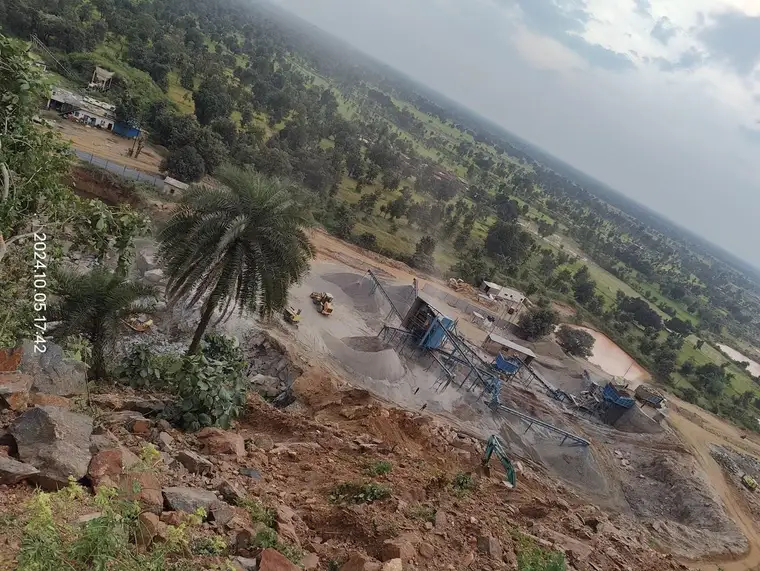
The question arrives as a single number: what TPH crusher plant does this package need. Somebody multiplies a nameplate by sixteen hours and twenty-six days, finds that a modest plant covers the whole job twice over, and orders accordingly. Four months later the paver is standing, waiting on WMM.
A crusher plant capacity calculation done properly starts from the other end: the tonnes the road needs, the months in which it can be laid, and the output a plant holds over a season. The rating in TPH comes last.
TPH meaning, and what the rating leaves out
TPH means tonnes per hour. On a crusher plant it is the rate at which the primary can accept feed and the rest of the line can pass it, quoted by the manufacturer for a stated rock, feed size and crusher setting. Change any one of the three and the figure changes. A plant that passes 250 tonnes an hour of a softer stone into a coarse product will not pass 250 tonnes an hour of hard basalt while making 10mm chips.
It is also a rate, not a quantity. It describes an hour in which everything is running, fed and discharging. It says nothing about how many such hours a month contains.
Crusher plant production per day, on paper and on site
The paper sum takes a minute.
200 TPH × 8 h = 1,600 t a shift
200 TPH × 16 h = 3,200 t a day on two shifts
250 TPH × 16 h = 4,000 t a day on two shifts
250 TPH × 16 h × 26 days = 104,000 t a month
104,000 tonnes a month, on paper, from a 250 TPH plant
Now the figure we plan on. A single 250 TPH three-stage plant holds 25,000 to 30,000 MT a month on a normal two-shift pattern. Spread over the same 26 days that is roughly 950 to 1,150 tonnes a working day, against 4,000 on paper.
No factor turns the first number into the second, and anybody offering one is guessing. The ratio is different for every rock, every product list and every site. What can be said honestly is where the hours go.
Where the hours go
- Feed gaps. The plant runs at the rate the face delivers. A tipper queue at the hopper, an excavator down, a blast that came out blocky and has to be broken at the grizzly: the jaw idles through all of it. Fragmentation alone moves a shift's output a long way, which is the subject of blast fragmentation and crusher output.
- The product split. Rock breaks into its own natural spread of sizes, and a road does not want that spread. A contract heavy in 20mm and 10mm, or one that needs a low-fines GSB, sends a large share of the stream back round the tertiary circuit. Every tonne going round occupies crusher and screen capacity without becoming a tonne on a stockpile.
- Deck changes. Moving between GSB, WMM and single sizes means changing meshes and settings. That is hours out of a shift each time, and on a package drawing several products it happens often.
- Wear-part stops. Jaw plates are turned and replaced, cone liners changed, screen mesh patched, belts repaired. On a well-run plant these are planned stops. They are still stops.
- Stockpile room. When a product heap reaches the head of its conveyor, the plant either stops or makes something nobody has asked for.
- Dispatch. A plant produces into the yard and the yard empties onto tippers. If the road head cannot take material that week, or the tippers are elsewhere, the yard fills and the previous point takes over.
Then come the ordinary subtractions: shift changes, meals, greasing, power cuts on a grid connection, rain. A sustained monthly figure has all of it inside, which is why it is the only capacity number worth planning against.
Sizing the plant from the programme
Four inputs size a plant: total demand, the months available for laying, the peak month, and the stock that can be carried into it.
Total demand comes from the take-off, layer by layer; the method is in how much aggregate a kilometre of highway needs. Laying months are fewer than calendar months. Bituminous work and most earthwork stop in the rains, so a year offers something like eight laying months, depending on the region, and the programme will show demand bunched into them. The quantities below are assumed for illustration.
Requirement this year, assumed = 300,000 t
Laying months, October to May = 8
Demand in a laying month = 300,000 ÷ 8 = 37,500 t
Plant, sustained = 27,500 t a month
Short in each laying month = 37,500 - 27,500 = 10,000 t
Short over eight months = 10,000 × 8 = 80,000 t
Needed from four wet months = 80,000 ÷ 4 = 20,000 t a month
One plant covers the year only if it carries about 80,000 t of stock into October
So the annual total fits, and the plan still fails unless two more things are true. The plant has to keep producing through the monsoon, when wet feed blinds the lower decks and the face may be under water; that is decided by quarry monsoon planning. And there has to be somewhere to put the stock.
Stock to carry = 80,000 t
Loose bulk density, typical = 1.6 t/m³
Volume = 80,000 ÷ 1.6 = 50,000 m³
At 5 m average stacking height = 50,000 ÷ 5 = 10,000 m²
About a hectare of stockpile floor, before haul lanes and loader room
Loose crushed aggregate usually stacks at 1.5 to 1.7 tonnes per cubic metre depending on the size and the rock, so use your own figure once the plant is running. The stacking height is whatever the product conveyors and the loader can build.
The peak month is the last check. Demand inside the laying season is not level: sub-base and base run ahead, bituminous aggregates follow, and the months where they overlap are the ones the plant is really sized for. Read the peak off the programme and set it against sustained output plus what the stock can release in that month. If it does not close, the answer is more plant, more stock or a longer programme. There is no fourth option.
When two plants beat one big one
A second plant of the same size often serves a package better than one plant of twice the rating, for practical reasons.
- Feed. A plant is only as big as the face behind it. Doubling the rating means doubling the drilling, blasting, loading and haul out of one quarry, and one lease may not have the bench length for it.
- Lead. On a long package two plants can sit towards either end, and the saving in haulage is often larger than any saving in crushing. The sums are in lead distance and the aggregate rate.
- Cover. With one plant, a failed cone stops the road. With two, it halves the supply for a shift.
- Products. One plant can stay set for GSB and WMM while the other makes single sizes, which takes most of the deck changes out of both.
- The tail. Demand falls away in the last months of a package. One of two plants can leave early.
The case for a single larger plant is the mirror image: one lease, one set of consents, one crew, one weighbridge, one source for the quality engineer to approve. Where a single quarry with a long face sits near the middle of the package, that is usually enough to win.
What to send for a plant recommendation
A plant can be matched to a package from the layer quantities, the laying programme by month, the rock, the gradings and where the lease is. If the requirement is more than one plant will hold, say so early, because plants are allocated a season ahead. We run six, at 250 to 350 TPH, and the total across the fleet is up to 120,000 MT a month, which is a sustained figure and not six nameplates added together. The arrangement is described on crusher plant operations, and what the plants make on stone crushing.