
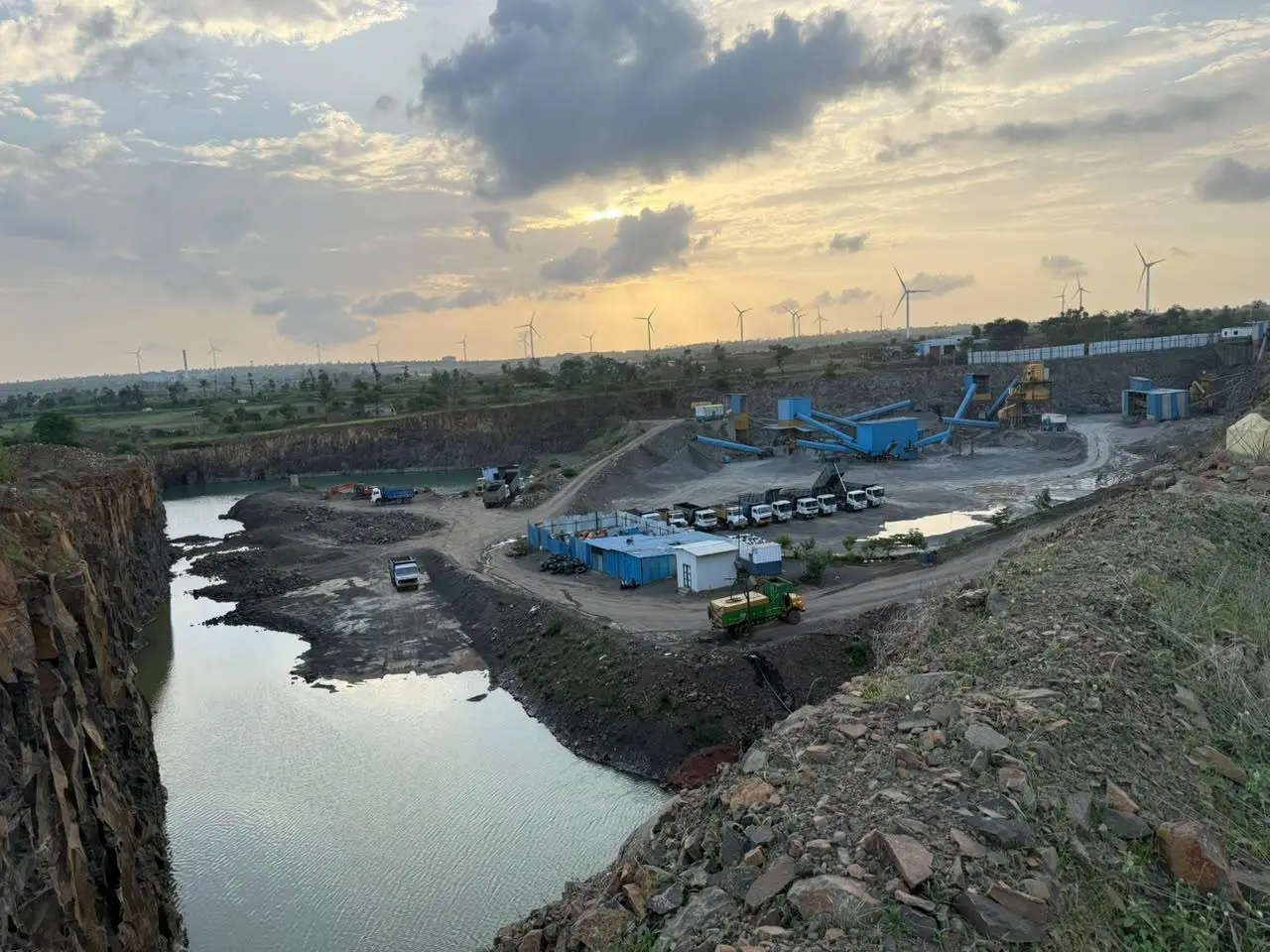
Appointing an aggregate supplier for a highway project looks like a rate comparison. Three quotations, one column, lowest wins. Then the monsoon ends, the programme compresses, and the lowest rate turns out to belong to a plant that cannot hold the tonnage, a quarry whose transit passes do not cover what was delivered, or a weighbridge the client's engineer will not accept.
This checklist is written for the purchase desk. Each line says what to ask a vendor for and what goes wrong when nobody asks.
What an aggregate supplier for a highway project has to prove
An aggregate or GSB supplier for a highway package has to prove four things: that the stone is lawfully mined, that the plant can make the monthly quantity to the contract grading, that it can be delivered on the programme, and that every load can be weighed and tested in a way the engineer will accept. The ten checks below are those four, broken into things you can ask for on paper or go and see.
| Check | What to ask for | Why it matters |
|---|---|---|
| Source of stone | The lease or quarry permit, its validity and area, and recent royalty-paid transit passes | Unpaid royalty is recovered from the contractor's bill |
| Clearances | Environmental clearance for the lease and consent to operate for the crusher | A plant shut by notice supplies nothing |
| Plant capacity | Dispatch records for the last three months, by product | Nameplate TPH is not monthly tonnage |
| Haulage | Whose tippers they are, and the route to your chainage | Market hauliers leave for a better-paying load |
| Weighbridge | The current Legal Metrology verification certificate | The slip is the bill |
| Test reports | Source approval tests, then reports at the contract frequency | A failed layer costs more than the stone in it |
| Opening stock | Tonnes on the ground, by product, on your start date | The first weeks of laying come out of the stockpile |
| Rate basis | What is included, and the rule for lead, diesel and royalty | A low rate with open terms is not a low rate |
| Vendor documents | GST, PAN, registration and bank details, and work orders | Vendor registration, and proof the firm has done it before |
| Fallback | A second plant or source, and how quickly it can take over | Breakdowns and closures come in the laying season |
The source: lease, royalty and transit passes
Building stone is a minor mineral. Under Section 15 of the Mines and Minerals (Development and Regulation) Act, 1957, each state writes its own rules for leases, royalty and transport, and Section 4(1A) of the same Act forbids anyone to transport or store a mineral except in accordance with them. On the road that comes down to one document: every tipper leaving a quarry or a crusher carries a transit pass showing royalty paid on that load.
It matters to the buyer because of who gets asked for the passes. On public works the executing agency checks royalty when it passes the contractor's bill. In Uttar Pradesh, for example, the pass is Form MM-11, issued electronically since 2017, and a state order of October 2015 has the agency deduct the royalty and the cost of the mineral, ordinarily taken as five times the royalty, from the contractor's bill where the forms are not produced. Other states use other forms and other multiples, so check the current notification for yours. The principle travels. The liability lands on the contractor, long after the supplier has been paid.
So ask for the lease, and ask for a handful of recent passes. Check that the lessee, the mineral and the quantities match what you are being offered. How the system works is set out in quarry lease, royalty and transit pass, and the crusher's own permissions in stone crusher licence and clearances.
Plant capacity against your monthly need
The figure on a crusher's nameplate is tonnes per hour at the feed, on a good day. What you need is tonnes per month, of your product, through breakdowns, liner changes, power cuts and rain. Our own planning figure is a fair yardstick: a 250 TPH three-stage plant holds 25,000 to 30,000 MT a month on a normal two-shift pattern. Put the vendor's plant against your peak month, not your average.
Peak month on the programme (assumed) = 45,000 t
One 250 TPH plant on two shifts = 25,000 to 30,000 t a month
Shortfall = 15,000 to 20,000 t a month
The gap has to come from stock, a third shift or a second plant, and the vendor should say which
Ask for capacity by product as well. A plant turns out a spread of sizes fixed by its crushers and its screen decks, so a vendor selling you mostly 20mm and 10mm for bituminous work makes fewer tonnes of those than the plant total suggests, and has to find a buyer for the rest. Dispatch records by product for the last three months answer the question better than any brochure. The arithmetic of sizing is in what TPH a package needs.
Fleet, weighbridge and test reports
Whose tippers. A supplier with its own fleet controls the delivery. One who hires from the market controls only the stockpile, and a market haulier takes your load until a better-paying one appears. Ask who owns the vehicles and what the route to your chainage is, because the distance sets the number of trips a tipper can make and so the rate. That is worked through in lead distance and the delivered rate.
The weighbridge. The slip is the quantity you pay for. Weighbridges are verified and stamped by the state Legal Metrology department, and under Rule 27 of the Legal Metrology (General) Rules, 2011 an instrument of this kind falls due for re-verification every 12 months. Ask for the current certificate and read the due date on it. Then agree, before the first load, how a disputed weight is settled: usually a check-weigh at a second bridge and a tolerance written into the order.
Test reports. Before the first load there should be a source approval set on the actual rock: grading, aggregate impact value, combined flakiness and elongation index and water absorption, with liquid limit, plasticity index and CBR for GSB. The limits are in aggregate tests and their MoRTH limits. After that, MoRTH Section 900 sets minimum frequencies. Table 900-3 asks for WMM to be tested for grading every 200 m³, for combined flakiness and elongation every 500 m³ and for impact value every 1,000 m³ of aggregate, and for GSB to be tested for grading and Atterberg limits every 400 m³.
Stock, the rate and what moves it
Laying starts faster than a plant can ramp up. Ask how many tonnes of each product will be on the ground on your start date, and go and look at them. A stockpile that exists is worth more than a production forecast.
Then read the rate line by line. A delivered rate should say that it covers the material, loading, royalty and the other levies on the mineral, haulage to a named point, and unloading, with GST shown separately. Lead, diesel and royalty are what move it after signing, and a fourth is worth writing down with them.
- Lead. The delivery point travels along the package. The order needs either named chainages or a slab of distances with a rate against each.
- Diesel. A formula tied to a published pump price, with the base date stated.
- Royalty. Revised by state notification from time to time. Payable at actuals against the pass is the cleanest wording.
- Quantity. If the monthly call-off falls well below what was promised, the vendor's cost per tonne rises. Say what happens then.
A fixed rate that is silent on all of these will be reopened the first time one of them moves, and it will be reopened in the middle of your laying season.
Documents and fallback capacity
Vendor registration wants the usual set: GST registration, PAN, the incorporation or registration number, and bank details. Add evidence that the firm has supplied a highway package before, which means purchase orders and completion certificates from named contractors that you can verify with a phone call.
Last, ask the uncomfortable question. A single plant on a single quarry is one cone failure or one district closure away from supplying nothing. A vendor with more than one plant can say where the tonnes would come from. One without should say how much stock it will carry instead, and you should price that answer into the comparison.
Running this checklist on us
Sansar Infra LLP was incorporated in 2015 under the Limited Liability Partnership Act 2008 and has traded since 2000 as JSS Construction Company. GST, PAN, LLPIN and bank details are supplied on request for vendor registration. Purchase orders and completion certificates from PNC Infratech, MKC, Kaluwala and others are available for verification. Material comes off our own plants and off plants we run on client sites, on our own tippers, with a weighbridge slip against every load. Send the grading, the monthly quantity, the chainage and the start date through the aggregate supply page, and ask for whichever of the documents above you want to see first.