
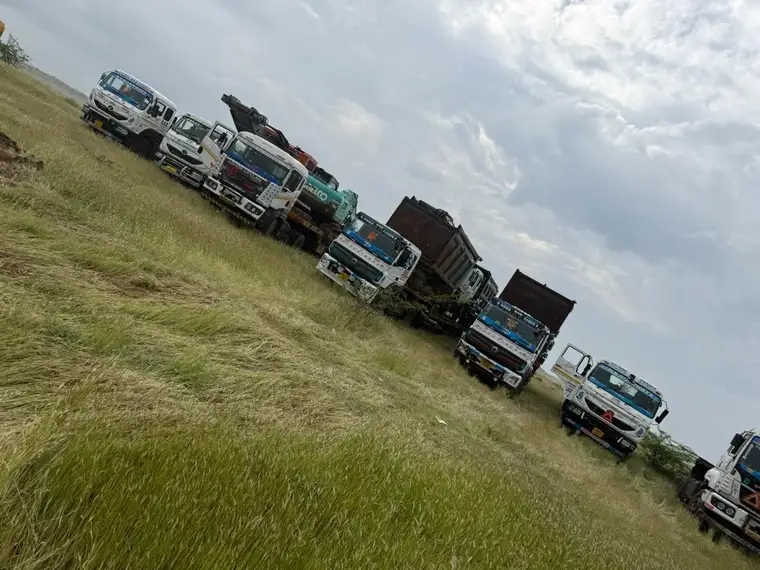
A delivered aggregate rate has two parts. One is what the stone costs to make, which hardly changes from one customer to the next. The other is what it costs to carry, and that changes with every kilometre between the stockpile and the paver. The trade word for that distance is lead, and on most highway packages lead distance decides more of the delivered rate than the crusher does.
What follows is what lead and lift mean, how a longer lead turns into fewer tipper trips, what else moves the rate, and the point at which it stops making sense to haul at all.
Lead distance, meaning and measurement
Lead is the horizontal distance over which material is carried from where it is excavated or loaded to where it is placed. Lift is the vertical height through which it is raised on the way. The pair comes from earthwork measurement, where a basic item rate covers a short initial lead and lift, 50 m and 1.5 m in the CPWD pattern of items, and anything beyond is paid as extra lead.
In aggregate supply the lift drops out and the lead is counted in kilometres: the road distance from the plant's weighbridge to the place the tipper unloads. Four things about it cause most of the arguments.
- It follows the road a loaded tipper can use. Lead is measured along the shortest practicable route, not the straight line on the map and not the route a driver happens to prefer. A bridge with a weight restriction or a town with no-entry hours changes the lead without moving either end.
- It moves. The plant stays where it is and the laying point travels along the alignment, so the lead on the day the order is signed is not the lead six months later.
- It is quoted one way and driven both ways. A 30 km lead is 60 km of running for every load.
- On a linear job it is an average. Nobody delivers a highway to one point.
That average is simple geometry. With material needed evenly along a package, it depends only on where the haul road from the plant meets the alignment.
Plant joins at the mid-point = 60 km ÷ 4 = 15 km average along the road
Plant joins at one end = 60 km ÷ 2 = 30 km average along the road
Either way, add the distance from the plant gate to the alignment
A plant feeding in at the middle halves the average haul along the road
How tipper trips per shift fall as lead grows
A tipper's day is a fixed number of minutes, and lead decides how many round trips fit into them. The assumptions below are for illustration. Replace them with a stopwatch on your own route.
- Payload: 20 tonnes a load, about what a four-axle tipper carries inside its legal gross weight.
- Speed: 30 km/h loaded and 40 km/h returning empty, averaged over the whole route including villages and the site road.
- Fixed time: 30 minutes a trip for everything that is not travel, meaning queueing, loading, the weighbridge, tipping and turning.
- Shift: 540 productive minutes.
Loaded haul = 20 km ÷ 30 km/h = 40 min
Empty return = 20 km ÷ 40 km/h = 30 min
Fixed time = 30 min
Cycle = 40 + 30 + 30 = 100 min
Trips = 540 min ÷ 100 min = 5.4, so 5 trips
Delivered = 5 trips × 20 t = 100 t
Five trips and 100 tonnes a tipper a shift at 20 km
| Lead | Cycle time | Trips possible | Trips made | Tonnes a tipper a shift | Tipper-shifts per 1,000 t |
|---|---|---|---|---|---|
| 10 km | 65 min | 8.3 | 8 | 160 | 6.3 |
| 20 km | 100 min | 5.4 | 5 | 100 | 10 |
| 40 km | 170 min | 3.2 | 3 | 60 | 16.7 |
| 60 km | 240 min | 2.25 | 2 | 40 | 25 |
| 80 km | 310 min | 1.7 | 1 | 20 | 50 |
Trips made is trips possible, rounded down. At 80 km a second trip needs about 80 minutes of overtime. Whether the driver and the road allow it is a local question.
Read the last column. A thousand tonnes takes about six tipper-shifts at a 10 km lead and twenty-five at 60 km. The stone is the same. The truck, the driver and the diesel behind each tonne have gone up four times.
Two things in the table are easy to miss. Trips come in whole numbers: at 60 km there is time for two and a quarter, the tipper makes two, and the quarter is lost unless the shift is stretched. That is why a delivered rate climbs in steps, and why a few kilometres either side of a step matter more than the same few kilometres anywhere else. And fixed time only counts on a short lead. At 10 km it is 30 minutes in 65, so five minutes saved at the loader buys a ninth trip. At 60 km it is 30 in 240 and buys nothing.
The full method, with queueing and the number of tippers one loader can keep busy, is in sizing a tipper fleet from cycle time. What a tipper holds by weight and by volume is in tipper capacity in tonnes and cubic metres.
What else moves a delivered rate
Distance is the first term. These are the others, and none of them shows on a map.
- The empty return. A tipper carrying aggregate comes back with nothing. Every kilometre of lead is paid for twice, whatever unit the haulage is quoted in.
- Road condition. Average speed is the figure that differs most between two routes of the same length. At 15 km/h loaded and 20 km/h empty, a 20 km lead on a broken road has the 170 minute cycle of a 40 km lead on a good one, and it takes the difference out of tyres and springs as well.
- Payload and the axle-load rules. Gross weight is fixed by notification under Section 58 of the Motor Vehicles Act. Since 2018 the limits are 7 tonnes on a steer axle with two tyres and 21 tonnes on a rear tandem, which makes 28 tonnes gross for a three-axle tipper and 35 tonnes for a four-axle one with twin steer axles. Payload is that less the tare. A rate built on overloaded trips lasts until a vehicle is weighed, because under Section 194 an overloaded vehicle may not move on until the excess is removed.
- Tolls and entry restrictions. A toll is a charge per trip, not per tonne-kilometre, so it weighs heaviest on a short lead with a plaza in the middle of it. No-entry hours in a town do something worse: they take productive minutes out of the shift.
- Diesel. Fuel rises in direct proportion to the running, which is twice the lead. It is the reason a long supply contract carries a diesel clause tied to a published pump price and does not try to hold a haul rate fixed for two years.
Hauling from a fixed plant or putting a plant on the site
Past a certain lead, the cheaper way to shorten the haul is to move the crusher. The comparison has a one-time cost on one side and a saving on every tonne on the other. Take 5 lakh tonnes and the two ends of the table above.
Hauled 60 km = 5,00,000 t ÷ 40 t a tipper-shift = 12,500 tipper-shifts
Hauled 10 km = 5,00,000 t ÷ 160 t a tipper-shift = 3,125 tipper-shifts
Saved = 12,500 less 3,125 = 9,375 tipper-shifts
9,375 tipper-shifts, with their diesel, is what a plant 50 km nearer saves
Against that saving stands the cost of dismantling, moving, erecting and commissioning a plant, opening a face if there is no working quarry, and taking it all away at the end. Divide that one-time cost by the haul saving per tonne and the answer is the break-even quantity. Below it, haul. Above it, every further tonne is cheaper from the plant on site.
Four things decide which side a package falls on. Quantity, because the one-time cost is spread over it. Lead from the nearest existing plant. Duration, since a plant earns its move over months and not weeks. And rock: there has to be a source near the alignment with a lease that can be worked, and the paperwork that goes with it is the most common reason a quarry sits idle with a plant already erected. Who should own that plant is a separate question, taken up in owning a crusher plant or contracting one.
For our own plants the rule of thumb is this. Inside about 60 km, a delivered rate is usually competitive. Beyond that, deploying a plant closer to the site normally beats hauling, and on a site with decent access erecting and commissioning one takes about two weeks.
What to send for a delivered rate
The chainage or nearest town, the material and grading, the monthly quantity, and the date laying starts. The location comes first because it fixes the lead, and the lead tells both sides on the first call whether this is a haul or a plant. Delivered supply on our own tippers is on the aggregate supply page, and a plant on your site is under crusher plant operations.