
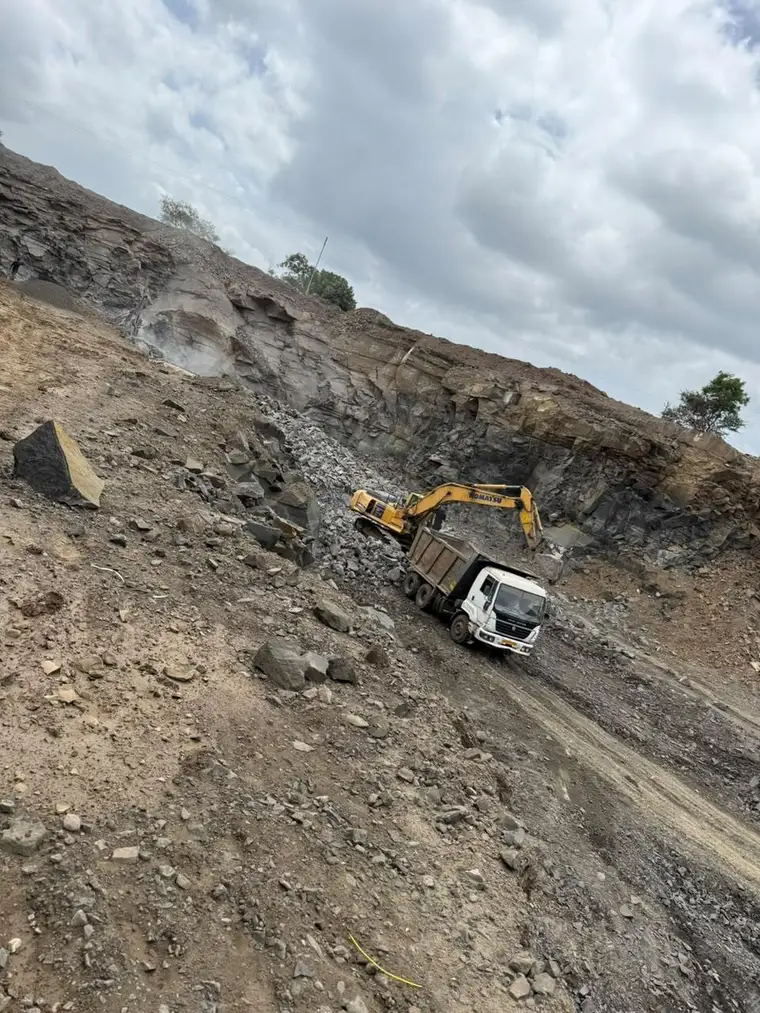
Send too few tippers to a face and the excavator sits with a full bucket in the air while the hopper runs empty and the plant crushes nothing. Send too many and they queue with their engines running. Both can be seen from the site office, and both come from the same sum, done wrongly or not done.
This is how to calculate the number of tippers required for a haul: the parts of a cycle, the tipper cycle time calculation, a table by lead distance, and the excavator and tipper matching underneath it. The figures are for face-to-hopper work in a quarry. The method is the same for an embankment haul or for plant to road head.
What cycle time is and what it is made of
Tipper cycle time is the time from one tipper pulling in under the excavator to the same tipper pulling in again. It has six parts.
- Spot. Reversing in and standing where the bucket can reach. Short where the loading point is laid out for it, long where the tipper has to turn on a cramped bench.
- Load. The number of bucket passes multiplied by the excavator's swing cycle.
- Haul. The lead at loaded speed. The ramp out of the pit decides most of it.
- Tip. Reversing to the hopper or tip head, raising the body, lowering it and pulling clear.
- Return. The same distance, empty and quicker.
- Wait. Queueing at the excavator or at the hopper. On a balanced fleet it is small. It is never nil.
Spot, load, tip and wait are fixed time: they do not change with distance. Haul and return are variable time and grow with the lead. On a short quarry haul the fixed time dominates, and a better loading layout is worth more than a faster truck. On a long haul it is the other way round.
The tipper cycle time calculation
Cycle time (min) = spot + load + haul + tip + return + wait
Trips per hour = working minutes in the hour ÷ cycle time
Tonnes per tipper-hour = payload × trips per hour
Tippers required = tonnes per hour needed ÷ tonnes per tipper-hour, rounded up
Every figure that goes into it is an assumption until someone has stood on site with a watch. These are the ones used below.
- Payload: 16 t, a 10 wheeler at its legal weight. See tipper capacity by axle configuration.
- Spot and load: 1 minute to spot, 3 minutes to load, taken as seven passes at about 25 seconds each.
- Speed: an average of 20 km/h loaded and 30 km/h empty, on a maintained quarry haul road no steeper than the 1 in 16 that DGMS allows.
- Tip and wait: 1.5 minutes to tip and pull clear, and 1 minute of waiting allowed in every cycle.
- Working hour: 50 minutes, to cover fuelling, tea, shift change and the stops nobody plans.
Fixed time = 1 + 3 + 1.5 + 1 = 6.5 min
Haul = 1.5 km ÷ 20 km/h × 60 = 4.5 min
Return = 1.5 km ÷ 30 km/h × 60 = 3.0 min
Cycle time = 6.5 + 4.5 + 3.0 = 14.0 min
Trips per hour = 50 ÷ 14.0 = 3.57
Tonnes/tipper-hour = 16 t × 3.57 = 57 t
Tippers = 200 ÷ 57 = 3.5, so 4
Four tippers running, and a fifth so that a puncture is not a plant stoppage
Trips per shift and tippers needed by lead distance
The same assumptions and the same 200 tonnes an hour, for leads from half a kilometre to ten. A shift is taken as 10 hours on site, which at 50 minutes to the hour is 500 working minutes.
| One-way lead | Cycle time | Trips per tipper per shift | Tonnes per tipper-hour | Tippers needed |
|---|---|---|---|---|
| 0.5 km | 9.0 min | 55 | 89 t | 3 |
| 1 km | 11.5 min | 43 | 70 t | 3 |
| 2 km | 16.5 min | 30 | 48 t | 5 |
| 3 km | 21.5 min | 23 | 37 t | 6 |
| 5 km | 31.5 min | 15 | 25 t | 8 |
| 10 km | 56.5 min | 8 | 14 t | 15 |
Working tippers only. Add spares for breakdowns and tyres. On a public road the speeds, and with them the whole table, change with traffic and the towns on the route.
Read down the last column and the cost of distance is plain. Each extra kilometre of lead adds five minutes to the cycle and, at this tonnage, a tipper and a quarter to the fleet. That is the mechanism behind how lead distance drives the aggregate rate, and on an embankment job it is why the mass haul diagram gets drawn before the fleet is hired.
Excavator and tipper matching
The table assumes the excavator can load whatever is sent to it. It cannot. A machine that needs a minute to have a tipper spotted and three minutes to fill it turns out one tipper every four minutes: 12.5 loads in a 50 minute hour, which is 200 tonnes. That is the ceiling for one loading point at these figures, and it is why the example was set at 200. To move more, open a second loading point with a second excavator, fit a bigger bucket, or shorten the swing by standing the tipper where the excavator turns through a right angle or less.
Bucket passes per tipper are the other half of the match. Four to seven is the range to aim for. With fewer than three, each pass is so large a share of the payload that the last one either short-loads the tipper or overloads it, and a bucket that size punishes the body when it drops rock from height. With more than about ten, the excavator is too small for the truck: the tipper stands for five minutes and a queue forms behind it.
Bucket, heaped = 1.6 m³
Fill factor in blasted rock = 0.85
Loose density = 1.65 t/m³
Tonnes per pass = 1.6 × 0.85 × 1.65 = 2.24 t
Passes = 16 t ÷ 2.24 t = 7.1, so 7
Seven passes at about 25 seconds is the 3 minute load used above
Fill factor is where the blast turns up in the haul. Well-fragmented rock fills a bucket. Slabby oversize bridges across the teeth and leaves it half empty, so the pass count and the loading time both climb. A bench too narrow for the tipper to stand beside the excavator, instead of behind it, does the same thing to the swing, and that was a bench design decision made months earlier.
What under-trucking and over-trucking look like
Under-trucked. The excavator waits. It tidies the muckpile, sorts oversize, or sits with a loaded bucket hanging. The hopper level falls, the feeder is slowed to keep the jaw fed, and the plant's tonnes per hour drop to whatever the tippers bring. The fleet looks efficient because every tipper is always moving. The expensive machines are the ones standing.
Over-trucked. The tippers wait. There is a queue at the excavator and another at the hopper, and tippers arrive in bunches because on a single-lane road the slowest one sets the pace. Diesel burns at idle, and the cycle measured with a watch is longer than the one calculated, all of it in the wait.
The check takes ten minutes. Stand at the loading point and count. If the excavator is waiting more often than a tipper is, add a tipper. If there are usually two or more tippers standing, take one off or open a second loading point. Then time five full cycles and put the real figures into the formula in place of the assumptions.
A bad haul road is a longer lead
Everything above took 20 and 30 km/h as given. On a rutted, unwatered or over-steep road those become something like 12 and 18, and the arithmetic does not care why the tipper is slow.
Haul = 2 km ÷ 12 km/h × 60 = 10.0 min
Return = 2 km ÷ 18 km/h × 60 = 6.7 min
Cycle = 6.5 + 10.0 + 6.7 = 23.2 min
Tippers = 200 ÷ (16 × 50 ÷ 23.2) = 5.8, so 6 in place of 5
Lead with that cycle on a good road = (23.2 - 6.5) ÷ 5 min per km = 3.3 km
The road has added 1.3 km to a 2 km haul, and one tipper to the fleet
That extra tipper is there every shift for the life of the quarry, with its driver, its diesel and its tyres, set against the grader and water tanker time it takes to keep the road. The geometry and surfacing that prevent it are in quarry haul road design.
Sizing the fleet for your haul
Three numbers size a fleet: the tonnes per hour the plant or the paver needs, the one-way lead, and the legal payload of the tipper. Add the excavator's bucket and the loading point can be checked as well. We run our own tippers from face to hopper and from plant to road head, loaded by our own excavators, so the match between the two is ours to get right and not a negotiation between two contractors. If you have a haul to price, send the lead, the monthly quantity and the material, and say what the road is like. The fleet is on the transportation page and the loading end on mining operations.