
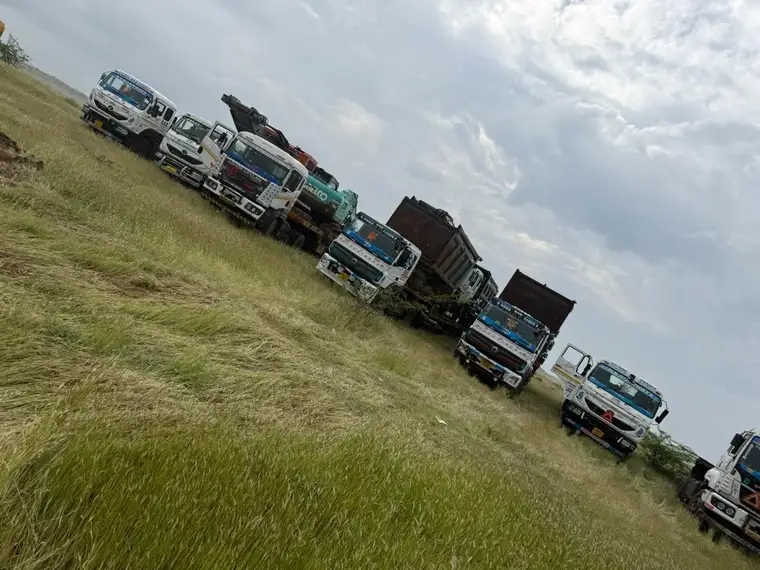
Ask what a 10 wheeler tipper carries and you get a figure in tonnes from one person, a bigger figure in tonnes from the next and a figure in cubic metres from a third. All three are describing the same truck. One is quoting the legal payload, one the load it actually left the quarry with, and one the size of the body. Only the first is a tipper capacity that a weighbridge, a transport officer and a rate per tonne will all agree on.
This article sets out tipper load capacity by axle configuration: the legal gross weight, what is left for payload once the truck's own weight comes off, how many cubic metres the body holds, and why those numbers never line up for stone. The gross weights are statutory. Tare weights and body volumes are typical values drawn from manufacturers' published specifications and move with the make, the body and the wheelbase.
What tipper capacity means: GVW, tare and payload
Tipper capacity is the payload a tipper may legally carry, which is its gross vehicle weight less its unladen weight, both of which are written on its registration certificate. Gross vehicle weight, GVW, is everything on the axles: chassis, body, fuel, driver and load. Unladen weight, or tare, is the truck as registered with its body on and nothing in it.
Section 113 of the Motor Vehicles Act, 1988 makes it an offence to drive a vehicle whose laden weight is above the gross vehicle weight specified in its certificate of registration. So the number that binds a particular tipper is the one on its own RC. Not the brochure, and not what the next truck in the queue is carrying.
Legal gross vehicle weight by axle configuration
A manufacturer does not choose the GVW. It is built up from the maximum safe axle weights that the Ministry of Road Transport and Highways notifies under section 58 of the Act. The current figures came in with notification S.O. 3467(E) of 16 July 2018, which replaced limits that had stood since 1996. It was amended on 6 August 2018, when the weight allowed on a single axle with two tyres, which is the steering axle on every tipper, was brought down from 7.5 to 7.0 tonnes. That amendment is why some articles still quote 28.5 tonnes for a 10 wheeler. The figure that reached the registration certificate is 28.
- Steering axle, two tyres: 7.0 tonnes.
- Single axle, four tyres: 11.5 tonnes.
- Tandem axle on a rigid vehicle, two axles less than 1.8 m apart: 21 tonnes.
- Ceiling for any rigid vehicle: 49 tonnes, whatever its axles add up to.
| Tipper | Legal GVW | How it adds up | Typical tare | Typical payload | Typical body |
|---|---|---|---|---|---|
| 6 wheeler, 2 axles | 18.5 t | 7.0 + 11.5 | 7–8 t | 10.5–11.5 t | 9–12 m³ |
| 10 wheeler, 3 axles | 28 t | 7.0 + 21 | 11–12.5 t | 15.5–17 t | 14–20 m³ |
| 12 wheeler, 4 axles | 35 t | 7.0 + 7.0 + 21 | 13.5–15 t | 20–21.5 t | 18–23 m³ |
| 16 wheeler, 5 axles | 47.5 t | As type-approved, under the 49 t ceiling | 16.5–18 t | 29.5–31 t | 18–29 m³ |
GVW from S.O. 3467(E) as amended on 6 August 2018. Tare, payload and body volume are typical and change with make, body type and wheelbase; read the unladen weight off the RC.
Before July 2018 the first three of those trucks were registered at 16.2, 25 and 31 tonnes. A tipper type-approved before that date carries the higher figure only once the registering authority has revised the GVW on its certificate, which the Ministry asked the states to do in an advisory of 7 August 2018. Look at the RC of an older truck before assuming it is a 28 tonner.
Hyva capacity in cubic metres: the body is not the load
Hyva is a maker of tipping gear whose name the trade uses for any tipper, so hyva capacity in cubic metre terms means the water-level volume of the body: inside length by inside width by side height. Bodies are built for a material. A rock body for shot boulder is short, thick-floored and scoop-ended. A box body for aggregate is longer and taller. A body for coal or other light material is bigger again, because that load is light for its volume.
Manufacturers' listings show the spread. Box bodies of 10.5 and 12 m³ are offered on 18.5 tonne 6 wheelers, 16 m³ on a 28 tonne 10 wheeler with 20 m³ on some variants, 23 m³ on a 35 tonne 12 wheeler, and 29 m³ on a 47.5 tonne 16 wheeler with an 18 m³ body as the alternative. Not one of those can be filled to the top with stone inside the legal weight.
Why one tipper carries different volumes of dust, 20mm and boulder
Payload is fixed in tonnes. Materials differ in loose bulk density, the weight of a cubic metre as it lies in the body with its voids. Typical loose figures for crushed hard rock are about 1.75 t/m³ for crusher dust, 1.55 t/m³ for 20mm aggregate and 1.65 t/m³ for blasted boulder. They shift with the rock's specific gravity, the grading and the moisture, which is worked through in aggregate weight in CFT, brass and tonnes.
Crusher dust = 16.5 t ÷ 1.75 t/m³ = 9.4 m³ (333 cft)
20mm aggregate = 16.5 t ÷ 1.55 t/m³ = 10.6 m³ (376 cft)
Boulder = 16.5 t ÷ 1.65 t/m³ = 10.0 m³ (353 cft)
Body filled level with 20mm = 16 m³ × 1.55 t/m³ = 24.8 t, which is 8.3 t over
Legally loaded, the body is about two-thirds full of stone
Two things follow. A supplier quoting by the brass or the cubic metre and one quoting by the tonne are not offering the same thing, and only the tonne survives a weighbridge. And a tipper that arrives level-full of 20mm has not done the buyer a favour. It is carrying half as much again as its certificate allows, and somebody on the route is carrying that risk.
Overloading under the Motor Vehicles Act
Three sections do the work. Section 113 sets the limit. Section 114 lets an authorised officer of the Motor Vehicles Department send a goods vehicle to a weighbridge and order the excess off-loaded at the driver's risk. Section 194 is the penalty, and the Motor Vehicles (Amendment) Act, 2019 rewrote it with effect from 1 September 2019.
- Overloading. A fine of twenty thousand rupees and a further two thousand rupees for every tonne of excess load, together with the charges for off-loading it.
- Movement. The vehicle is not allowed to move until the excess has been taken off.
- Refusing the weighbridge. A driver who will not stop and submit to weighing, or who sheds load before it, is liable to a fine of forty thousand rupees.
- Load projecting. A load that sticks out beyond the body at the sides, front or rear, or stands above the permitted height, carries its own fine of twenty thousand rupees under section 194(1A), which is where over-dimensional cargo permission comes in.
States collect through their own compounding notifications, so the amount paid at the roadside differs from one state to the next; check the current notification where the tippers run. The fine is the small part. A tipper held at a check-post with half its load on the ground is a missed cycle for the plant and for the paver, and overloaded axles are what wear out the haul road and the public road first.
Choosing a tipper size for the haul
The 10 wheeler is the default from face to hopper and from plant to road head because it fits most quarry ramps and most village approach roads. A 6 wheeler earns its place on narrow roads and short drops where a bigger truck cannot turn. The 12 and 16 wheelers pay on long leads, where one driver and one engine are spread over more tonnes, but they want a wider turning circle, a stronger haul road and a tip head built for the body height.
Size is only half of it. How many of them a haul needs comes from the cycle time, set out in how many tippers a haul needs, and the cycle time comes mostly from the lead and the road: see how lead distance drives the aggregate rate and quarry haul road design.
What to ask before you agree a haulage rate
Ask for three things: the rate per tonne against a weighbridge slip, the GVW and unladen weight on the RC of the tippers that will actually run, and the lead. With those you can work out loads per day yourself and see whether the rate assumes a legal load. Our tippers are Tata and Ashok Leyland, loaded against calibrated weighbridges at the plants, and the dispatch weight on the slip is the billed weight. What the fleet does and where it runs is on the transportation page. If what you need is material delivered by the tonne, start at aggregate supply.