
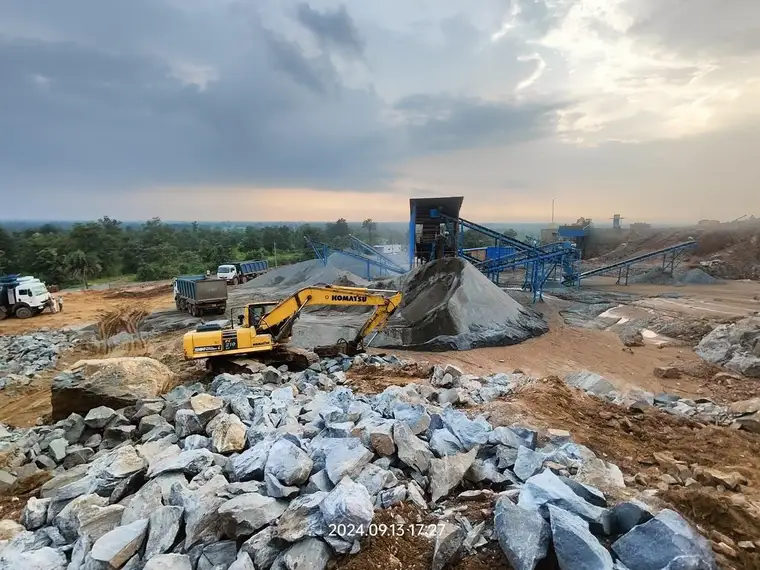
Ask what the layers of a road are and the answer comes back as a string of abbreviations: GSB, WMM, DBM, BC. The string is right. What it leaves out is why there are four of them, why they get dearer as they go up, and which stockpile at the crusher each one empties.
This page takes the layers of a flexible pavement in the order they are built, then the rigid alternative, then who decides how thick each one is. Clause numbers are from the MoRTH Specifications for Road and Bridge Works, Fifth Revision (2013). Check the edition your contract cites. Each section points to the page that covers that material in detail.
The layers of a flexible pavement, in order
A flexible pavement is a stack of layers, each of which spreads a wheel load over a wider area than the one above, so that the soil at the bottom sees a pressure it can carry. Stress is highest at the surface and falls with depth. So the strongest and most expensive material is used thinly at the top, and the cheapest is used thickly at the bottom.
| Layer | MoRTH clause | Its job | Crushed product that feeds it |
|---|---|---|---|
| Embankment and sub-grade | 305 | Foundation. The top 500 mm is the sub-grade | None as a rule. It is earthwork |
| Granular sub-base (GSB) | 401 | Spreads load and drains the pavement | GSB, Grading I to VI |
| Wet mix macadam (WMM) | 406 | Base course. Carries the load | WMM, blended from 40mm, 20mm, 10mm and dust |
| Prime coat | 502 | Seals and binds the WMM surface | None. A sprayed bituminous primer |
| Tack coat | 503 | Bonds one bituminous layer to the next | None. A sprayed bitumen emulsion |
| Dense bituminous macadam (DBM) | 505 | Binder course. The structural bituminous layer | 20mm, 10mm and dust, with 40mm for Grading 1 |
| Bituminous concrete (BC) | 507 | Wearing course. The riding surface | 10mm and dust, with 20mm for Grading 1 |
Embankment and sub-grade: Clause 305
Clause 305 covers embankment construction, and with it the sub-grade and the earthen shoulders. The sub-grade is the top 500 mm of the formation, the part the pavement designer takes a CBR value for. Table 300-2 asks for it to be compacted to at least 97 per cent of maximum dry density by IS 2720 Part 8, against 95 per cent for the embankment beneath.
No crushed stone goes into it as a rule. It still decides how much goes on top, because a weak sub-grade is paid for in thicker granular layers over every kilometre of the package. The clause is set out in embankment construction under MoRTH 305, and the test that governs it in sub-grade CBR and compaction.
GSB and WMM: the granular layers
GSB is granular sub-base, Clause 401. It is the first layer bought by the tonne, and it does two jobs: it spreads the load coming down from the base, and it carries water sideways out of the pavement. The clause allows six gradings, dense ones for load and open ones for drainage, and the contract says which. They are tabulated in GSB Grading I to VI.
WMM is wet mix macadam, Clause 406. It is the base course: crushed, graded aggregate mixed with water in a plant, laid by paver in layers of not less than 75 mm, and rolled to 98 per cent of maximum dry density. It sits directly under the bituminous layers, so it carries most of the load and is the first place a failing road shows it. The grading and the limits on the stone are in WMM under Clause 406.
The two are often confused because both are grey, graded and delivered by tipper. They are not interchangeable. WMM is all crushed rock held to a tighter envelope and tighter tests; GSB may include natural material and is specified partly for how it drains. The comparison is drawn out in GSB against WMM. Between them they are most of the tonnage in a road: close to four fifths on the section worked through in aggregate quantity per kilometre.
Prime coat, tack coat, DBM and BC
Two sprayed coats sit between the layers and are easy to forget because they have no thickness on the drawing. The prime coat of Clause 502 is a thin bituminous primer, normally a slow-setting SS1 emulsion to IS 8887, sprayed on the finished WMM so that it soaks into the surface and binds it. The tack coat of Clause 503 is a light spray of RS1 emulsion that bonds a bituminous layer to whatever is under it: the primed base, or the DBM before the BC goes down. Neither uses a tonne of aggregate. Both decide whether the layers above act as one or slide on each other.
DBM stands for dense bituminous macadam, Clause 505. It is the binder course, a hot mix of graded crushed aggregate and bitumen that does the structural work of the bituminous part of the pavement. Table 500-10 gives two gradings: Grading 1 with a nominal aggregate size of 37.5 mm, laid 75 to 100 mm thick, and Grading 2 at 26.5 mm, laid 50 to 75 mm.
BC stands for bituminous concrete, Clause 507. It is the wearing course, the layer the tyres touch. Table 500-17 gives Grading 1 at a nominal size of 19 mm, laid 50 mm thick, and Grading 2 at 13.2 mm, laid 30 to 40 mm. It is finer and richer in bitumen than DBM, and its aggregate has to meet the tightest limits in the whole pavement on strength and on shape. Those limits are listed in aggregate tests and their MoRTH limits. Shape is the one made or lost at the crusher, which is the subject of flakiness and elongation index.
The rigid pavement alternative: GSB, DLC and PQC
A rigid pavement carries the load on a concrete slab and does not rely on spreading it through a stack. From the bottom it is sub-grade, GSB as before, then dry lean concrete (DLC) under Clause 601 and pavement quality concrete (PQC) under Clause 602.
DLC is a lean, zero-slump concrete laid by paver and compacted by roller, as a firm and even sub-base for the slab. Clause 601 holds its coarse aggregate to a maximum size of 26.5 mm, sets a minimum cement content of 150 kg per cubic metre and asks for an average compressive strength of 10 MPa at seven days. PQC is the slab itself: designed for flexural strength, laid by paver, jointed, and separated from the DLC by a membrane so that the two can move independently.
For a crusher the difference is in the order book. A rigid package has no WMM, DBM or BC in the main carriageway. It wants graded coarse aggregate and a clean fine aggregate for concrete instead, and far more of them than the bituminous layers they replace would have taken, because the concrete layers are much thicker. Whether crusher dust can serve as that fine aggregate is a specification question, covered in crusher dust and M-sand.
Who decides the thickness
Not MoRTH. The specification says what each layer is made of and how it is laid and tested. How thick it is comes from pavement design.
For a flexible pavement the code is IRC:37. It works from two inputs: design traffic in msa, million standard axles, which is the cumulative number of 80 kN axle loads expected over the design life, and the CBR of the sub-grade. More traffic or a weaker sub-grade gives a thicker pavement. For a rigid pavement the code is IRC:58, which checks the slab for fatigue under the spectrum of axle loads it will see, on a foundation whose stiffness is read from the same sub-grade CBR.
On a national highway let on HAM, EPC or BOT it is the builder's own designer who does this, not the authority's, working inside the manual the agreement names, which is IRC:SP:84 for four-laning. The output is a pavement composition table on the drawings. Multiply it by the layer widths and densities and it becomes the material order.
From the layer to the order
Ask a supplier for aggregate and the first thing that comes back is a question. Name the layer and the grading and a rate can follow: GSB Grading V for a drainage layer, WMM to Clause 406, 20mm and 10mm for DBM Grading 2. We produce GSB, WMM, 40mm, 20mm, 10mm and crusher dust on three-stage plants, with the decks set to whatever grading the contract calls for. The products are listed on materials, delivery is on the aggregate supply page, and how the sizes are made is under stone crushing.