
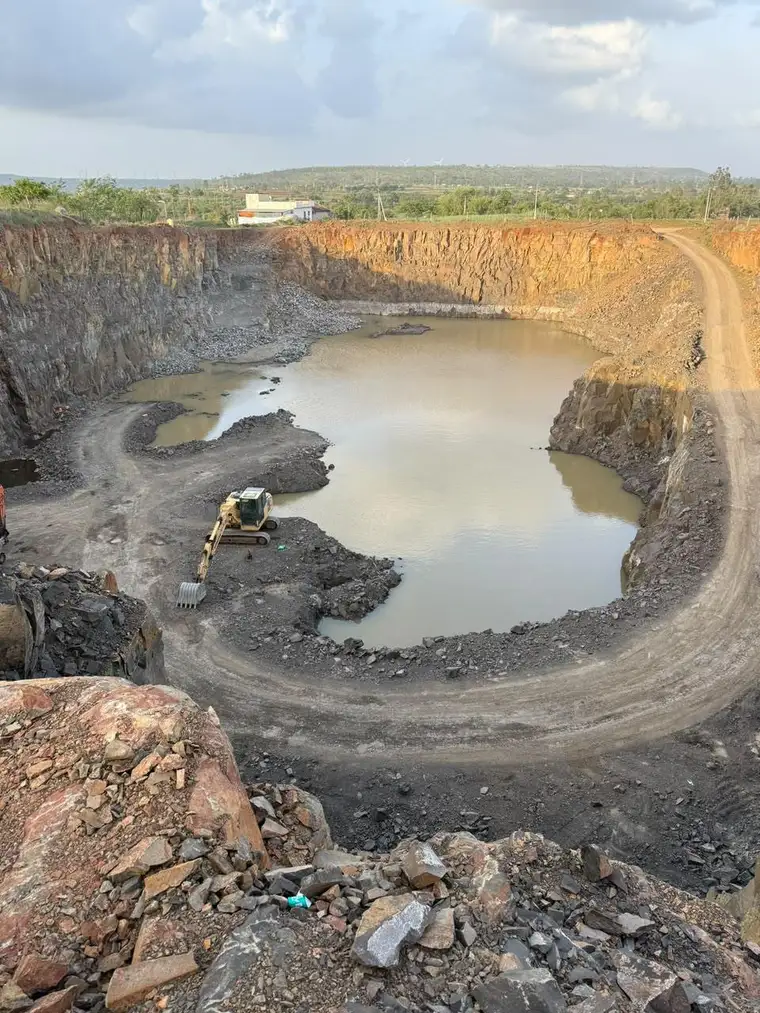
Most quarry haul roads are never designed. They are the track the first excavator walked in on, widened the day two tippers could not pass and graded the week a spring broke. Then every tonne the quarry produces goes over that track twice, for years.
Haul road design is two separate jobs. Gradient, width, edge protection and sight distance are safety geometry, and the Directorate General of Mines Safety (DGMS) has a number for each. The running surface is economics: what it is built from decides rolling resistance, and rolling resistance decides what the fleet costs to run.
What a haul road is, and which rules reach a stone quarry
A haul road is a road inside a mine or quarry built for loaded tippers and dumpers to run between the working face, the crusher hopper, the stockpiles and the waste dump. A stone quarry is a mine in law, and the regulations that apply to it are the Metalliferous Mines Regulations, 1961, which cover every mine other than coal and oil.
Those regulations do not themselves fix a mine haul road gradient or width. Regulation 106(2)(b) requires notice to DGMS at least 60 days before a quarry starts working with heavy machinery or deep-hole blasting, and the work then has to follow whatever conditions the Chief Inspector of Mines specifies in writing. For a mechanised quarry the road conditions sit in that permission letter. Read yours first.
The fullest published statement of what DGMS expects is the standard it notified for coal mines: G.S.R. 976(E) of 1 October 2018, Conditions for Haul Roads, under Regulation 101 of the Coal Mines Regulations, 2017. It does not bind a stone quarry by its own force. It is the benchmark all the same. Of two DGMS safety alerts issued in 2025 after fatal accidents, one at a granite quarry quotes the same gradient and one at a stone mine gives very similar widths.
| Item | Condition |
|---|---|
| Gradient | Not steeper than 1 in 16, which is 6.25% |
| Ramps | Not steeper than 1 in 10, not longer than 50 m at one stretch, for crawler-mounted machines only |
| Width, one-way traffic | Width of the largest vehicle plus 5 m |
| Width, two-way traffic | Three times the width of the largest vehicle plus 5 m |
| Corners and bends | A clear view of at least three times the braking distance at 40 km/h, or else two separate roads with a divider |
| Parapet or embankment | Where the road is above the surrounding ground: top 1 m or more, base 2.5 m or more, height not less than the diameter of the largest tyre |
| Drainage | A drain provided and maintained along one side |
The Regional Inspector may permit a variance where special conditions exist. The notification says in terms that dumped mud or overburden is not a parapet.
Haul road gradient: 1 in 16, and what steeper costs
One in sixteen is a rise of one metre for every sixteen along the road. A pit that goes down by a 6 m bench needs about 96 m of ramp for that bench, which is why ramps get steepened: at the proper grade the ramp eats floor that somebody wanted to quarry. Plan it into the bench layout from the first cut.
A loaded tipper on a steeper climb drops gears and runs hot. Coming down it is on the brakes for the whole length. The DGMS alert on the granite quarry describes exactly that: a dumper moving down a steep haul road went out of control and fell from one bench to the next. Keep the grade constant as well as legal, since a ramp that averages 1 in 16 with a short 1 in 10 kink forces a gear change at the worst place. Leave a level length at the top, at the bottom and on the approach to the hopper.
Haul road width for one-way and two-way running
Width is quoted in multiples of the widest vehicle on the road. The coal notification adds a fixed 5 m to the multiple. The 2025 DGMS alert on the stone mine gives a plainer rule: three times the dumper's width for one-way and five times for two-way. For a highway tipper, whose overall width the Central Motor Vehicles Rules cap at 2.6 m, the two land almost on top of each other.
G.S.R. 976(E), one-way = 2.6 m + 5 m = 7.6 m
G.S.R. 976(E), two-way = (3 × 2.6 m) + 5 m = 12.8 m
Stone mine alert, one-way = 3 × 2.6 m = 7.8 m
Stone mine alert, two-way = 5 × 2.6 m = 13.0 m
About 8 m for one-way running and 13 m for two-way
Treat that as running width: the drain, the parapet and whatever has slumped onto the edge do not count. Run a wider off-highway dumper and the figure moves with it. Bends need more, because a tipper's rear wheels track inside its front ones.
Crossfall, drains and edge protection
Water destroys haul roads. A flat road ponds, the pond softens the layer under it, and the next loaded axle punches through. Usual practice is a crossfall of about 2 to 3 per cent, as a crown or falling one way toward the drain: enough to shed rain, too little for a loaded tipper to feel. On a ramp cut along a bench the fall goes inward, toward the face and the drain. Never toward the drop.
Every ramp on a bench is a road standing above the ground next to it, so every ramp needs the parapet in the table: as high as the biggest tyre, a metre across the top, two and a half at the base, and built, not pushed up. A windrow of loose overburden left by a dozer will not stop a 28 tonne tipper.
What the running surface is built from
A haul road is a pavement and is built like one: a compacted formation, a base of sized quarry rock to carry the load, and a wearing course of crushed graded material on top. The quarry already makes the wearing course. A dense crushed blend of the kind sold as GSB, with enough fines to bind and not so many that it turns to slurry, rolls down into a surface that sheds water and holds a grader blade.
Single-size 40mm or 20mm does not. With no fines to lock it, it ravels and rolls under the tyres. Clayey overburden is the other common choice and the worse one: hard in April and grease in July. On a rock floor a thin regulating layer is enough. Over fill or weathered ground the base has to be deep enough that a tandem axle at its legal 21 tonnes does not deform the formation, the same axle limit that sets a tipper's payload.
Rolling resistance: where the road pays back
Rolling resistance is the force needed to keep a wheel turning on a surface, quoted as a percentage of the vehicle's weight. Equipment makers' handbooks work on about 10 kg per tonne for each 1 per cent, which makes 1 per cent of rolling resistance the same load on the engine as 1 per cent of gradient. A gradient gives some of that back on the way down. Rolling resistance is against the tipper in both directions.
| Running surface | Typical rolling resistance |
|---|---|
| Hard, compacted crushed stone, graded and watered, no visible tyre penetration | About 2% |
| Firm, flexing slightly under load, maintained now and then | 3–4% |
| Rutted, loose or potholed, tyres sinking 25 to 50 mm | 5–8% |
| Soft, wet and deeply rutted | 10% and above |
Typical values of the kind published in equipment makers' performance handbooks, for the order of magnitude only.
Grade resistance = 6.25%
On a 2% surface, total resistance = 6.25 + 2 = 8.25% = 2.31 t of pull
On a 6% surface, total resistance = 6.25 + 6 = 12.25% = 3.43 t of pull
Extra pull from the surface alone = 3.43 - 2.31 = 1.12 t, about 48% more
A neglected surface turns a legal 1 in 16 ramp into the equivalent of about 1 in 8
More pull means a lower gear, and a lower gear means a longer cycle and more diesel per tonne. Tyres take it twice: from the flexing that soft ground forces on the casing, and from the cuts that loose rock puts in tread and sidewall. None of it appears in the accounts under haul road. It appears as tyres, diesel and a tipper count that creeps up, which is the arithmetic behind the line on our earthwork page that a properly built haul road pays for itself in tipper tyres and cycle times inside a month. The cycle-time side is worked through in how many tippers a haul needs.
Dust suppression and grading maintenance
A haul road is never finished. Traffic pumps fines to the surface, the fines leave as dust or as mud, and what remains ravels. A water tanker and a motor grader keep it.
- Water. Light and frequent. Enough to hold the fines down, never so much that the ramp goes slick. A driver who cannot see through dust slows down, so dust is cycle time as well as a hazard.
- Grading. Cut the surface back to its crossfall and clear spilled rock in the shift it falls. A stone the size of a fist is a tyre cut waiting for a loaded rear wheel.
- Drains. Reopened before the rains and after every heavy storm. A blocked drain in June is a failed patch in July, which is most of monsoon planning for a quarry in one line.
- Patching. Dig a soft spot out to firm ground and rebuild it in compacted layers. Dust tipped into a pothole lasts until the next shower.
Building it before the first tonne
The cheapest time to build a haul road is at mobilisation, when the grader and roller are already on site and the crusher has just started making graded material. We build and keep the internal roads on the quarries we work with our own graders and rollers, as part of earthwork, and the tippers on those roads are ours too, so the cost of the road and the saving from it land in the same pocket. If you are opening a face, or have a quarry where the tipper count looks high for the lead, send the pit plan, the lead to the hopper and the vehicles in use. The haulage side starts on the transportation page.