
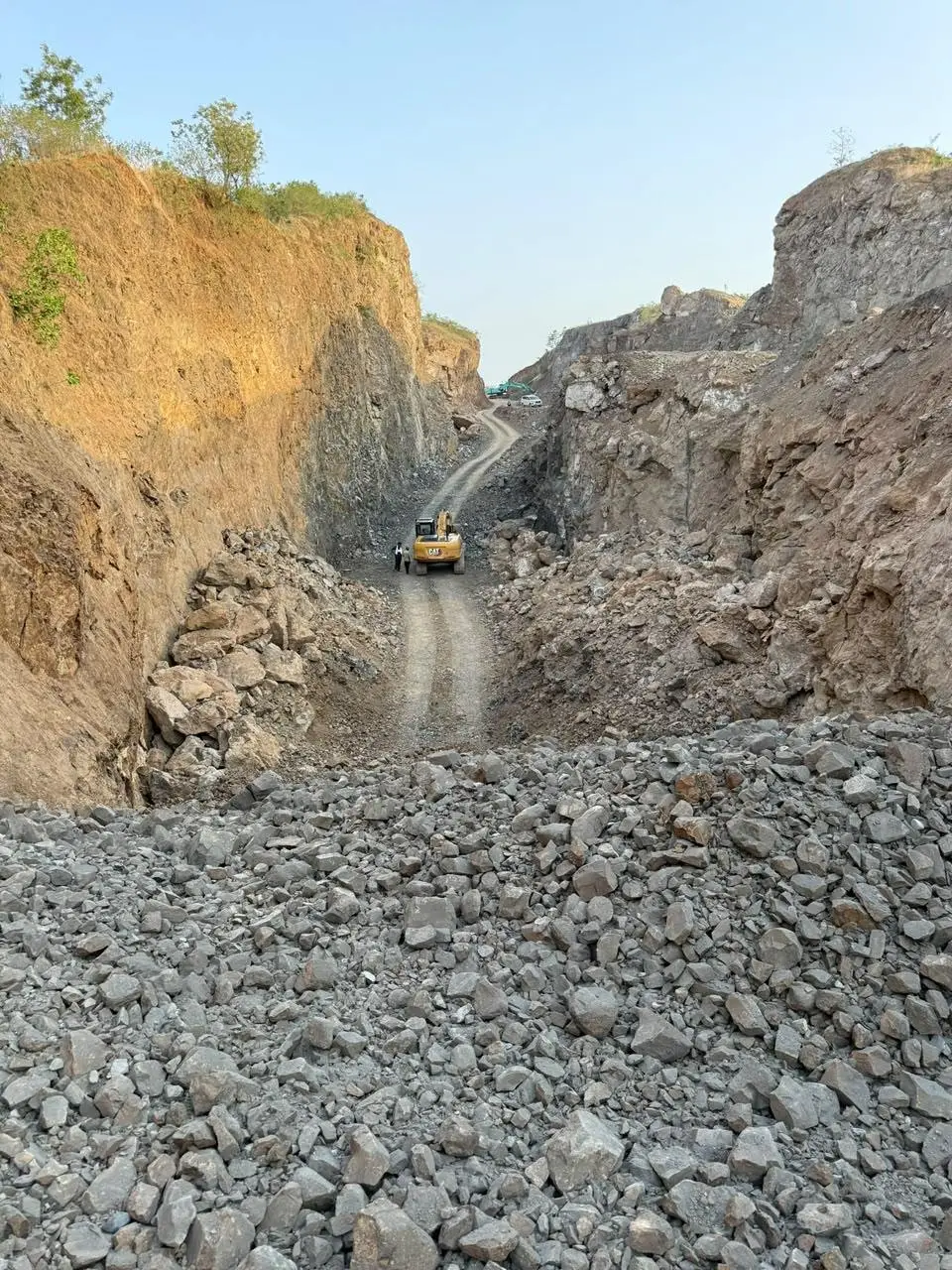
A crusher plant can be erected in about two weeks. A quarry cannot, and the commonest way to lose a season is to plan the two as if they were the same kind of job. The plant is steel on foundations. The quarry is a mineral right, permissions from five different offices, and a hillside that has to be stripped and benched before it gives up a tonne.
What follows is the order to do it in: how to start a stone quarry for a highway package without finding the missing paper after the machines have arrived. Central law is quoted as it stands in October 2026. Where the state decides the detail, the text says so.
What opening a stone quarry involves
Opening a stone quarry means putting three things in place together: the right to take the mineral, the clearances to work the ground, and a face that a drill and an excavator can work safely. In Indian law an excavation made to win mineral is a mine. So a road-metal quarry feeding a single highway package answers to the Directorate General of Mines Safety (DGMS) for how it is worked, as well as to the state mining department for what it takes out.
Quarry development in sequence, lease to first tonne
Steps 2 to 6 are the stone quarry lease process and the permissions that hang off it. They run side by side once the rock is proved, and they are the long ones. Steps 7 to 10 are the weeks everybody budgets for.
- 01
Prove the rock
Before any money goes into a lease, take samples from pits or core holes across the block and test them as aggregate: impact value, Los Angeles abrasion, water absorption, soundness and, after a trial crush, flakiness. Why two quarries in one district can give different answers is in which rock makes good road aggregate. The same pits show how deep the overburden runs.
- 02
Get the mineral concession
Building stone and road metal are minor minerals, so the right to quarry them is granted under rules each state makes under Section 15 of the MMDR Act 1957: a lease, a quarry licence or a short-term permit. The differences, and the royalty and passes that follow, are in quarry lease, royalty and transit pass. If the client already holds the lease, start by reading its boundary, its validity and its permitted annual quantity.
- 03
Mining plan and environmental clearance
The state rules ask for an approved mining plan, and the EIA Notification 2006 asks for prior environmental clearance for a mining lease of any size; the Supreme Court settled that for leases under 5 ha in Deepak Kumar v. State of Haryana in 2012. In the table brought in by the January 2016 amendment, an individual lease below 50 ha is Category B, cleared by the State Environment Impact Assessment Authority (SEIAA), and 50 ha or more goes to the Ministry. Leases whose boundaries lie within 500 m of each other are counted together as a cluster. The same amendment sent leases up to 5 ha to a district authority, which the National Green Tribunal ruled against in September 2018, so check the notification as it stands for both the bands and the authority.
- 04
Pollution board consents
Consent to establish before anything is built and consent to operate before production, from the State Pollution Control Board under the Air Act 1981 and the Water Act 1974. The pit and the crusher are commonly separate consents with separate conditions, and the siting distances for a crusher are each state's own.
- 05
Mine-safety notices and appointments
File not less than thirty days' prior notice of commencement in Form VII of the OSH (Central) Rules 2026, and appoint a manager: Section 67 of the Code puts every mine under one, and Regulation 34 of the Metalliferous Mines Regulations 1961 sets the certificate the manager must hold. A quarry to be worked by deep-hole blasting or heavy machinery also gives 60 days' written notice of its method of working under Regulation 106(2)(b), and starts only on the conditions the Chief Inspector sends back. Those conditions fix the bench height and width.
- 06
Explosives
Either a licensed magazine of your own under the Explosives Rules 2008, or supply from a licensed contractor who brings explosive to the shot and takes the balance away. Charging and firing are done by a certificated blaster, which is the regulations' word for a shotfirer. A magazine needs land, safety distances and a licence of its own, so the application goes in alongside the lease, not after the first bench is drilled. The detail is in explosives licence, magazine and shotfirer.
- 07
Access and haul road
Build the road from the public road to the plant site, and from the plant to where the first face will be, before the heavy traffic starts and not after it has rutted the track. Gradient and width come from the permission conditions and from what a loaded tipper can climb.
- 08
Strip the overburden
Topsoil comes off first and is stacked on its own for restoration. Then soil, murrum and weathered rock are dug or ripped down to sound rock and hauled to a dump that does not sit on stone you will want later. On most sites this is two to four weeks. How deep it runs, and what that does to every tonne under it, is the subject of overburden removal and the stripping ratio.
- 09
Cut the first bench
The first blast has no free face to break to, so it is a box cut or a sidehill cut that makes one. It is drilled closer and charged heavier than a production round and it breaks worse. From that opening the face is squared up, the floor levelled, and a bench of the permitted height established, with room for the drill above and the excavator below.
- 10
Stand the plant
The plant goes on ground that will never be quarried, close enough to keep the face-to-hopper lead short and far enough that a shot does not stop it. Regulation 164 of the 1961 regulations treats everything within 300 m of an opencast shot as the danger zone, where people must be warned and under shelter before firing, and a mine's own permission may set it wider. A plant inside that radius empties for every blast. Put the hopper below the tipping point so tippers discharge downhill into it, with the stockpiles and the weighbridge on the way out to the public road.
Mine safety law changed in November 2025
Anyone working from an older checklist will find the Mines Act 1952 at the top of it. That Act was repealed on 21 November 2025, when the Occupational Safety, Health and Working Conditions Code 2020 came into force. Section 143 of the Code keeps regulations made under the old Act alive until the Central Government replaces them, and DGMS lists the Metalliferous Mines Regulations 1961 among those still in force. The Mines Rules 1955 have gone: the OSH (Central) Rules 2026 superseded them in May 2026. Replacement metalliferous regulations were published in draft in February 2026.
How long each stage takes
Two clocks run. The authorities' clock is counted in months. The contractor's is counted in weeks, and it should not be started until the first is nearly out.
| Stage | Who controls it | Time to allow |
|---|---|---|
| Lease, mining plan, environmental clearance | State mining department and SEIAA | Months; varies by state |
| Consents, mine notices, explosives licence | Pollution control board, DGMS, the explosives licensing authority | Notice periods of 30 and 60 days, plus processing |
| Mobilisation | Contractor | About two weeks |
| Stripping to sound rock | Contractor, and the depth of overburden | Two to four weeks on most sites |
| Plant erection and commissioning | Contractor, alongside the stripping | About two weeks with decent access |
| Award to first tonne | Contractor, with the clearances already in hand | Three to six weeks on a normal site |
The last four rows are our own working figures. Poor access or a monsoon start pushes all of them out.
The monsoon caveat is not a formality. Stripping wet clay and casting foundations in the rain are both slower than the programme assumes, which is why running a quarry through the monsoon starts with the dry months.
Why a quarry sits idle with the plant already erected
It is rarely the rock. Royalty, transit passes, district permissions and magazine licensing are the single most common reason a quarry stands with a plant erected and nothing moving. Each is small, and each can stop a dispatch on its own: a royalty balance that has run out so the portal will not issue a pass, a consent to operate that covers the crusher but not the pit, a magazine that is built but not yet licensed, a bench drilled and waiting on a blasting permission.
The cure is dull. One person owns the list, every item on it has an application date and a named office against it, and no machine is mobilised against a paper that has not at least been filed. Read the conditions attached to each clearance as closely as the clearance itself. The conditions are what the quarry is inspected against.
The first bench is not the quarry
Rock near the surface has been weathering for a long time. Joints are open and stained, absorption runs higher, and the first few thousand tonnes usually carry more fines and weaker stone than the rock a bench down. Test the first production again before it is offered against a specification, and expect to send some of it to haul roads, working platforms and fill.
What to settle before anyone mobilises
Five things decide whether a quarry opens in weeks or stalls: test results on the rock, the lease and its conditions, the clearance and consent letters, who holds the explosives licence, and the month the rain reaches the site. Send those with the location and the monthly tonnage the road needs. We open and work faces on client-held leases and on our own, and the scope is set out under mining operations.