
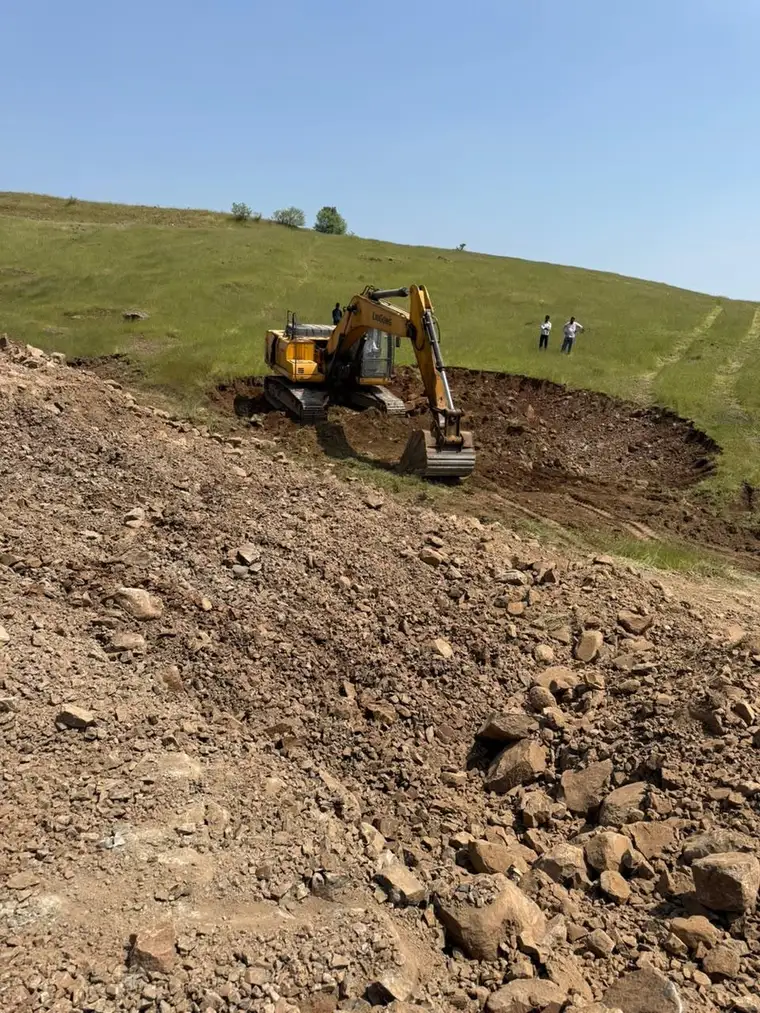
A quarry sells rock and digs soil. The soil earns nothing, has to be moved first, and decides more of the cost of a tonne than most first estimates allow. Overburden removal is also where the quality of the aggregate is settled, months before a sample reaches the laboratory.
The stripping ratio is the number that puts the soil into the rate. It is simple to calculate and easy to get wrong, because the depth it rests on is hidden until somebody digs.
What overburden is
Overburden is the material lying above the rock a quarry means to sell, which has to be removed to reach it. On a stone quarry it normally comes in layers, and they are not treated alike.
- Topsoil. The top few hundred millimetres, dark and full of roots. It is the only layer with a later use, and it is stripped and kept apart.
- Soil, clay and murrum. The bulk of the dig on most sites. An excavator takes it without ripping. This is the layer that fails a sub-base sample if it reaches the plant.
- Weathered rock. Stained and jointed, sometimes hard enough to need a ripper or a breaker, and often good enough to crush. Whether it counts as overburden or as product is a test result for absorption, impact value and soundness, not a judgement by colour.
The stripping ratio formula
Stripping ratio is the quantity of overburden removed divided by the quantity of rock won. In Indian practice it is most often stated as cubic metres of overburden per tonne of mineral, written m³/t. It is also given volume to volume and tonne to tonne. The three produce different numbers for the same quarry, so say which one you mean.
Overburden = 100 m × 80 m × 4 m average cover = 32,000 m³
Rock = 100 m × 80 m × 24 m to the floor = 192,000 m³
Rock mass = 192,000 m³ × 2.7 t/m³ = 518,400 t
Ratio = 32,000 m³ ÷ 518,400 t = 0.062 m³/t
By volume = 32,000 m³ ÷ 192,000 m³ = 1 to 6
0.062 m³ of overburden for each tonne of rock, or 1 m³ stripped for every 6 m³ of rock in place
The 2.7 t/m³ is a typical in-place density for granite. Basalt runs heavier and most sandstone lighter, so use the figure from your own rock. The ratio is not a property of the lease, either. It belongs to a block and a depth. The same 4 m of soil over a single 12 m bench gives 0.123 m³/t, twice the stripping in every tonne, which is why a quarry that can go down a second bench is a different business from one that cannot.
Finding the depth before committing
Dig before you sign. Trial pits on a grid, taken with an excavator down to where the bucket stops, give the thickness of soil and the top of the weathered zone. They do not show where sound rock starts. For that a drill has to go down: core holes if the budget allows, or probe holes with a blast-hole rig, logged by penetration rate and the colour of the cuttings. The same pits supply the samples for the rock tests that come first in opening a stone quarry.
Use the free evidence too: a well, a road cutting, a neighbour's face. Then plot the rock head, not the ground. The rock surface does not run parallel to the ground above it. Cover thickens in hollows and thins on ridges, and a lease pegged across a hollow can carry twice the stripping of the one beside it. Investigation holes and probing ahead of a face are work our drilling machines do alongside production.
Overburden removal methods
Soil and murrum are dug by excavator and loaded into tippers; a dozer is the cheaper tool only where the push to the dump is short. Weathered rock is ripped where it will rip. Where it will not, the choice lies between a breaker and a light blast, and it turns on the quantity and on what is standing nearby, as set out in rock breaker versus blasting.
Strip ahead of the face, not up to it. The cleaned strip behind the crest should be wide enough for the next rounds to be drilled on bare rock, and Regulation 106 of the Metalliferous Mines Regulations 1961 wants loose stone and debris kept 3 m back from the edge of any excavation in any case. The last pass is the one that decides quality: the rock surface scraped, pockets and open joints dug out, and the edge of the remaining soil battered back so that it cannot slump onto the bench in the first rain.
Do the bulk of it in the dry months. Wet clay stays in the bucket and under the tyres, and a stripped area that floods has to be cleaned twice. The planning for that is in running a quarry through the monsoon.
Where the spoil goes
The first rule is a negative one: not on future reserves. Spoil tipped over rock that will be quarried in the third year has to be moved again in the third year, at full cost and for nothing. Before the first load, mark the limit of rock that will ever be worked and put the dump outside it, inside the lease boundary, clear of drainage lines, at a slope it will hold when wet and with a drain round its toe. The approved mining plan normally shows the place.
Spoil has uses. Haul road formation, bunds along bench edges and ramps, and the backfilling of a finished pit all take it. Topsoil goes into none of these. It is stacked on its own in low, wide heaps away from traffic and kept for spreading over dumps and worked-out ground at closure. Mining plans and clearance conditions generally require that, and handing a site back in decent order depends on it.
How badly stripped overburden fails GSB on plasticity index
Crushed rock has no plasticity. Clay has a great deal. When a bench is shot with soil still on it, or with clay left in the joints, the clay goes into the muck pile, into the tipper and into the hopper. The grizzly passes it with the fines, and it finishes where fines finish: in the sub-base blend and in the dust.
MoRTH Table 400-2, in the Fifth Revision that most running contracts cite, allows granular sub-base a plasticity index of 6 at most. A small amount of clay in the fraction passing 425 microns can take the material past that with every sieve still inside its band, and it cannot be screened out afterwards. The limits are set out in GSB grading as per MoRTH Clause 401.
What the ratio does to the cost of a tonne
Leave money out and count machine time. Take an excavator that strips and loads 100 m³ an hour measured in place, a tipper that carries 10 m³ loose, and soil that swells 25 per cent when dug. All three are assumptions to be replaced with your own. A 250 TPH plant on two shifts takes 25,000 to 30,000 MT a month, so the table is worked for 25,000 t of rock.
| Cover over rock | Ratio, m³/t | Overburden a month | Excavator hours | Tipper loads |
|---|---|---|---|---|
| 4 m over 24 m | 0.062 | 1,550 m³ | About 16 | About 195 |
| 4 m over 12 m | 0.123 | 3,075 m³ | About 31 | About 385 |
| 10 m over 12 m | 0.309 | 7,725 m³ | About 77 | About 965 |
Rock taken at 2.7 t/m³ in place. Tipper loads are loose volume, 25 per cent more than the volume in place.
The third row is five times the first for the same tonnage of rock, before the haul to the dump is counted, and the haul is where the tipper hours go. Stripping also comes early: the cover over a year's rock has to be moved before that rock earns anything. Somewhere up the scale is the break-even ratio, where uncovering a tonne costs as much as the margin on it. Stone is a low-value mineral, so a quarry reaches that point at ratios a coal mine would not notice.
What to measure before asking for a rate
Send the pit and probe logs with their positions, the size of the block to be worked, the depth that the lease and the water table allow, and where the dump can go. With those a stripping ratio is arithmetic and a rate can be honest. Without them it is a guess that somebody pays for later. Overburden depth is one of the things our first site visit is for, along with rock type, access and water, and that visit decides most of the cost. What we do between bare ground and a working face is set out under mining operations.