
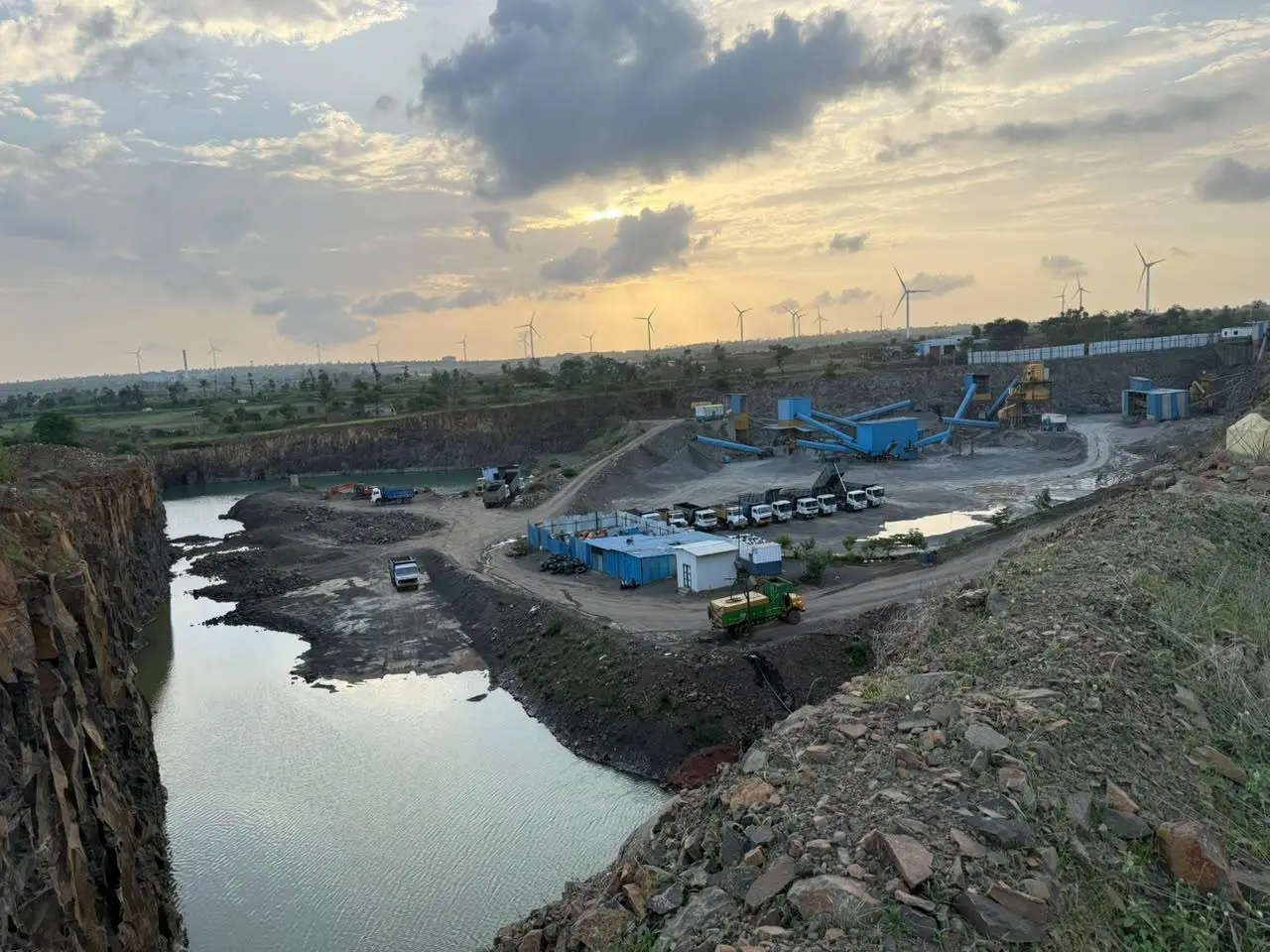
Before a quarry sells a tonne to a highway package it has to be approved as a source, and approval is a file of test certificates. The same tests then repeat for the life of the job. Knowing which limit belongs to which layer saves a lot of argument, because stone that is comfortable in wet mix macadam can be a clear failure in bituminous concrete with nothing wrong with the stone or the laboratory.
The limits here are from the MoRTH Specifications for Road and Bridge Works, Fifth Revision (2013). Contracts routinely tighten them or add tests of their own, so check the edition and the technical schedule your contract cites before you rely on a figure.
The tests on aggregate for road construction
The tests on aggregate for road construction are a set of laboratory checks, most of them in the parts of IS 2386, that measure a stone's toughness, hardness, porosity, resistance to weathering, particle shape and grip on bitumen, each against a limit MoRTH sets for the layer the stone is going into.
Two things about that sentence matter in practice. The limit belongs to the layer, not to the stone, so the same 20mm chip has one set of limits in WMM and a tighter set in DBM. And the list gets longer as the layer gets closer to the tyres: granular sub-base is judged on one strength test, bituminous concrete on eight properties.
Aggregate impact value, Los Angeles abrasion and the other limits by layer
| Test | IS code | What it measures | GSB | WMM | DBM | BC |
|---|---|---|---|---|---|---|
| Aggregate impact value | IS 2386 Part 4; IS 5640 for soft stone | Toughness under a sudden blow | 40 max | 30 max | 27 max | 24 max |
| Los Angeles abrasion value | IS 2386 Part 4 | Hardness: wear and impact together | – | 40 max | 35 max | 30 max |
| Combined flakiness and elongation index | IS 2386 Part 1 | Particle shape | – | 35 max | 35 max | 35 max |
| Water absorption | IS 2386 Part 3 | Porosity | Over 2: wet impact test | Over 2: soundness test | 2 max | 2 max |
| Soundness, sodium sulphate, 5 cycles | IS 2386 Part 5 | Resistance to weathering | – | see contract | 12 max | 12 max |
| Soundness, magnesium sulphate, 5 cycles | IS 2386 Part 5 | Resistance to weathering | – | see contract | 18 max | 18 max |
| Coating and stripping | IS 6241 | Bond between stone and bitumen in water | – | – | 95 min retained coating | 95 min retained coating |
| Polished stone value | BS 812-114 | Resistance to polishing under tyres | – | – | – | 55 min |
| Dust passing 0.075 mm | IS 2386 Part 1 | Cleanliness of the coarse aggregate | By grading table | By grading table | 5 max | 5 max |
All figures are per cent except polished stone value. For WMM, DBM and BC the stone may satisfy either the impact limit or the Los Angeles limit. For DBM and BC soundness is either the sodium or the magnesium sulphate test. A dash means the table sets no requirement. Tables 400-2, 400-12, 500-8 and 500-16.
The gradings that go with these are in GSB grading as per Clause 401 and WMM grading as per Clause 406. GSB adds a liquid limit, a plasticity index and a CBR to its single aggregate test; those are soil tests on the fines and sit in the GSB article.
Four things in the table that get misread
- Impact or abrasion, not both. In Tables 400-12, 500-8 and 500-16 the two strength tests are joined by the word or. A source that passes either one has met the strength requirement, and a failure on the other does not undo that unless the contract says both.
- The 2 per cent absorption line means two different things. In the bituminous tables it is a limit: over 2 per cent, the stone is out. In Clause 401 it is a trigger: GSB stone over 2 per cent is tested for wet aggregate impact value under IS 5640. In Clause 406 it is also a trigger: WMM stone over 2 per cent goes for a soundness test.
- WMM soundness has no number in MoRTH. Clause 406 calls for the test and stops there. IRC:109-2015 puts the sodium sulphate loss at 12 per cent maximum. Which governs is a contract question, which is why the table says see contract.
- Soft stone is tested wet. Kankar, laterite and brick ballast soften in water, so a dry impact value flatters them. Clause 401 sends them to the wet test whatever their absorption.
What each test predicts on the road
- Aggregate impact value. Stone passing 12.5 mm and held on 10 mm takes 15 blows from a 13.5 to 14 kg hammer falling 380 mm, and the fines passing 2.36 mm are weighed. It predicts whether the stone will shatter under the roller and under wheel loads, which in a granular layer means the grading you approved is not the grading in the road.
- Los Angeles abrasion value. The sample is tumbled in a steel drum with a charge of steel balls, 500 revolutions for the common gradings, and the loss through the 1.70 mm sieve is the result. It combines impact with rubbing, so it reads the damage done in the dryer drum, the paver and years of traffic.
- Aggregate crushing value. A slow 40 tonne squeeze in a steel cylinder. MoRTH does not use it for these four layers. It comes in through IS 383 for concrete, where 30 per cent is the limit for wearing surfaces such as pavements, and Clause 602 adds a Los Angeles limit of 35 for pavement quality concrete.
- Water absorption and specific gravity. Both come from one test: a 24 hour soak, then weighing. Absorption is the quick screen for weathered or porous rock, and porous stone drinks binder. Specific gravity has no limit, but the minimum bitumen contents in the DBM and BC tables assume stone of 2.7, and it is the figure that turns a volume into tonnes of aggregate.
- Soundness. Five cycles of soaking in sodium or magnesium sulphate solution and oven drying. Salt crystals growing in the pores stand in for years of wetting, drying and frost. A stone can be strong on the day and still fail this.
- Flakiness and elongation. The one test here that the plant, not the rock, mostly decides. It has its own article.
- Coating and stripping. Stone is coated with bitumen and kept under water, and the share of surface still coated is judged by eye. It predicts ravelling and potholes after the monsoon. High-silica rock is the usual failure, covered rock by rock in which rock makes good road aggregate. IS 6241 was revised in 2024, so ask which edition the laboratory is working to.
- Polished stone value. A measure of how much grip the stone face keeps after polishing. It applies to the wearing course only, since no tyre ever touches DBM.
How often the tests are run
Section 900 gives minimum frequencies and calls them the desirable minimum. The Engineer can ask for more, and can agree to fewer where results have been consistent.
| Test | GSB | WMM | DBM and BC |
|---|---|---|---|
| Grading | 1 per 400 m³ | 1 per 200 m³ of aggregate | Mix grading: 1 set per 400 t of mix, at least 2 a day per plant |
| Impact or Los Angeles value | Not listed | Impact value: 1 per 1,000 m³ of aggregate | 1 per 350 m³ of aggregate, per source |
| Flakiness and elongation | Not listed | 1 per 500 m³ of aggregate | 1 per 350 m³ of aggregate, per source |
| Atterberg limits | 1 per 400 m³ | 1 per 200 m³, on the fraction passing 425 micron | Plasticity index: once per source |
| Water absorption, soundness, polished stone value | Not listed | Not listed | Once per source, and again when the stone changes |
Not listed means Section 900 names no routine frequency for that layer; the test is still run for source approval. On DBM and BC the impact and shape tests are also repeated whenever the quality of the aggregate changes.
Read the last row with the face in mind. Once per source assumes the source stays the same, and a quarry that moves into a weathered zone or a different flow has, as far as the specification is concerned, become a different source.
What to send, and what to ask for
When you ask for material, name the layer and not just the size, because 20mm for WMM and 20mm for DBM pass the same sieve and answer to different limits. Ask for the source's current certificates for every test in that layer's column, dated, from a laboratory your Engineer accepts. On our plants samples are pulled at commissioning and at intervals through the run and go to whichever laboratory the contract nominates. The plants and what they produce are on stone crushing, and the products by size on materials.