
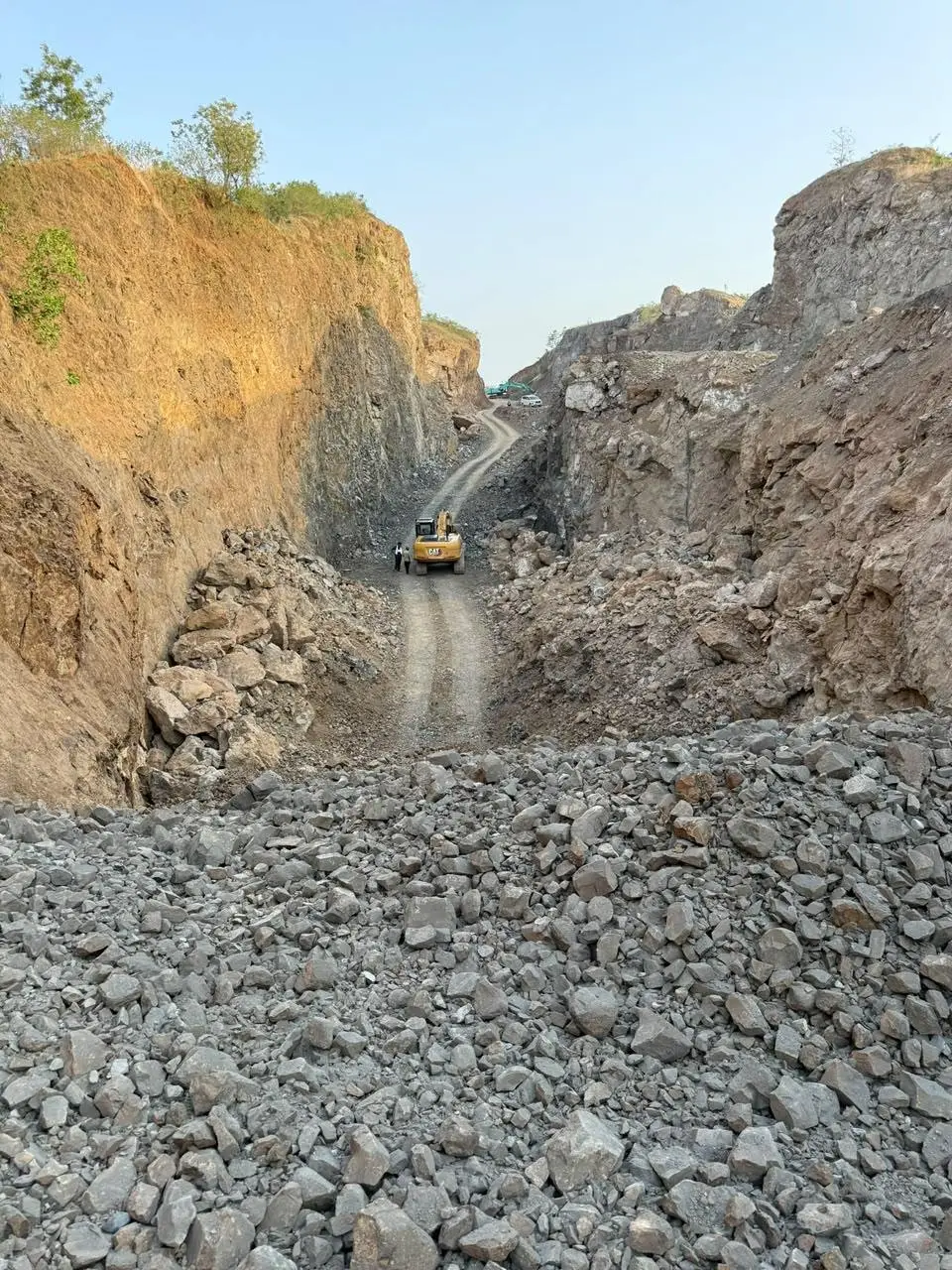
Ask which is the best stone for road construction and the answer is usually basalt or granite, depending on which state the person works in. Both answers are local habit. A highway contract never names a rock. It lists tests and limits layer by layer, and a quarry is a source only for the layers its stone passes.
What the rock type does tell you is where the trouble will come from: which test will be tight, how the stone behaves in the crusher and what it costs in steel. Strength and density figures below are typical ranges for sound, unweathered rock. Any one quarry can sit outside them, and weathering moves all of them the wrong way.
What makes a rock good road aggregate
Good road aggregate is rock that, once crushed, stays inside the MoRTH limits for the layer it is used in: tough enough for the impact and abrasion limits, dense enough to keep water absorption low, sound against weathering, cubical in shape and, for bituminous layers, able to hold a film of bitumen when water is present.
Those limits tighten toward the surface, so a rock can be a perfectly good sub-base stone and never get near the wearing course. The full table, from GSB to bituminous concrete, is in aggregate tests and their MoRTH limits. References here are to the Fifth Revision; check the edition your contract cites.
Basalt
Basalt is the rock of the Deccan Traps, the stack of lava flows that covers most of Maharashtra and runs into western Madhya Pradesh, Gujarat and the northern edges of Karnataka and Telangana. It is dark, fine grained and heavy, with a specific gravity typically between 2.8 and 3.0 and a compressive strength typically between 100 and 300 MPa.
It is low in silica, which makes it a basic rock in the chemist's sense, and bitumen takes to it well. It is also dense enough to matter in a mix design: the minimum bitumen contents in the MoRTH tables for DBM and bituminous concrete assume aggregate of specific gravity 2.7 and allow a proportionate reduction for heavier stone. In the crusher it is tough. Our own record of the hard basalt on the Nanded to Jalna expressway calls it heavy on liners and generous on strength, and our Samruddhi Mahamarg work was in hard Deccan basalt too.
The caution is that a lava pile is not one rock. The compact core of a flow is the stone everybody wants. The top of the same flow can be vesicular, full of gas holes, or amygdaloidal, with those holes filled by softer secondary minerals, and between flows there are weathered bands. Stone from those zones absorbs more water and is weaker, and the 2 per cent absorption line is where it shows first. Working the face selectively is a mining decision that decides a laboratory result.
Granite and gneiss
Granite and its banded relative gneiss make up the old crystalline shield of the south, across Karnataka, Telangana, Andhra Pradesh and Tamil Nadu, and the Bundelkhand massif around Jhansi and Mahoba. Specific gravity is typically 2.6 to 2.8 and compressive strength typically 100 to 250 MPa.
Granite is strong, and it is abrasive, because a large part of it is quartz. That shows in liners, in drill bits and in the day's drilling metres. Our note on the hard granite of the Challakere to Hiriyur road in Karnataka reads: different bits, different liners, different penetration rates. Why quartz does that to steel is in what decides crusher wear life.
The other consequence of the silica is stripping. High-silica rock is acidic, its surface prefers water to bitumen, and in a wet pavement the binder film can lift off the stone. MoRTH deals with it directly. Aggregate for bituminous layers must retain at least 95 per cent of its coating in the IS 6241 test, and where a source has poor affinity for bitumen, Clause 505 makes approval conditional on treating the binder with an approved anti-stripping agent at the contractor's cost. Granite is used in every layer of Indian highways. It is just not used in bituminous mixes without that test in the file.
Limestone and dolomite
Limestone comes from the old sedimentary basins: the Satna and Katni belt of Madhya Pradesh, Kota and Chittorgarh in Rajasthan, Kadapa and Kurnool in Andhra Pradesh, Kalaburagi in Karnataka. Its range of quality is wide. Specific gravity runs from about 2.3 in porous beds to 2.7 in dense ones, and compressive strength from about 30 to 250 MPa.
Its mineral, calcite, is soft, so limestone is the cheapest of the four rocks to crush. Wear parts last, impact crushers can be used where harder rock would eat them, and the product is well shaped with fewer stages; jaw, cone and VSI explains why. It is a basic rock and bonds with bitumen better than any of the others.
Its weakness is polishing. A stone made of one soft mineral wears to a smooth face under tyres, and bituminous concrete has to show a polished stone value of at least 55. Many limestones do not reach it, and softer beds can also miss the Los Angeles limit of 30 for that layer. So limestone is common in GSB, WMM, DBM and concrete, and in the wearing course only where the source has passed the polishing test. Clay or marl partings in the face are the other thing to watch, because they arrive at the plant as plastic fines.
Sandstone and quartzite
Sandstone is the rock of the Vindhyan range, from eastern Rajasthan across Bundelkhand to Mirzapur and the Kaimur hills. No rock on this list varies more. Typical compressive strength runs from about 20 to 170 MPa and specific gravity from about 2.0 in porous beds to 2.6 in dense ones, and the difference is the cement between the sand grains. Silica-cemented beds grade into quartzite and are as hard as anything in a quarry. Clay-cemented or iron-cemented beds are soft and thirsty.
Three things follow. Porous beds go over 2 per cent water absorption, which under Clause 401 sends GSB stone to the wet impact test and under Clause 406 sends WMM stone to a soundness test. Bedded stone breaks along its bedding and comes off the crusher slabby, so the flakiness and elongation index needs a tertiary stage to hold. And hard sandstone is nearly pure quartz: the most abrasive feed a crusher sees, and as prone to stripping as granite.
Against that, a hard gritty sandstone keeps its texture under traffic better than most rocks, because worn grains pluck out and expose fresh ones. The hard beds make sound GSB and WMM. For bituminous layers only the dense, quartzitic stone is a candidate, with the stripping test done.
Basalt vs granite vs limestone vs sandstone
| Property | Basalt | Granite | Limestone | Sandstone |
|---|---|---|---|---|
| Specific gravity, typical | 2.8–3.0 | 2.6–2.8 | 2.3–2.7 | 2.0–2.6 |
| Compressive strength, typical | 100–300 MPa | 100–250 MPa | 30–250 MPa | 20–170 MPa |
| In the crusher | Tough; good shape if reduction is shared | Abrasive; hard on liners and bits | Easy; suits impactors | Most abrasive when quartzitic; slabby when bedded |
| Bond with bitumen | Good | Prone to stripping | Very good | Prone to stripping |
| Polishing | Varies by source | Varies by source | Polishes; often short of 55 | Holds texture where hard |
| Test most often tight | Water absorption in vesicular zones | Coating and stripping | Polished stone value; abrasion in soft beds | Water absorption, impact value, shape |
| Layers it usually suits | All | All, with stripping addressed | GSB, WMM, DBM; BC if polishing passes | GSB and WMM; bituminous only from dense beds |
Ranges are typical figures for sound rock from published rock-property tables. Weathered, porous or laminated stone falls outside them, and none of this replaces the test certificate.
Hill rock, laterite and kankar
Not every package has a quarry of one of those four. Hill rock, of the kind we worked on two packages in Manipur, is the hardest to generalise about. In folded hill country the rock can change from one cutting to the next, so a source is approved face by face and tested again when the face moves. Slaty and schistose rock usually goes out on shape before it goes out on strength.
Laterite and kankar are a different case: soft aggregates. Kankar is nodular calcium carbonate that forms in the soils of dry regions. Laterite is the iron-rich weathered cap of humid country, dug soft and hardening as it dries. MoRTH allows kankar in the lower sub-base under Clause 401, and kankar and laterite of suitable quality in water bound macadam for sub-base courses only. Because both soften again when wet, a dry impact value flatters them, so Clause 401 requires the wet aggregate impact value under IS 5640 for kankar, laterite and brick ballast, and for any stone with absorption above 2 per cent, against the same limit of 40 that applies to GSB.
Choosing a source: what to test first
If you are choosing between quarries, get four results on stone from the working face, not a hand-picked sample: impact or Los Angeles value, water absorption, combined flakiness and elongation off the plant that will crush it, and coating and stripping if any of it is going into a bituminous layer. Then walk the face and look for what the sample cannot show, the weathered band, the clay parting, the bedding. We have worked basalt on the Samruddhi Mahamarg, granite in Karnataka, sandstone through Bundelkhand and hill rock in Manipur, and plant selection starts with the rock, because hard basalt and soft sandstone want different settings and different wear parts. Send the rock, the layer and the monthly quantity, and the rest is on the stone crushing page.