
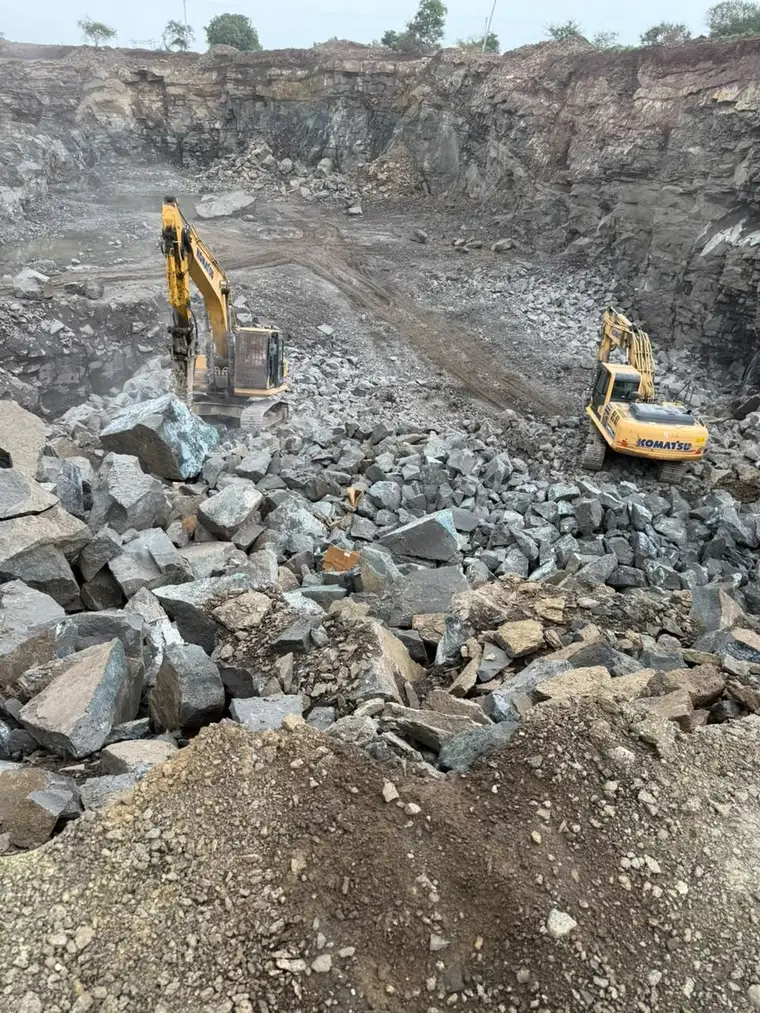
Two quarry managers compare notes. One says he is running at 0.45. The other says he gets 6. They may be describing the same blast.
Powder factor in blasting is quoted two ways round, in units that are rarely stated, and it is used to judge a blast it only half describes. This article gives the powder factor formula both ways with a worked example, the typical ranges from soft to hard rock, what moves the figure, and why chasing the lowest one costs money at the crusher.
What powder factor is
Powder factor is the quantity of explosive used to break a unit quantity of rock. The textbook form puts explosive on top: kilograms of explosive per cubic metre of rock in the solid, or per tonne. Specific charge means the same thing. Indian quarry and mine sites often turn it over and quote tonnes of rock broken per kilogram of explosive, or cubic metres per kilogram, because that is how a production report reads: so many tonnes out for so many kilograms in.
The two forms move in opposite directions. In kg per cubic metre a bigger number is a heavier-charged blast. In tonnes per kg a bigger number is a lighter one. A figure quoted without units is not information, so ask.
The powder factor formula, both ways round
For one hole in a bench pattern, the rock broken is the burden multiplied by the spacing multiplied by the bench height. The explosive is everything loaded into the hole, including what sits in the sub-drill below floor level.
Rock volume = 3.0 m × 3.5 m × 8.0 m = 84 m³
Rock weight = 84 m³ × 2.7 t/m³ = 227 t
Powder factor = 34 kg ÷ 84 m³ = 0.40 kg/m³
Per tonne = 34 kg ÷ 227 t = 0.15 kg/t
Turned over = 227 t ÷ 34 kg = 6.7 t/kg
By volume = 84 m³ ÷ 34 kg = 2.5 m³/kg
0.40 kg/m³ and 6.7 t/kg are the same blast
The 2.7 t/m³ is the in-situ density of the rock. It varies with rock type and should come from a test on your own stone. For a whole blast, add up the explosive in every hole and divide by the rock in the block: pattern area times bench height, or better, the surveyed volume.
Two cautions on the arithmetic. Use the explosive actually loaded, taken from the magazine's daily record of issue and return, not the design quantity. And do not set a figure worked on solid volume against one worked on loose volume in the tipper. Broken rock bulks up, so the same blast looks lighter on loose measure.
Typical powder factor for soft to hard rock
Explosives makers publish rule-of-thumb ranges for bench blasting. The figures below are from the Dyno Nobel field reference guide, with our conversion to tonnes per kg for a rock of 2.6 t/m³.
| Rock class | kg per m³ | t per kg at 2.6 t/m³ | The sort of rock |
|---|---|---|---|
| Hard | 0.7–0.8 | 3.3–3.7 | Massive granite, basalt, quartzite |
| Medium | 0.4–0.5 | 5.2–6.5 | Limestone, dolomite, strong sandstone |
| Soft | 0.25–0.35 | 7.4–10.4 | Weathered and weakly cemented rock |
| Very soft | 0.15–0.25 | 10.4–17.3 | Shale, laterite, rocky overburden |
Typical ranges, not specification values. The rock examples are indicative only. Softer rocks are also lighter, so their true tonnes-per-kg figure sits somewhat below the one shown.
Read the table as where to start a trial, not where to finish. Basalt on the Samruddhi Mahamarg, granite in Karnataka and sandstone through Bundelkhand are all rock we have worked, and fragmentation differs on every one. A jointed basalt and a massive one can sit in different rows of this table. That is why a shot is designed for the bench in front of the crew and not copied from the last site.
What moves the powder factor
- Rock strength and jointing. Strong, massive rock needs more energy to make new fractures. Closely jointed rock is already in blocks and only has to be shaken apart. But if the joint blocks are bigger than the crusher's feed opening, more explosive will not cut them. The pattern has to tighten instead.
- Hole diameter. A larger hole carries more explosive per metre and wants a wider pattern. At the same powder factor, big holes on a wide pattern break coarser than small holes on a tight one, because the explosive sits in fewer places.
- The explosive. Powder factor is by weight, and a kilogram is not a fixed amount of energy. ANFO, emulsion and cartridged slurry differ in density and in strength per kilogram, so a figure that worked with one product does not carry over to another unchanged. Some designers work in an energy factor for that reason: powder factor multiplied by the product's relative weight strength.
- Bench geometry. A short bench spends a larger share of every hole on stemming and sub-drill. Wet holes, a toe that keeps standing and a lightly loaded front row all pull the figure about.
- The fragmentation wanted. This is the one that should lead. Armour stone and rip-rap want big blocks and a light blast. Crusher feed wants everything through the jaw.
The pattern sets the powder factor more directly than any decision about explosive does. Widen a 3.0 m by 3.5 m pattern by half a metre each way and the figure falls by a quarter without a single cartridge changing. How that choice is made is in burden, spacing and the drilling pattern, and holes that are short, off pattern or deviated change the real burden while the paperwork stays the same.
Why the lowest powder factor is not the cheapest tonne
Explosive is an obvious line on the cost sheet and it is tempting to manage it down. Up to a point that is right: over-charging wastes money and throws rock, and Regulation 162 of the Metalliferous Mines Regulations 1961 makes it the blaster's duty to see that no hole is over-charged or under-charged for the task. Past that point the saving reappears, larger, further down the line.
- Oversize. Every boulder too big for the hopper is handled twice: set aside by the excavator, then broken by a rock breaker on the floor or at the grizzly.
- Digging. A tight, blocky muckpile loads slowly. The excavator works harder for each bucket and the tippers wait.
- Crusher throughput. A primary jaw fed coarse, slabby rock bridges and stalls. Our three-stage plants are built to take a 700mm boulder down to 10mm chips, and a blast that sends a steady stream of bigger ones costs the plant its tonnes per hour.
- Toe and floor. An under-charged bottom leaves a toe that has to be drilled and shot again, on a floor the tippers are already running on.
- Vibration. It does not fall just because the explosive does. A National Institute of Rock Mechanics study of Indian mines warns that both inadequate and excessive specific charge increase ground vibration. The limits are in blast vibration limits in India.
The measure that matters is the cost of a tonne through the last screen, not the cost of a tonne on the quarry floor. Oversize costs more at the hopper than it saves at the face. How fragmentation shows up in plant output, and how to find the powder factor at which drilling, explosive, breaking and crushing add up to the least, is worked through in blast fragmentation and crusher output.
Using the number on site
Track powder factor blast by blast beside three other things: the oversize count, the breaker hours, and the primary crusher's tonnes per hour on that muckpile. On its own the figure says what was spent. Next to those it says what was bought. When it drifts with no change in design, look at the drilling first.
If you are pricing a quarry or a rock cut, send the rock type, the bench height you have in mind and the top size your crusher or your specification will accept. Those three fix the range worth trialling better than any table. We work out burden, spacing, stemming and delay sequence for the rock, the face height and the fragmentation the crusher wants, and drill the pattern with our own machines. The detail is on the controlled blasting and drilling pages.