
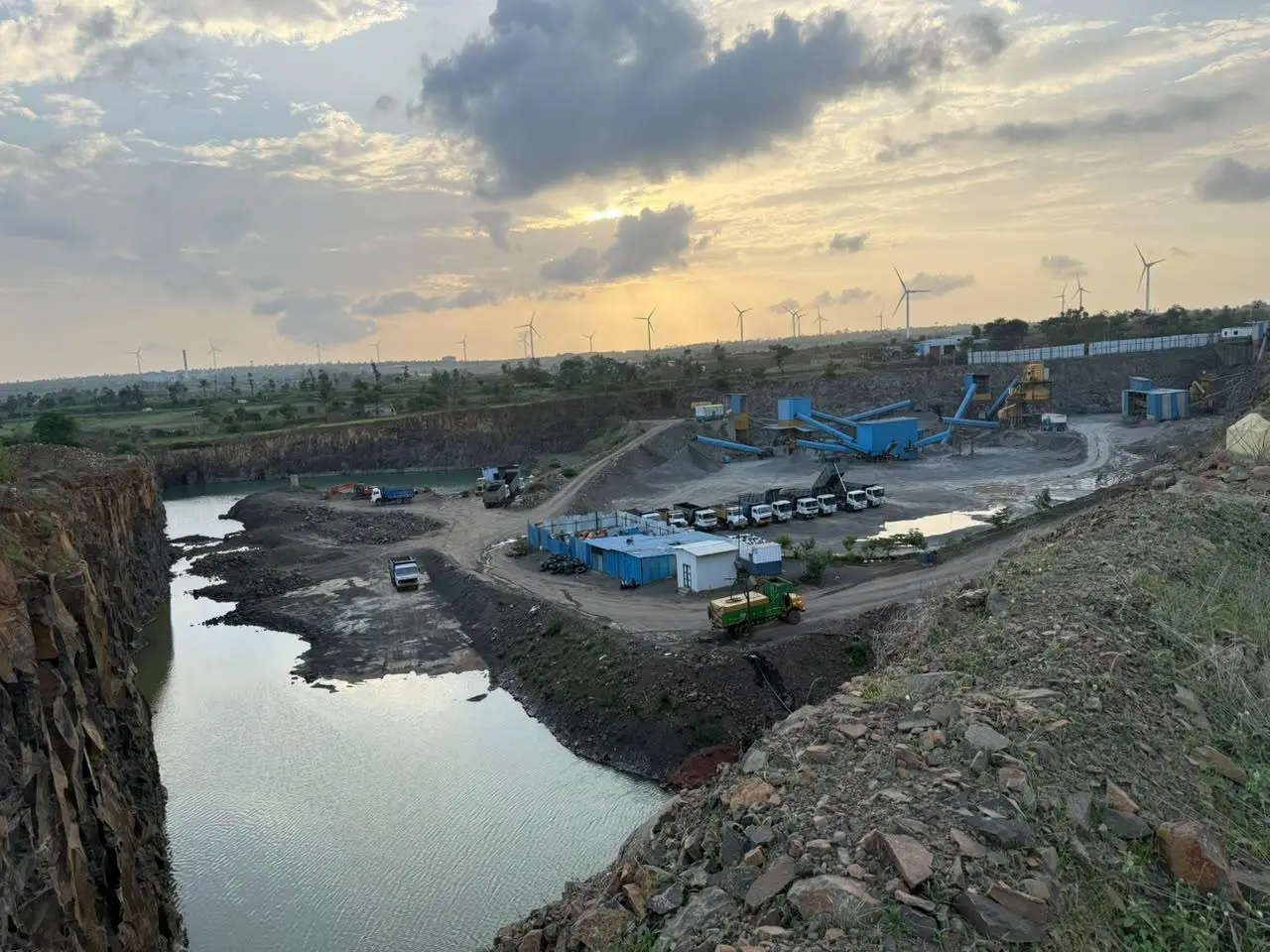
A crack in a plastered wall 300 m from a quarry will be blamed on the quarry whether the blast caused it or the monsoon did. The only defence, and the only honest way to know, is a number: the vibration that reached that wall, measured against the limit set for that kind of building.
In India the blast vibration limit comes from a DGMS technical circular of 1997, which gives the permissible peak particle velocity, or PPV, for five classes of structure in three frequency bands. The table is reproduced below, followed by what the numbers mean on a bench. The design of any shot stays with the licensed person who fires it.
What PPV is and where it is measured
Peak particle velocity is the highest speed at which a point in the ground moves as the vibration from a blast passes through it, in millimetres per second. It is how fast the ground under a foundation shakes, not how fast the wave travels, and the circular treats it as the best measure of a blast's potential to cause damage.
It is measured with a blasting seismograph: a triaxial transducer recording motion in three directions at right angles, and a recorder that stores the waveform. The circular wants the transducer placed near the structure on solid undisturbed ground and well in contact with it, and it applies the limit to the PPV on the ground adjacent to the structure. A geophone sitting loose on a floor slab or on fill gives a reading nobody should rely on.
Frequency matters as much as velocity. Buildings respond most to slow vibration: the circular puts the natural frequency of brick and concrete structures at generally 8 to 16 Hz, and vibration arriving near that frequency is amplified by the building. That is why the table allows a house three times the velocity above 25 Hz that it allows below 8 Hz.
DGMS Circular 7 of 1997: the PPV limit table
The source is DGMS (Tech)(S&T) Circular No. 7 of 1997, dated 29 August 1997, on damage of structures due to blast induced ground vibrations in the mining areas. Values are the permissible PPV in mm/s at the foundation level of the structure, by the dominant excitation frequency of the vibration.
| Type of structure | Ownership | Below 8 Hz | 8 to 25 Hz | Above 25 Hz |
|---|---|---|---|---|
| Domestic houses and structures (kuchha, brick and cement) | Not the owner's | 5 | 10 | 15 |
| Industrial buildings (RCC and framed structures) | Not the owner's | 10 | 20 | 25 |
| Objects of historical importance and sensitive structures | Not the owner's | 2 | 5 | 10 |
| Domestic houses and structures (kuchha, brick and cement) | Owner's, limited span of life | 10 | 15 | 25 |
| Industrial buildings (RCC and framed structures) | Owner's, limited span of life | 15 | 25 | 50 |
"Owner" means the owner of the mine. The last two rows are the mine's own buildings, put up for the life of the project. Check with DGMS for any later circular, and read the conditions of your own permission.
Read it in two steps. First the row: who owns the building and what kind it is. A village house or a hutment beside a quarry is in the first row. A temple or a monument is in the third. Then the column, which is not chosen but measured. The seismograph reports the dominant frequency along with the PPV.
The column is where sites go wrong. Saying "the limit is 10 mm/s" assumes the vibration will arrive between 8 and 25 Hz. A National Institute of Rock Mechanics study of Indian surface mines found the dominant frequency in coal-bearing strata was below 8 Hz, which put those mines on the 5 mm/s limit, while non-coal mines generally saw higher frequencies. Until trial blasts on your own ground show otherwise, plan to the left-hand column.
The circular is addressed to mines. A highway rock cut is not a mine, and MoRTH Clause 302 sets no PPV figure of its own: it requires controlled blasting where structures in use lie within 200 m and leaves the number to the contract. The DGMS table is the Indian reference that contracts normally adopt, so read the technical schedule for the figure that binds you.
Maximum charge per delay and scaled distance
The explosive in a blast does not go off at once. Delay detonators fire the holes in sequence, milliseconds apart, and the ground responds to each packet separately. So the quantity that sets the vibration is the largest weight of explosive detonating in one delay interval, the maximum charge per delay, and not the total in the shot.
Distance and charge are combined into one figure, the scaled distance: distance in metres divided by the square root of the maximum charge per delay in kilograms. The circular requires the square-root form where the blast and the measurement are both on the surface. PPV then follows a power law in scaled distance with two constants, K and B, that belong to the site: its rock, its joints, its water table. They are not looked up. They come from trial blasts, with PPV recorded at several distances and a line fitted through the results, and the circular asks for at least 15 observations from at least 10 blasts before the fit is used.
Predictor: PPV = K × (D ÷ √Q)^-B
Assumed: K = 300, B = 1.3 (invented for this example)
200 m, 100 kg per delay: D ÷ √Q = 200 ÷ 10.0 = 20.0, PPV ≈ 6.1 mm/s
200 m, 50 kg per delay: D ÷ √Q = 200 ÷ 7.07 = 28.3, PPV ≈ 3.9 mm/s
100 m, 100 kg per delay: D ÷ √Q = 100 ÷ 10.0 = 10.0, PPV ≈ 15.0 mm/s
Halving the charge took about a third off the PPV. Halving the distance multiplied it by about two and a half.
With those invented constants the first case, 6.1 mm/s, passes a 10 mm/s limit and fails a 5 mm/s one. The same blast is inside the limit or outside it depending on the frequency it arrives at, which is the argument for measuring. The general rule drops out of the square root: at twice the distance the same PPV allows four times the charge per delay, and at half the distance a quarter.
How a blast is brought under the limit
Every method is a way of making the heaviest delay lighter, or of keeping the delays truly separate.
- Less charge per delay. Fewer holes on each delay, down to one. This is the first move, because it changes the hook-up and not the drilling.
- Decking. Where a single hole already holds more than the allowable charge, the column is split by inert stemming into decks on separate delays.
- Smaller holes, shorter benches. Less explosive per hole and more holes for the same rock. This is the expensive one, and the reason blasting near houses costs more per cubic metre than an open bench.
- Delays that keep charges apart. Delays too short or too scattered let two charges overlap and act as one. Holding the programmed time closely is the main use of electronic detonators near structures.
- Direction of firing. Where the layout allows, the sequence is run so that initiation progresses away from the structure.
The circular's own list is a safe charge per delay, in-hole delays with non-electric initiation, deck charging, proper burden and proper stemming. Less explosive is not automatically less vibration, either: the NIRM study warns that both inadequate and excessive specific charge increase it, a point taken up under powder factor. How the pattern is laid out is in burden, spacing and the drilling pattern, and the wider family of methods in controlled blasting techniques.
Monitoring and records
A limit that is not measured is an opinion. The routine near structures is a seismograph at the nearest structure of each type for every blast, and a record for each shot that ties the reading to what was fired:
- Date, time and location of the blast, and the distance to each monitoring point.
- Number of holes, depth, burden and spacing, total explosive and maximum charge per delay.
- The delay sequence and the type of initiation.
- PPV on each of the three axes and the dominant frequency, with the waveform printout attached.
The circular also asks for a plan of every structure with zones drawn at 50 m, 100 m, 200 m and 300 m from them, and for the mine's own blasting staff to be trained to monitor routinely. Kept shot after shot, the readings refine the site constants, and they are the only thing that will answer a complaint.
Pre-blast condition surveys
Vibration is the measurable half of a damage claim. The other half is what the building looked like before. The circular says it plainly: all structures crack from natural causes such as changes in humidity, temperature and soil moisture, old cracks widen and multiply with time, and that damage is independent of blasting.
So before the first shot, every structure inside the zone of influence is walked through with its owner. Existing cracks are photographed with a scale and a date and marked on a sketch of each wall, and the owner keeps a signed copy. A householder with a new crack has proof that it is new, and a contractor is not paying for one older than the quarry.
What to ask a blasting contractor for
Before blasting starts near structures, ask for four things: the plan showing every structure and its distance, the trial-blast report with the charge per delay it supports at each distance, the monitoring arrangement, and the pre-blast survey. During the work, ask for the shot record and seismograph printout of any blast you choose. Fragments are a separate hazard with a separate zone, covered in flyrock and the danger zone. Our blasting has ground vibration monitored and nearby structures assessed before the first shot, not after a complaint. If you have houses near a boundary, send the distances and the rock type through the controlled blasting page.