
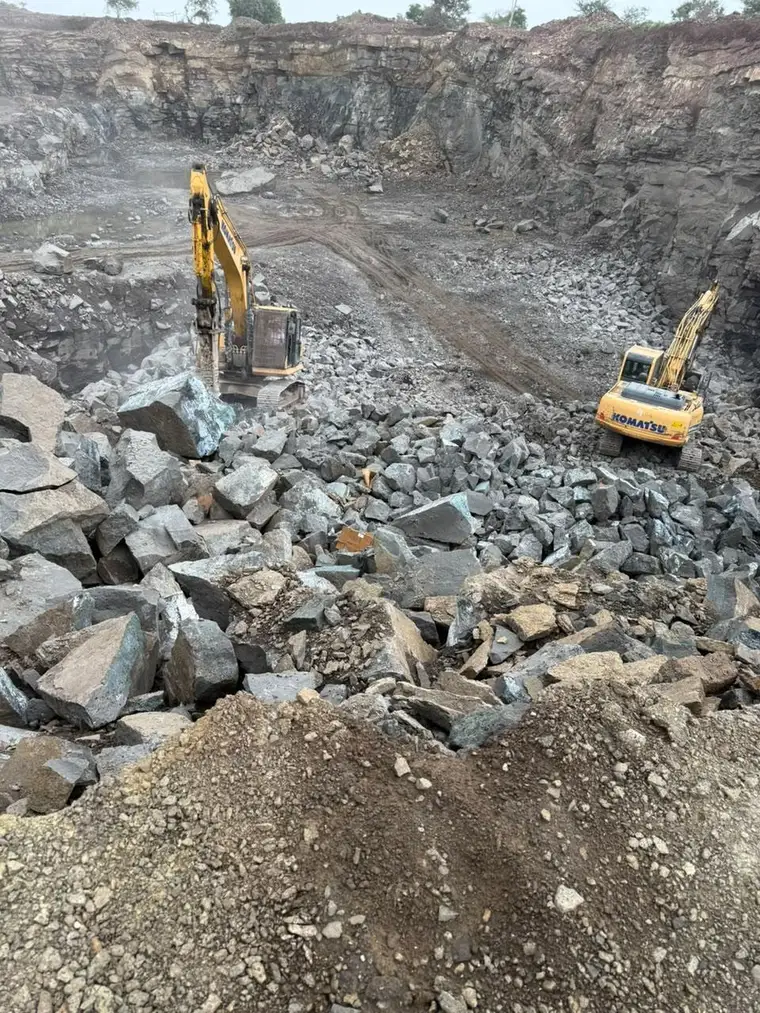
Of everything a blast does that it was not meant to, flyrock is the one that kills. A DGMS safety alert of August 2025 describes a fragment about 30 cm across going through a truck-mounted blasting shelter parked 165 m from a deep-hole blast. Two of the three people inside died. The advice that followed was to shelter beyond 300 m, in a shelter built to stop what might hit it.
Flyrock in blasting has a short list of causes, and nearly all of them can be seen before the shot is fired: in the face, in the driller's log or in the stemming heap. This article covers the statutory danger zone, the causes and the control measures, for the people who commission blasting and stand at the edge of that zone when it goes off.
What flyrock is
Flyrock is rock thrown by a blast beyond the area the blast was designed to throw it into. Every bench blast moves rock: the muckpile heaves forward, and that is the design working. Flyrock is the fragment that leaves that envelope, and it does so by one of three routes.
- From the collar. Gas vents up the hole, lifts the stemming out and takes the rock around the collar with it. Fragments go high and can land in any direction, including behind the blast.
- From the face. Where the rock in front of a charge is thin or weak, the charge bursts through it and throws fragments forward, low and fast.
- From the floor. A boulder broken by a charge laid on it or drilled into it has no burden and almost no stemming.
Behind is not safe. DGMS's 2003 circular on blasting projectiles records fragments travelling about 412 m in the reverse direction, away from the free face, and striking a man who had left his shelter on hearing the blast.
The blasting danger zone: 300 m, and where 500 m comes from
The danger zone is defined in Regulation 164 of the Metalliferous Mines Regulations 1961, the regulation headed "Taking shelter etc.", as the entire area within a radius of 300 metres of the place of firing. Those are the regulations for mines other than coal and oil, which is what a stone quarry is.
The 500 m that many people search for is not a mistake. In that 2003 circular DGMS noted that fragments had landed beyond the 300 m zone, and advised mines to treat all places within 500 m of the place of firing as the danger zone, with anyone who has to remain inside it sheltering in a substantially built shelter. Permissions issued to individual mines often repeat 500 m as a condition, and the Coal Mines Regulations 2017 use 500 m for coal. So on a quarry, 300 m is the floor in the 1961 regulation, and the mine's own DGMS permission, which usually asks for more, is what binds.
What has to happen inside the zone is in the same regulations, and applies to every opencast shot.
- Clearing and shelter. Before a hole is charged, stemmed or fired, the blaster has to see that everyone in the vicinity has taken proper shelter, and takes shelter himself before firing. Where the workings give too little protection from flying fragments, adequate shelter has to be provided.
- Warning. Sufficient warning, by efficient signals or other means approved by the manager, over the entire danger zone.
- Guards on public ways. Where a public road or railway crosses the zone, two persons are posted, one at each extreme point of it inside the zone, to clear traffic and confirm clearance to the blaster before he fires.
- Other people's buildings. Where a permanent building not belonging to the mine owner lies inside the zone, the charge fired at one time is held to 2 kg unless DGMS has permitted more in writing, and within 50 m nothing is fired without written permission. This is why deep-hole blasting near a village runs on a DGMS permission with conditions.
- All clear. After firing, an all-clear signal is given, except where there has been a misfire.
A highway rock cut is not a mine, so the mines regulations do not reach it directly. There the MoRTH specification sets the floor. Clause 302 wants red danger flags planted 200 m from the blast in all directions, everyone including workmen out of the flagged area at least 10 minutes before firing, a warning siren, and blasting at fixed hours made known to people nearby. Contracts and safety plans usually go further.
Causes of flyrock
Every cause is a mismatch between the explosive in a hole and the rock holding it in. The table sets each one against what it looks like on the bench.
| Cause | What it looks like | Control |
|---|---|---|
| Short or poor stemming | Charge loaded close to the collar; fine, wet cuttings as stemming; holes topped up in a hurry | Stemming length fixed in the design and measured in every hole; angular chips in place of fines |
| Thin front-row burden | Face undercut or hollowed by the last shot or the excavator; crest broken back | Profile the face; move, angle, deck or lightly load any front hole short of burden |
| Weak planes and cavities | Clay seams, open joints, voids; the drill dropping; a hole that takes far more explosive than calculated | Read the driller's log before charging; stem across the weak zone; stop loading a hole that keeps taking product |
| Overcharging | The same charge in every hole whatever its depth or burden | Charge worked out hole by hole from measured depth and burden |
| Hole deviation | Front-row holes wandering toward the face, or toward each other, at depth | Careful collaring and alignment; survey the holes where the face is high |
| Firing order and timing | Back rows firing before the rock in front has moved; holes out of sequence | A sequence that gives every hole relief; hook-up checked by a second person |
| Secondary blasting | Boulders broken by plaster or pop shots on the floor | Break oversize with a rock breaker; if a boulder must be shot, a small charge under cover |
| Loose rock on the bench | Stones and drill debris lying around the collars | Clean the bench top before charging |
Regulation 162 makes the central point a duty: the blaster has to ensure that no hole is over-charged or under-charged for the task.
Flyrock control measures on the bench
Profile the face. The burden on the drawing is measured at the crest. The burden that matters is the least distance from any part of the charge to open air, and on a face that has been dug hard at the toe or has lost a slab, that can be far less than the nominal figure with nothing at the collar to show it. Profiling means measuring the face in front of every front-row hole before charging, with a laser profiler on a high face and at the least a tape, a pole and a plumb line on a low one.
Stem to length, with the right material. Stemming is what confines the charge at the top of the hole, and Regulation 162 requires every hole to be stemmed with sufficient and suitable material so that the shot cannot blow out. Length is a design figure, commonly of the order of the burden, and it is the first thing shaved when a hole comes up short or a crew is behind. Material matters as much. Fine, wet drill cuttings flow out of a hole like a fluid, while angular crushed chips lock against each other and the wall; explosives makers suggest a size of about a tenth to a twentieth of the hole diameter. What may go into a hole on a mine is what the regulation and the DGMS permission allow, so settle it before the first shot.
Give every hole relief. A charge can only push its rock forward if the rock in front has already begun to move. Hole-by-hole delays, with enough time between rows for the burden to clear, give each charge a free face to break to. Fire a back row too soon and it has nowhere to go but up. The pattern behind this is in burden, spacing and the drilling pattern, and holes that are not where the plan says are the subject of blast hole deviation.
Muffle what is close. Where structures are near, the shot is covered with blasting mats, sandbags over each collar, belting and mesh. Muffling catches what a small, well-stemmed blast still lets go. It will not hold an overcharged hole, so it goes with the short holes and small charges described in controlled blasting techniques.
Keep explosives off the floor. Boulders shot on the quarry floor are an old source of flyrock, which is one reason oversize is now broken with a rock breaker and explosives are kept for the bench.
What to ask for before a shot is fired near anything
Ask to see the danger zone drawn on a plan, with the structures, roads and plant inside it marked, and the DGMS permission if anything that is not the owner's falls within it. Ask where the shelters are and what they are built of, who the guards are, and what the signals mean. Ask whether the face was profiled and what the stemming length is, then go and look at a hole. Vibration is a separate limit with its own table, in blast vibration limits in India. Our shots are fired by licensed shotfirers under DGMS rules, with exclusion zones enforced. If you have a cut or a quarry with something close to it, send the distances and a photograph of the face through the controlled blasting page.