
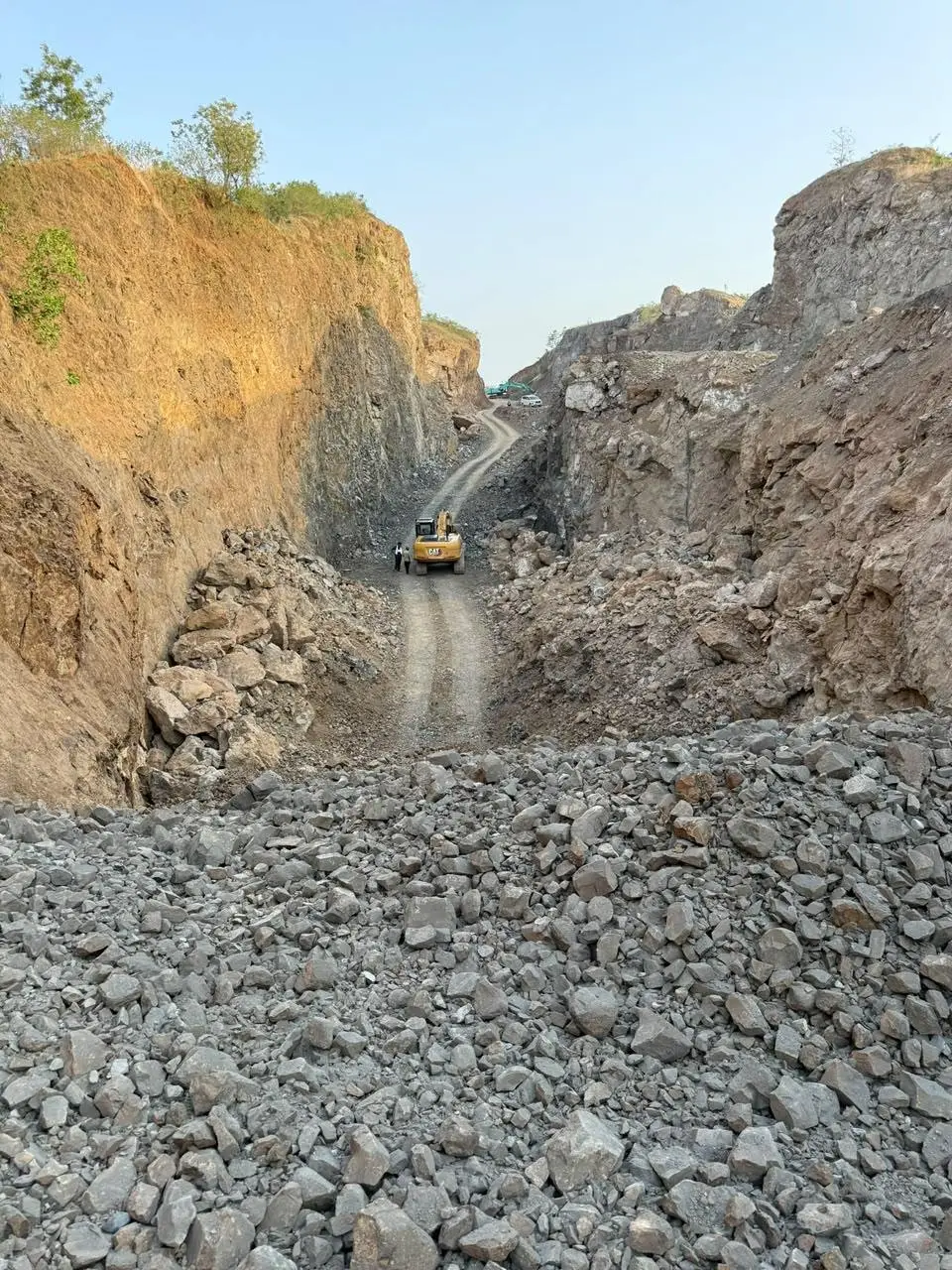
A highway contract will say "controlled blasting" in one line of the technical specification and leave the rest to the people on the bench. That line can mean a row of empty holes along a slope, a shot buried under sandbags thirty metres from a house, or an ordinary bench blast fired one hole at a time. They cost very different amounts and are not interchangeable.
This article sorts the controlled blasting techniques by what each one controls, sets out what the MoRTH Specifications for Road and Bridge Works, Fifth Revision, require for pre-splitting, and shows where each method fits. It is written for the people who commission and supervise blasting. The design of any shot belongs to the licensed person who fires it.
What controlled blasting means
Controlled blasting is blasting designed to limit a named side effect of the shot: damage to the rock that stays behind, vibration in the ground, or the distance fragments travel. A production blast is designed for one result, a muckpile an excavator can dig and a crusher can swallow. Controlled blasting makes one of its side effects a design condition as well, and the first question on any job is which.
- The wall. Cracks from the back row of a production blast run into rock that is meant to stay: the slope traffic will pass under for the life of a road, or the final face of a quarry.
- The vibration. What a neighbouring building feels depends on the explosive fired in any one instant and on distance. The limits are in blast vibration limits in India.
- The throw. Fragments that leave the blast area are the hazard that kills. See flyrock and the danger zone.
Wall control: four ways to leave a clean face
All four rest on one idea. Put a row of closely spaced holes along the line where the excavation is to stop, load them lightly or not at all, and the rock breaks to that row instead of past it. They differ in how much explosive is in the row and when it fires.
Line drilling
A single row of small holes, drilled a few diameters apart along the final line and left empty. The production blast breaks back to the row because the web of rock between the holes is the weakest plane on the site. No explosive goes near the final wall, so it is used hard against foundations and structures. It is the most drilling per metre of face of any method here, and it fails if the holes are not parallel.
Pre-splitting
The row is loaded with a light charge much narrower than the hole and fired before the production holes in front of it. With the burden still in place the charges cannot heave anything. They crack the rock from hole to hole and leave a split for the production blast to break to. Done well, half of every drill hole stays visible on the finished face, and a supervisor judges the work by counting those half-barrels.
Smooth or contour blasting
The same lightly loaded row, fired after the production holes, usually as the last delay of the same blast. By then the burden has gone and the perimeter holes only trim a thin slice off the wall, so they can stand somewhat further apart. It is the standard perimeter method underground, and on a surface cut it suits rock too broken for a pre-split crack to run cleanly.
Cushion blasting
Also fired after the main excavation, often as a separate small shot. A row of holes is drilled along the final line with a narrow berm of rock left in front. Each hole gets small, well-spread charges and is packed with stemming for its full depth, so the charge is cushioned from the wall, and the row trims the berm off. It tolerates weathered and fractured rock better than the other three, at the price of a second pass.
Pre-splitting as per MoRTH Clause 303
Clause 303 of the Fifth Revision defines pre-splitting as the establishment of a specified excavation slope in rock by the controlled use of explosives and blasting accessories in properly aligned and spaced drill holes. The contractor submits a drilling and blasting plan, then starts with a short test section that is pre-split, production blasted and dug out so the Engineer can see the face before the method is accepted.
| Item | Requirement |
|---|---|
| Hole diameter | 60 mm minimum, 75 mm maximum |
| Hole spacing | 900 mm maximum, centre to centre |
| Lift | Holes for any one lift not longer than 9 m |
| Alignment | Within 300 mm of the planned slope plane; parallel to the next hole within two-thirds of the spacing |
| Explosive | Standard cartridges only, no larger than half the hole diameter. Ammonium nitrate blasting agents not permitted |
| Firing | All charges detonated together. If fired with the production blast, the row nearest the line is delayed at least 50 milliseconds |
| Finished face | Within 300 mm of the designed slope |
Fifth Revision (2013). Check the edition, and any amendment, that your contract cites.
The 900 mm cap agrees with the handbooks, whose rule of thumb for pre-split spacing is ten to twelve hole diameters: 750 to 900 mm for a 75 mm hole. The rock decides how far below the cap the spacing has to come.
Alignment is the row that decides whether a pre-split works. A 300 mm tolerance at the bottom of a 9 m hole is about two degrees, and holes that cross or fan out leave a face nothing like the drawing, which is why blast hole deviation matters more here than anywhere else on the job. The clause allows a 600 mm offset at the bottom of each lift for the rig to collar the next one, which is why a deep pre-split cut shows faint benches.
Vibration control: charge per delay, decking and delays
Nothing about the wall methods reduces vibration much. What a structure feels is governed by the weight of explosive detonating at one instant, the maximum charge per delay, and by distance. So the vibration methods all do one thing. They cut the blast into smaller pieces in time.
- Fewer holes per delay. Down to a single hole on each delay. It changes the hook-up, not the drilling.
- Decking. A hole is divided by inert stemming into separate charges, each on its own delay, so a tall bench no longer means a large charge per delay.
- Smaller holes on a tighter pattern. Less explosive per metre of hole, and more holes for the same rock.
- Accurate delays. Shock-tube detonators allow hole-by-hole firing with no electrical circuit on the bench. Electronic detonators hold each delay to the programmed millisecond, which matters when the design depends on charges not overlapping.
Throw control: muffled blasting
Muffling is covering the shot so that anything leaving the collar or the face is caught. The cover is heavy and flexible: blasting mats woven from old tyres or wire rope, sandbags over each collar, conveyor belting weighted down, often with wire mesh over the lot.
Muffling does not make an overcharged hole safe. It catches what a small, properly stemmed blast still lets go, so it goes with short holes and small charges and never replaces them. DGMS says as much in its 1997 circular on blast vibration: controlled blasting together with effective muffling of holes controls ground vibration and also arrests fly rock.
Clause 302 of the MoRTH specification draws two lines for every highway rock cut. Where built-up area, huts or structures in use lie within 200 m, only controlled blasting may be used. Where people live within 20 m of the blast site, hard rock has to be excavated without blasting at all, which in practice means a rock breaker.
The techniques compared
| Technique | What it controls | Where it is used | What it costs in drilling |
|---|---|---|---|
| Line drilling | The wall | Final line hard against a structure or foundation | Highest. The closest holes of any method, none of them breaking rock |
| Pre-splitting | The wall | Permanent highway cut slopes in sound rock; final quarry faces | High. A dedicated row, 900 mm apart at most under Clause 303 |
| Smooth or contour blasting | The wall | Cuts in jointed rock; tunnels | Moderate. A perimeter row somewhat wider than a pre-split |
| Cushion blasting | The wall | Trimming a final face in weathered or fractured rock | Moderate, plus a second pass |
| Muffled blasting | Throw | Short holes close to houses, roads and live carriageways | Small holes on a tight pattern, and labour for the cover |
| Decking, one hole per delay | Vibration | Any bench or cut with structures nearby | Little extra drilling. More detonators and time |
Relative, not priced. Apart from the Clause 303 pre-split, spacing is a design decision for the rock on site.
On a highway cut and on a quarry bench
A highway cut is permanent and public. The slope has to stand without shedding blocks onto the carriageway, and there is usually a village or a live road inside the 200 m that brings Clause 302 into play. A cut in sound rock therefore gets a pre-split along its slope lines, small-diameter production holes between them, and muffling wherever something is close. Our drilling and blasting package on the Western Bhopal Bypass, NH-46, is of this kind: the alignment runs close to built-up areas, so charge design is the whole job.
A quarry bench is temporary. The face blasted today is the burden of next month's shot, so nobody pre-splits a working face. What a quarry controls is fragmentation, vibration at the nearest house and throw toward the plant, all of it inside the production blast through burden and spacing, stemming, decking and the delay sequence. Wall control comes in only at the final pit limit and on benches that will be left standing, a bench design decision made long before the last shot.
What to ask before the first shot
Ask the blasting contractor which of the three things the design controls, and how each will be shown: a test section for the wall, a charge per delay and a seismograph record for vibration, a muffling method and a cleared danger zone for throw. Then send the drawing with the slope lines, the distance to the nearest structure and the rock type. Our crews design each shot for the bench in front of them, with ground vibration monitored and exclusion zones enforced. The scope is on the controlled blasting page.