
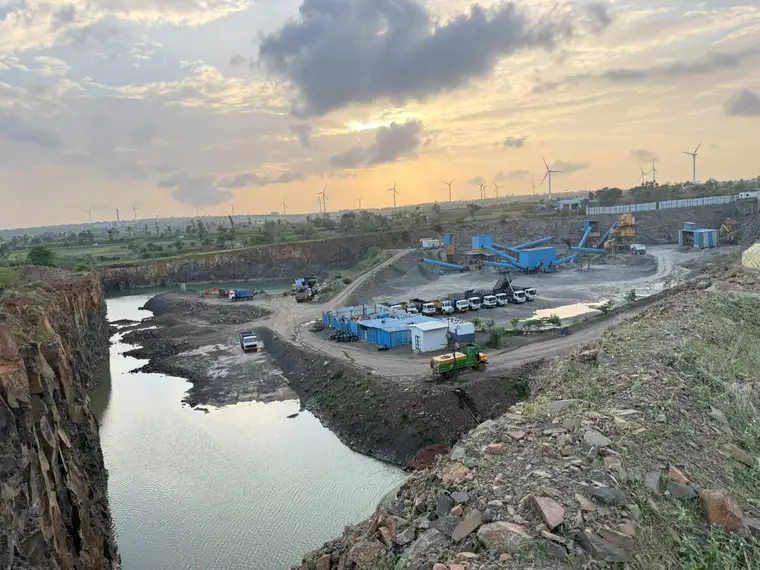
Mining in the monsoon is slower, not impossible. What separates a quarry that keeps a road supplied from June to September from one that does not is almost entirely decided in April and May. Rain never stops the job in one place. It takes a shift from the pit, another from the haul road and a third from the screens, and three lost shifts a week is a month of two-shift production gone by the end of September.
The southwest monsoon covers most of the country from June to September. Its dates differ by region, and so does its character: one long wet spell in some places, a string of cloudbursts in others. Plan for the site, not for the calendar.
What rain does to a quarry and a crusher plant
A quarry in the rainy season loses output at seven points between the face and the road. Take them in order.
| Link | What rain does to it | What is done before June |
|---|---|---|
| Pit floor | Water collects on the lowest bench and drowns the toe and the loading point | Garland drain above the crest; sump, pump and delivery line sized and tested |
| Haul road and ramps | Fines turn to slurry, ruts hold water, tippers lose traction on the gradient | Cross-fall restored, side drains opened, surface re-sheeted with clean stone |
| Blast holes | Holes fill with water; ANFO dissolves and fails | Emulsion stocked; holes charged the day they are drilled |
| Feed and screens | Wet clayey fines blind the lower decks and the grading drifts | Clean rock exposed ahead; grizzly set to scalp harder; decks cleaned every shift |
| Stockpiles | Dust and sub-base material hold water and handle badly | Stock built on a sloped pad that drains |
| Road site | Soil too wet to compact; laying stops, then demand comes back in a surge | Stock at the plant to cover the surge |
| Charging and the magazine | Lightning close to explosives | Storm procedure written down; lightning conductors and earthing tested |
Sizing a sump pump for quarry dewatering
Water arriving on the pit floor is the rain on the catchment multiplied by the share of it that runs off. The catchment is not the pit. It is every square metre of ground that drains towards the pit, which is why a garland drain cut round the crest before the rains, turning the hillside's water away, is the cheapest pump a quarry owns.
Catchment = 4 ha = 40,000 m²
Rain = 100 mm in 24 hours = 0.10 m
Runoff = 40,000 m² × 0.10 m × 0.8 = 3,200 m³
Pump rate = 3,200 m³ ÷ 20 hours = 160 m³/h
Head = 20 m lift + pipe friction = about 25 m
One pump of 160 m³/h at about 25 m head, and a second of the same duty standing by
The 100 mm day is an illustration, not a design storm. Take the heaviest one-day falls from the nearest rain-gauge record, and for a pit meant to work through several monsoons use one of the worst days on it, not an average wet one. A runoff coefficient of 0.8 suits bare rock and compacted floors. A soil catchment under vegetation sheds less.
Then test the answer against a cloudburst. If 40 mm falls in one hour on the same 4 ha, 1,280 m³ arrives while the pump moves 160 m³. The sump and the lowest floor have to hold about 1,100 m³ without drowning the loading point or the pump itself. That is the case for a pump on a raft or a skid that can be drawn up the ramp, and for keeping the working face a bench above the sump in the wet months. Bench floors graded to a toe drain, as described in bench height, width and slope, bring the water to the sump and not over the crests.
Smaller points decide whether the pump is running on the night it is needed. Grid power fails in the same storm that fills the pit, so the pump wants a genset or a diesel drive of its own. The delivery line has to discharge outside the catchment, or the same water is pumped twice. Pumped water carries silt, so it passes through a settling pit before it leaves the lease, on whatever terms the consent to operate sets.
Haul roads in the rain
A haul road fails in the monsoon from the top down. Fines on the running surface turn to slurry, the slurry fills the ruts, the ruts hold water against the formation, and the formation softens under the next loaded tipper. The repair is made before June: cross-fall restored so that water leaves the surface sideways, side drains cut and their outlets opened, soft lengths dug out, and the surface re-sheeted with clean crushed stone that has little dust in it. On ramps, traction goes before the road does. The design side is in quarry haul road design.
Water in blast holes and the choice of explosive
A hole drilled today and left open overnight in July is a hole full of water tomorrow, often with its collar washed in. ANFO, the cheapest bulk explosive on a dry bench, has no water resistance. Ammonium nitrate dissolves, and a column that has taken up water detonates poorly or not at all, leaving toe, oversize and sometimes a misfire to deal with. Wet holes are charged with emulsion or slurry explosive, cartridged or pumped, which is made to sit under water.
That is a planning matter, not a decision for the morning of the shot. What a magazine holds, and how much its licence permits, is fixed well ahead; the rules are in explosives licence, magazine and shotfirer. On the bench the wet-season habits are plain: drill and charge the same day where the pattern allows, plug the collars of holes that must stand, measure the water in each hole before choosing what goes into it, and keep the drilling floor graded so that it drains away from the pattern.
Electrical storms, charging and the magazine
Lightning and a charged pattern do not belong together. A strike, or the current it induces in the ground and in lead wires, can fire electric detonators, and no initiation system is proof against a strike close by. The working rule is the same everywhere: when a storm approaches, charging stops, the pattern is cleared and people take shelter outside the danger zone until it has passed.
For the magazine the rule is written down. Rule 12 of the Explosives Rules 2008 requires lightning conductors on every magazine and, whenever a thunderstorm appears imminent nearby, everyone working in or about it to be withdrawn to a safe distance and the building kept closed and locked until the threat has gone. The Metalliferous Mines Regulations 1961 have no clause that names lightning at the face, so there the authority is the manager's standing orders, the conditions on the blasting permission and the explosive maker's instructions. Write the storm procedure into the first of these before June, and in the wet months charge only what can be fired in the same shift.
Wet feed, blinded screens and a road that cannot take material
At the plant the trouble is damp fines. Dry dust falls through a mesh. Wet dust with clay in it sticks to the wires, the apertures of the lower decks close up, and undersize rides over into the product above. The 10mm carries dust it should have lost, the sub-base blend swings from load to load, and a grading that held all winter drifts without anyone touching a setting. In the rains the decks are cleaned every shift, the grizzly is set to scalp harder, and feed from a clay-stained part of the face is kept out of product altogether.
The road site has its own version. Embankment and sub-grade soil that is wetter than its optimum moisture content cannot be rolled to density however many passes it gets, so earthwork stops and the layers above it wait; the test behind that is explained in OMC, MDD and the field density test. For the plant this means demand falls away in the wet weeks and returns all at once in the first dry spell.
The plan made before June
- Stock built ahead. A 250 TPH plant on two shifts makes 25,000 to 30,000 MT a month, so each week lost to rain is roughly 6,000 to 7,000 tonnes not made. Stock is built in the dry months against the weeks the plant will lose and the surge when laying restarts.
- Rock exposed ahead. Stripping is the worst job to do wet. Clean rock uncovered before the rains keeps soil out of the feed at the time it is hardest to keep out; see overburden removal and the stripping ratio.
- Drains and bunds cut. Garland drain above the crest, toe drains on the benches, the sump dug and the dump's toe drain opened, all while an excavator can still travel to them.
- Pumps and standby power. Pump, delivery line and genset run under load in May, not unpacked in July.
- The maintenance window. Liner changes, screen cloth, belting and the structural repairs that need a plant standing are booked for the wettest weeks, when the output lost to them is output the rain would have taken anyway.
Starting a job in the rains
A monsoon start pushes mobilisation out. Access tracks that carry a low-bed trailer in March may not in July, foundations are cast between showers, and stripping wet ground takes longer than the programme allows. We say so before signing and not after. In dry conditions our working figures are about a month from order to steady production for a plant, and three to six weeks from award to first tonne for a quarry; a start in the rains lengthens both. If the road needs material in October, the time to talk is before the rain arrives. The scope is set out under mining operations and crusher plant operations.