
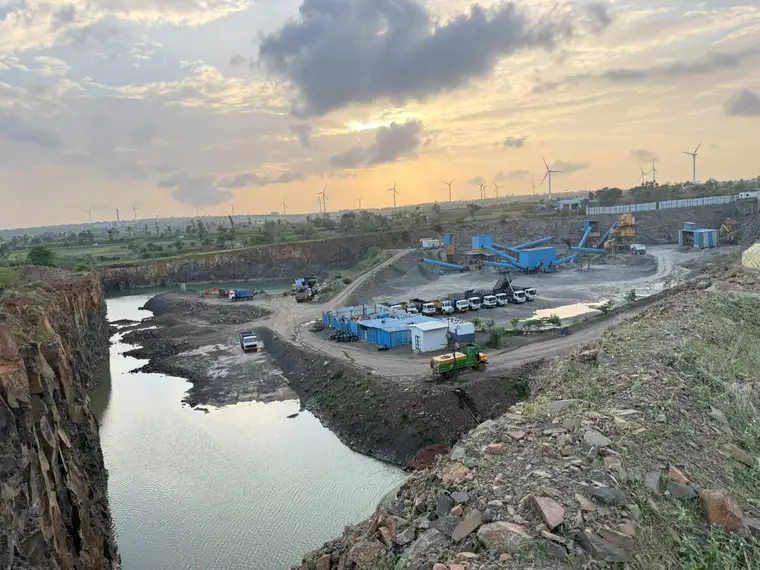
The mobile crusher vs stationary crusher question usually gets argued on mobility, which is the least important thing about it for a road. A highway package does not need its crusher to move. It needs 25,000 or 30,000 tonnes a month of material that passes the same sieve analysis in month twenty as it did in month two.
Mobility has a price, paid in fuel, in screen area and in the number of products one machine can split. Sometimes that price is worth paying several times over. This page sets out when.
What separates a mobile crushing plant from a stationary one
A mobile crushing plant is a crusher or screen built onto its own chassis with its own power unit, so it can be driven or towed into position and started without foundations. A stationary plant is a set of separate machines on concrete foundations, linked by conveyors and driven by electric motors. In practice there are three families.
- Track-mounted. Each machine sits on crawler tracks with an on-board diesel engine that drives the crusher directly, through hydraulics or through a generator. It walks off the trailer and can follow the face. A jaw, a cone and a screen are three machines working in a train.
- Wheeled or skid-mounted. The same stages built as modules on a wheeled chassis or on steel skids, usually with electric drives. They stand on levelled, compacted ground or light footings and are towed or lifted between sites. The trade calls them portable or semi-mobile.
- Stationary. A multi-stage plant on reinforced concrete: hopper and grizzly, primary jaw, secondary cone, tertiary stage, screen towers and a conveyor for every product. How the stages share the work is in jaw, cone and VSI: the stages of a crusher plant.
Mobile crusher vs stationary crusher, side by side
| Point of comparison | Track-mounted | Wheeled or skid-mounted | Stationary multi-stage |
|---|---|---|---|
| Set-up time | Hours for each unit | A day or two to a few days | About two weeks to erect and commission on a site with decent access |
| Foundations | None; firm, level ground | Compacted pad or light footings | Reinforced concrete under each machine and trestle |
| Power source | On-board diesel; some models also plug into an external supply | Electric motors from DG sets or grid | Electric motors from grid or DG sets |
| Typical capacity | Single jaw units commonly rated around 300–450 TPH; a train runs at the rate of its slowest machine | Modular lines offered from about 50 to 450 TPH | 250–350 TPH for a three-stage highway plant; larger where the quarry justifies it |
| Grading and shape control | Good for two or three products; each further split needs another screen unit | Close to a fixed plant if enough modules are bought | Most screen area and surge capacity; tertiary stage in closed circuit; several products at once |
| What drives cost per tonne | Diesel burned on board, capital per TPH, upkeep of tracks and hydraulics | Civil cost saved, set against extra modules and lifts | Power, wear parts, and the haul from face to hopper as the face moves away |
| Relocation | Drives onto a low-bed; one heavy load per unit | Towed or lifted; a few loads | Dismantled, carried on low-bed trailers and re-erected |
Capacities are manufacturers' ratings for a stated rock and setting. Sustained monthly output is a different and lower number for every type.
Why a rating in TPH overstates a month's production, for any kind of plant, is explained in what TPH crusher plant a highway package needs.
Where a track mounted crusher is the right machine
Track-mounted plant earns its place wherever the job is short, the site is tight, or the tonnage is small enough that foundations would cost more than they save.
- Short jobs. A few months of crushing for a rural road, a bridge approach or a single structure. Two weeks of erection and a set of foundations cannot be recovered over that life.
- Urban and constrained sites. No room for a plant yard and neighbours close by, where a machine that arrives, crushes and leaves is the only kind that fits.
- Recycling. Crushing demolition concrete or milled pavement where it lies, so the material is handled once.
- Low monthly volumes. A few thousand tonnes a month does not keep a three-stage plant and its crew busy.
- A face that moves fast. In a quarry, a tracked primary can work at the face and cut the tipper haul to the hopper to almost nothing.
The limits show as the product list grows. A tracked jaw and cone will make a crusher-run base material well. Ask the same train for GSB, WMM, 40mm, 20mm, 10mm and dust at once and it needs a second and third screen unit, each with its own engine, operator attention and transfer point.
Where a fixed multi-stage plant is the right one
A two to three year highway package is the opposite case on every count. It needs tens of thousands of tonnes a month, in five or six products at once, to gradings fixed by MoRTH Clauses 401 and 406 and the bituminous sections of the specification. And it needs them at the lowest cost per tonne the rock allows, because at that quantity a small difference in rate is a large sum.
- Screen area. Making six products together takes several decks and the room to mount them, and screen area is what a compact chassis has least of.
- Control. A closed tertiary circuit with surge capacity ahead of it gives the last crusher a steady feed, which is where particle shape is won. Flaky stone fails the flakiness index however clean the grading looks.
- Energy. Electric motors on a grid connection generally crush a tonne for less than an on-board diesel does, and over a package the difference compounds.
- Stock. Long product conveyors build large stockpiles of each size, which is how a package carries material into the laying season.
The fixed plant's weakness is time and paperwork at the start. It wants foundations, a power supply and consents for a named site, all covered in setting up a stone crusher plant, week by week. Do not assume a mobile unit escapes the consents, though. Pollution boards treat mobile crushers in different ways, so ask the state board before one is brought onto a site.
The middle ground: skid-mounted and semi-mobile plants
Skid-mounted and wheeled plants try to keep the fixed plant's electric drive and screen area while shedding most of its civil work. Modules arrive largely assembled, stand on a compacted pad or simple footings, and are joined by short conveyors. They suit a job of a year or so, or an owner who expects to move every season.
The trade-off is that the layout is the manufacturer's and not the site's. Module heights fix the transfer points, stockpile conveyors are shorter, and adding a product later means adding a module.
A fixed plant that still moves
Stationary describes how a plant stands, not how long it stays. Our six plants are fixed three-stage plants at 250 to 350 TPH, and they are built to be broken down, loaded onto low-bed trailers, carried to the next project and put up again. It takes about two weeks to move the plant and machines and about two weeks to erect and commission on a site with decent access: roughly a month from order to steady production.
That month is the real comparison with a tracked train, and on a package measured in years it disappears. It is how a plant gets from a finished project in Karnataka to a new one in Madhya Pradesh. What the move involves, permits for over-dimensional loads included, is in shifting a crusher plant by ODC transport.
Choosing for your package
Three numbers settle it: the monthly tonnage, the number of products, and the months of work. For a few thousand tonnes a month, or a job well short of a year, look at tracked or skid-mounted plant hired with its operator. For a highway package with a two to three year programme and a peak month in the tens of thousands of tonnes, a fixed three-stage plant on or near the lease is what the gradings and the rate both point to. The next question is whether to own it or have it run, which is worked through in own a crusher or contract the crushing. If it is the second, crusher plant operations is the page, and what we need to start is the site, the rock, the gradings and the monthly volume.