
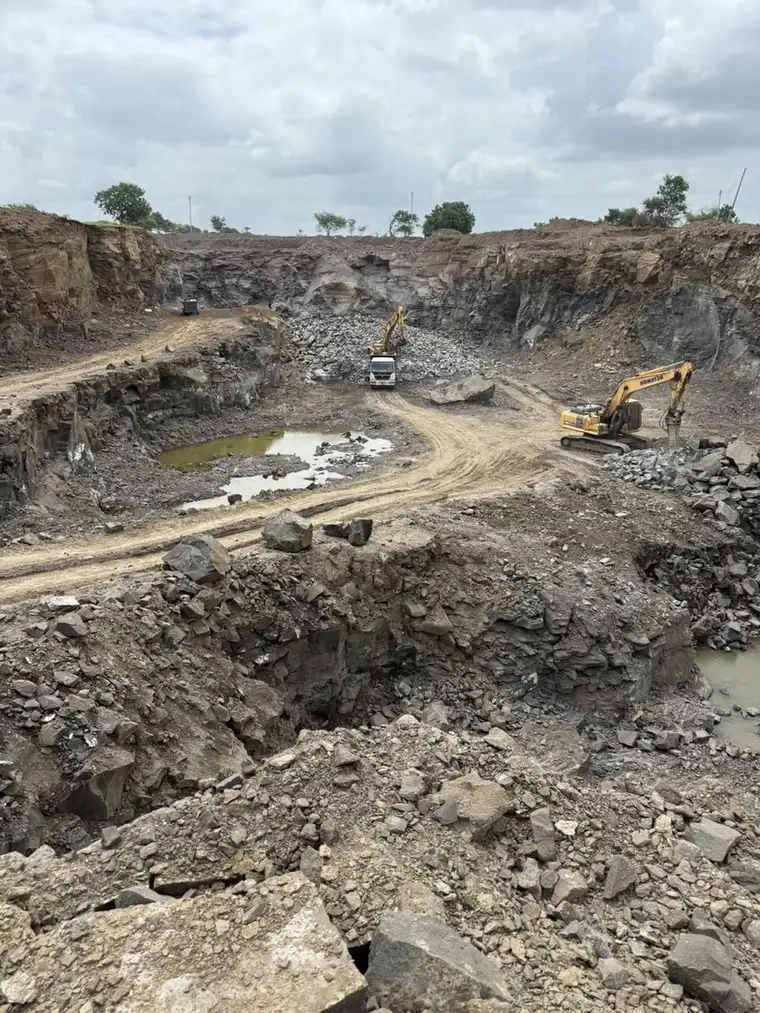
A rock cutting on a highway package can be taken out with explosives, with a hydraulic breaker, or with something between the two. Rock breaker vs blasting is usually argued as cost per cubic metre, and on cost alone blasting wins by a distance in hard rock. But the decision is seldom made on cost alone. It is made by what stands near the cut, by what the contract and the Engineer allow, and by how long the programme can wait.
Clause references below are to the MoRTH Specifications for Road and Bridge Works, Fifth Revision (2013). Check the edition your contract cites, and the contract's own special conditions, which override it.
The rock excavation methods on the table
- Drill and blast. Holes drilled on a pattern, charged and fired in a delay sequence. One shot breaks hundreds or thousands of cubic metres in a second, and the excavators spend the following days loading it out.
- Controlled blasting. The same method under tight limits: smaller holes, a small charge on each delay, covered shots, and vibration monitored. Slower and dearer than open blasting. The methods are described in controlled blasting techniques.
- Hydraulic rock breaker. A percussive hammer on an excavator, breaking rock in place piece by piece. No explosives, no magazine, no evacuation, and a small fraction of the output.
- Other hard rock excavation without blasting. Ripping with a heavy dozer where the rock is weathered or closely bedded, and hydraulic splitters or expanding grout in drilled holes where nothing may be shaken at all. Each suits a narrow range of rock.
Rock breaker vs blasting: the decision factors
| Factor | Favours blasting | Favours a rock breaker |
|---|---|---|
| Volume | Large cuts; the cost of each cubic metre falls as the shot grows | Small quantities: trimming, trenches, isolated outcrops, boulders |
| Rock hardness and structure | Hard, massive rock such as granite and fresh basalt, where a breaker makes slow progress and eats chisels | Weathered, bedded or closely jointed rock that parts along existing planes |
| Nearness of structures | Nothing in use within 200 m, or controlled blasting accepted inside that distance | People living within 20 m, or structures too fragile to take any vibration |
| Traffic and utilities | Greenfield alignment, or a road that can be closed for each shot | Widening under live traffic; cuts beside pipelines, cables, railways or towers where closures are not given |
| Permissions | Explosives licence, magazine, shotfirer and the Engineer's written permission all in place | No licence obtainable in the time, or blasting barred by the contract or the district authority |
| Programme | The cut is on the critical path and has to be out before the monsoon | A small cut with float, or work that can only proceed in short possessions |
| Finish | A presplit slope is specified | Final trimming of slopes, drains and formation after the bulk is out |
The 200 m and 20 m figures are those of MoRTH Clause 302.4. A contract or a district order may be stricter.
Volume is the first row because of output. A breaker's production depends on the strength and jointing of the rock more than on the size of the machine. Published figures run from several cubic metres an hour for a breaker working alone in massive rock of 60 to 100 MPa, to a hundred or more for the largest quarry breakers in bedded limestone. Treat any figure as typical at best, and ask for a trial in your own rock before pricing on it.
Our blasting page puts the comparison bluntly: blasting breaks rock that a hydraulic breaker would take a month to do at ten times the cost.
What MoRTH Clauses 301 and 302 require
Clause 301.2.1 classifies excavated material, and three of its classes are hard rock. Hard rock requiring blasting. Hard rock using controlled blasting, where built-up areas or huts are within 200 m of the blast site. And hard rock where blasting is prohibited, for reasons such as people living within 20 m, to be taken out by chiselling, wedging or any other agreed method. The Engineer decides the class, and the clause adds that merely using explosives does not earn a higher one unless blasting is clearly necessary in his opinion. Each class carries its own rate, so this is the paragraph to read before pricing a cut.
Clause 302 then governs blasting operations. In outline:
- Permission. Blasting is done only with the written permission of the Engineer, and all statutory rules on acquiring, transporting, storing, handling and using explosives are to be followed. The contractor submits details of the blasting procedure before each phase.
- Storage. The magazine is built to the explosives department's design at an approved site. Where no local law applies, storage is in general to be not closer than 300 m to the road or to any building, camp or place of human occupancy.
- Hours and notice. Blasting is at pre-determined hours, made known to people in the vicinity. Utility owners with structures nearby are told in advance, and the railway authority is notified before any blasting within 50 m of a railway track or structure.
- Exclusion. Red danger flags are planted 200 m from the blast in all directions, everyone is cleared from the flagged area at least 10 minutes before firing, and a siren is sounded.
- Near habitation. Only controlled blasting is to be resorted to where built-up area, huts and structures in use lie within 200 m. Excavation of hard rock without blasting is mandatory where people live within 20 m of the blast site.
- Charge and records. Blasting is to be as light as possible consistent with thorough breakage. Any method that leads to overshooting is discontinued, misfires follow a set procedure, and a day-to-day account of explosives is kept open to the Engineer.
The road specification is not the only authority on the site. The explosives licence, the magazine and who may fire a shot are governed by the explosives rules, covered in explosives licence, magazine and shotfirer. The vibration a structure may be exposed to has its own limits, set out in blast vibration limits.
Presplitting under Clause 303
Clause 303 defines presplitting as establishing a specified excavation slope in rock by the controlled use of explosives in properly aligned and spaced drill holes. It applies where the drawings show it or the Engineer decides. A line of closely spaced, lightly charged holes is fired along the final slope, so that the production blast breaks back to a clean plane instead of shattering rock that has to stand for the life of the road.
| Item | Requirement |
|---|---|
| Hole diameter | Not less than 60 mm and not more than 75 mm |
| Hole spacing | Not more than 900 mm centre to centre |
| Hole length in one lift | Not more than 9 m |
| Hole alignment | Within 300 mm of the slope plane, and within two-thirds of the spacing of parallel to the next hole |
| Explosive | Cartridged only, not more than half the hole diameter; no ammonium nitrate blasting agents |
| Production holes | None within 2.5 m of the presplit plane unless approved, and none deeper than the presplit holes |
| Offset between lifts | Not more than 600 mm, as a working bench for drilling the next lift |
| Finished face | Within 300 mm of the design plane, measured at right angles to the slope |
| Payment | Square metres of acceptable presplit slope surface |
Fifth Revision (2013). A drilling and blasting plan goes to the Engineer before drilling, and the work begins with a short test section.
The alignment line is the demanding one. Three hundred millimetres over a 9 m hole is under two degrees, which makes presplitting a set-up and hole deviation problem before it is a blasting one.
Controlled blasting for road cutting: the middle course
Between 20 m and 200 m of occupied structures the specification does not ask for a breaker. It asks for controlled blasting, and on most highway cuts near villages and town edges that is the workable answer. The charge fired on each delay is cut down until the vibration at the nearest structure stays inside its limit, which means smaller holes, shorter benches, decked charges and more delays. Shots are covered against flyrock, the road is closed for minutes, and each blast is monitored.
It costs more per cubic metre than an open bench with nothing nearby, and it is a great deal cheaper than a stop-work order. It is also many times faster than breaking. The usual arrangement on a constrained cut is all three methods in their place: controlled blasting for the bulk, a presplit line where the slope must stand clean, and a breaker for the last trim, the drain lines and anything inside 20 m.
The Western Bhopal Bypass on NH-46, which we work for PNC Infratech under MPRDC, is this kind of job: a drill-and-blast package on an alignment close to built-up areas, where charge design is the whole job.
What to send before the method is fixed
To advise on method we need the chainages and approximate volume of rock, the rock type, the distances to the nearest occupied structures, utilities and any railway, the classification the contract or the Engineer has given the cut, and the programme. With those we can say what can be blasted, what should be presplit and what is better left to a breaker. Our crews are licensed shotfirers, and ground vibration is monitored. The service is described under controlled blasting, and the holes under drilling services.